

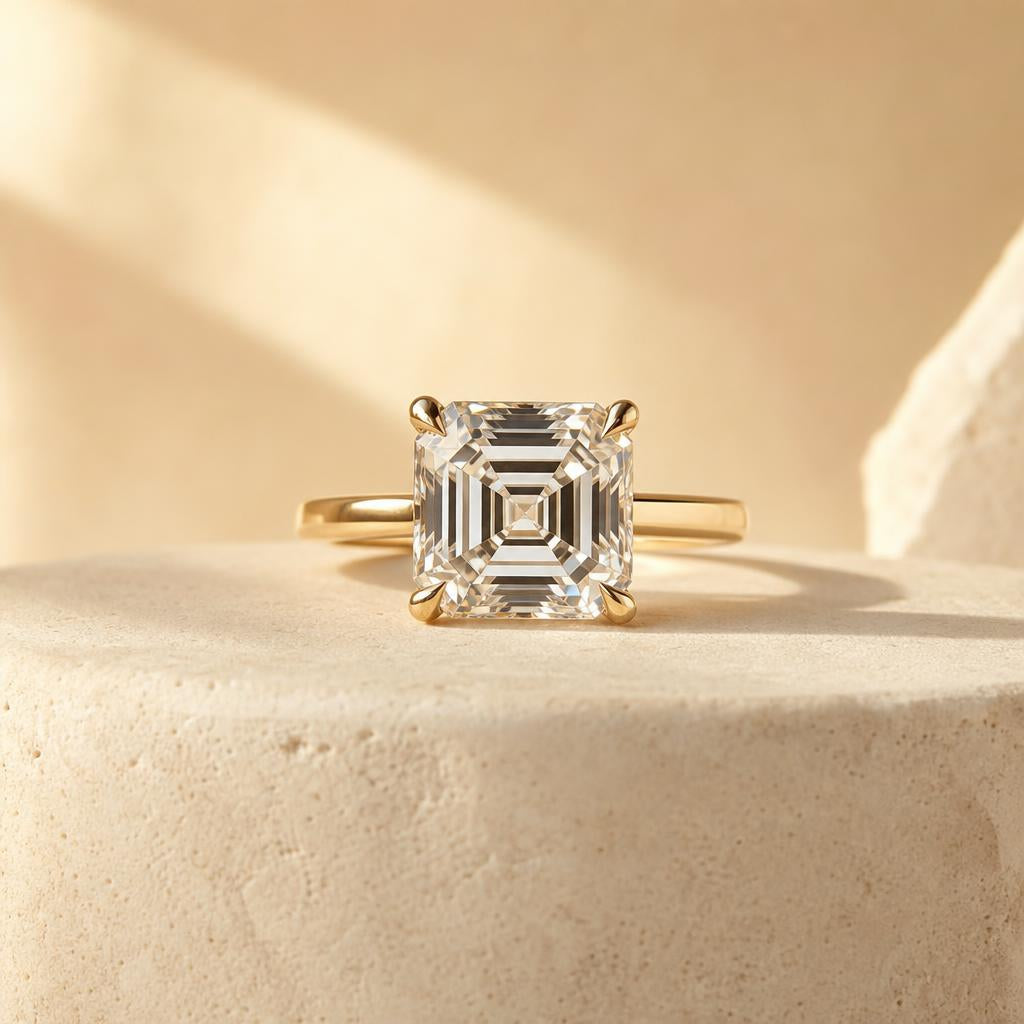
The Best Asscher Cut Rings: Architectural Styles Worth Knowing About
There's a particular kind of ring that doesn't announce itself with sparkle so much as with structure — broad, mirrored facets stacked like the steps of a small glass staircase, corners cropped just enough to soften a perfect square. That's the asscher cut: one of the oldest cuts in fine jewelry, and quietly one of the most architectural styles you can put on your hand. If you've always been drawn to rings that read as considered rather than loud, this is the cut worth understanding before you shop.
Because true asscher-cut styles are genuinely rare even within a large catalog, we're pairing our two signature asscher rings with their closest relative — the emerald cut — so you can see the full step-cut family side by side and decide which geometry actually suits your hand.


What Actually Makes a Cut "Architectural"
Most engagement rings are cut for maximum fire — tiny, precisely angled facets designed to scatter light in every direction, the way a round brilliant or a cushion cut does. Step cuts work in almost the opposite direction. Instead of dozens of small triangular facets, an asscher or emerald cut is built from a handful of long, broad, rectangular facets arranged in concentric layers, like the steps of an amphitheater seen from above. Light doesn't scatter as much as it moves — a long, cool flash that travels across the stone rather than exploding out of it. Jewelers sometimes call this the "hall of mirrors" effect, and it's the reason step-cut rings tend to photograph so calmly. There's less glitter, but more presence.
The asscher cut specifically dates back to 1902, developed by the Asscher Diamond Company in Amsterdam, and it became one of the defining shapes of the Art Deco period in the 1920s — which is part of why it still reads as vintage-inspired even in a brand-new setting. If you already love the geometry of that era, it's worth reading our guide to vintage-inspired engagement rings alongside this one — the two aesthetics overlap more than people expect.
Asscher vs Emerald: The Step-Cut Family, Explained
Because both cuts share the same faceting technique, they get confused constantly. The difference comes down to proportion and corners.
| Detail | Asscher Cut | Emerald Cut |
|---|---|---|
| Outline | Square, nearly 1:1 | Rectangular, elongated |
| Corners | Deeply cropped, almost octagonal | Lightly cropped |
| Optical effect | Concentric "hall of mirrors" steps | Long, elongated flashes |
| Era association | Art Deco, 1920s vintage | Old Hollywood, modern minimal |
| Finger effect | Reads compact and dense | Visually lengthens the finger |
Neither is objectively "better" — they're two answers to the same design question. If you want a stone that looks substantial and grounded on the hand, asscher is the more deliberate choice. If you want a stone that visually stretches and slims the finger, emerald cut tends to do that job more dramatically.
Worth knowing: Step cuts are unusually revealing — their broad, open facets act like a window straight into the stone, which is exactly why mined diamonds in this shape are notoriously expensive to buy clean. Simulated stones don't have that problem. Because they're lab-created rather than mined, they come out optically flawless every time, which happens to be the one condition under which a step cut looks its absolute best.
Solitaire or Side-Stone: Two Ways to Wear an Asscher Cut
The two asscher styles in the edit above make the case for two very different moods.

The Astrid Ring
A 3-carat asscher-cut center flanked by side stones, built for the person who wants their ring to feel unmistakably vintage — full, layered, and a little dramatic in the best way.
Shop The Astrid Ring →Side stones add visual weight without adding height, which matters with a shape this geometric — a halo would compete with the asscher's own concentric lines, so a flanking side-stone setting is usually the more flattering choice for this particular cut. If you're weighing the difference between a fuller side-stone look and a quieter single-stone one more broadly, our piece on engagement ring setting types breaks down the trade-offs in more detail.

The Échelon Ring
A 1.25-carat asscher solitaire with nothing to distract from the stone itself — the deeply layered step cuts do all the talking, on a clean, unadorned band.
Shop The Échelon Ring →A solitaire setting like this one is the purest way to wear a step cut — nothing softens the geometry, so the ring reads as confidently minimal rather than busy. It's a similar instinct to what drives minimalist engagement ring shopping generally: fewer elements, but each one has to be right.
If Asscher Feels Too Spare: The Case for Emerald Cut
Not every hand — or every taste — wants a perfectly square stone. If you love the calm, mirrored quality of a step cut but want something that elongates the finger rather than sitting compact and centered, emerald cut is the natural next stop. It's the same optical family, just stretched.

The Kensington Ring — Gold
A 3-carat emerald-cut center in warm 18k gold plating — the same architectural step facets as an asscher, in a silhouette built to look old-money quiet rather than deliberately vintage.
Shop The Kensington Ring — Gold →Warm metal changes the personality of a step cut considerably — gold softens the geometry, where silver or platinum-tone settings sharpen it. That's worth sitting with before you choose, and it's the same logic we walk through in why yellow gold is quietly becoming the modern choice again. And if a fully unadorned emerald cut still feels like too much negative space, a halo setting — like The Harlow Ring — adds a ring of smaller stones around the center to soften the edges and add a little extra light without abandoning the shape altogether.
How a Step Cut Actually Wears on the Hand
Because there's no brilliant-cut sparkle to distract the eye, proportion matters more with step cuts than with almost any other shape. A few things worth knowing before you buy:
- Asscher cut tends to look larger than its carat weight suggests on smaller hands, because the squared outline reads as one dense block of light rather than a tapered point.
- Emerald cut does the opposite — its elongated shape can make a stone of the same carat weight look slightly smaller face-up, while visually lengthening the finger it sits on.
- Cropped corners are functional, not just decorative. They protect the stone's most vulnerable points from chipping, which is one reason asscher and emerald cuts have stayed popular for over a century despite looking nothing like a "safe" everyday shape.
- Step-cut facets show dust and fingerprints more visibly than a brilliant cut, simply because there's more flat, open surface for light to catch. It's a small trade-off for the clarity these cuts are known for.
✦ Pro tip: Because the open facets show smudges so readily, a step-cut ring benefits from a quick clean more often than a halo or pavé style would. A soft cloth and lukewarm water before any event where the ring will be photographed is usually all it takes — for a fuller routine, our guide on how to clean moissanite rings applies just as well here.
Choosing a Setting and Planning for a Stack
Both cuts pair most naturally with simple prong or bezel settings that don't crowd the stone's own lines — anything too ornate tends to fight the geometry rather than complement it. If you're already thinking ahead to a wedding band, the flat, elongated profile of an emerald or asscher cut changes what actually sits flush against it; it's worth a look at what wedding band actually works with an emerald cut ring before you commit to a stacking plan, since not every band style clears the corners cleanly.
It's also worth deciding early whether you want the ring to read as overtly vintage (asscher, side stones, a little more visual weight) or quietly modern (emerald cut, solitaire, warm metal) — the two moods sit closer to the old money aesthetic than almost any other shape family, but they get there by slightly different routes.
Quick Takeaways
- Asscher and emerald cuts are both step cuts — broad, mirrored facets instead of brilliant-cut sparkle.
- Asscher is square with deeply cropped corners; emerald is elongated and finger-lengthening.
- Simulated stones are unusually well-suited to step cuts, since their clarity is flawless by construction.
- Side-stone settings suit asscher's density; solitaire settings suit either cut's minimalism.
- Step-cut facets show smudges more easily and reward a quick, regular clean.
- Simple prong or bezel settings let the geometry lead — avoid anything too ornate.
Frequently Asked Questions
Is an asscher cut more or less sparkly than a round brilliant?
Less sparkly in the traditional sense, but not less striking. Asscher and emerald cuts trade the scattered fire of a brilliant cut for long, clean flashes of light — the effect is calmer and more architectural rather than diminished.
Does an asscher cut make small hands look larger or smaller?
Asscher's square, dense outline tends to read as substantial on smaller hands, since the whole stone reads as one compact block rather than tapering to a point. Emerald cut, being more elongated, tends to visually lengthen the finger instead.
What's the actual difference between asscher and emerald cut?
Both are step cuts built from the same layered, rectangular faceting style. Asscher is nearly square with deeply cropped corners; emerald cut is more rectangular and elongated with lighter corner cropping.
Do simulated asscher-cut stones show inclusions the way mined diamonds do?
No. Step cuts are especially unforgiving of inclusions because their open facets act like a window into the stone — which is exactly why simulated stones, which are optically flawless by nature, tend to look their best in this particular shape.
Step cuts aren't for everyone, and that's part of their appeal — a ring built from broad, quiet facets asks to be looked at closely rather than caught glinting across a room. Whether you land on asscher's dense, vintage-leaning square or emerald cut's longer, more modern line, you're choosing a shape that's spent a century proving it doesn't need brilliance to hold attention.


