

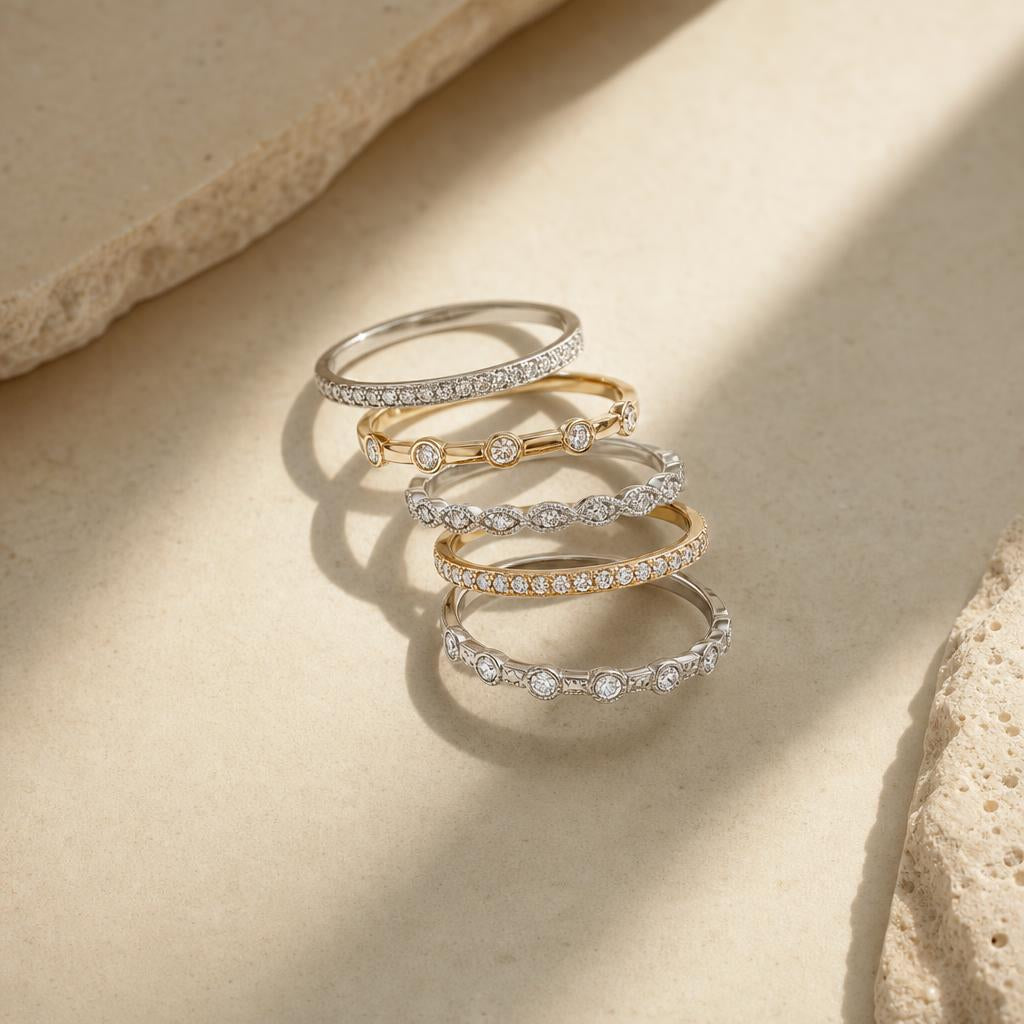
His and Hers, Not Identical: How to Build a Wedding Ring Stack
Somewhere along the way, "his and hers" started meaning "the same ring, twice." Two identical bands, ordered as a set, worn as proof you match. It is a sweet idea. It is also, for most women, the wrong one — because a wedding ring stack is not supposed to look like a matched pair. It is supposed to look like yours.
If you already wear an engagement ring, you already know this instinctively. Nobody wants a plain band that competes with a solitaire, and nobody wants a stack that reads as an afterthought. The goal is a set of rings — his, and the ones you choose for yourself — that clearly belong to the same relationship without pretending to be identical objects. Here is how to actually build one.


What "his and hers" actually means once you stop shopping for a matched set
Skip the boxed sets sold as a pair, and the phrase "his and hers" gets a lot more useful. It stops being a product category and starts being a design principle: two rings, worn by two people, that were chosen with each other in mind rather than pulled off the same shelf. His might be a plain, brushed band from wherever he prefers to shop. Yours is a ring stack you build — piece by piece, on your own timeline, in the metal tones and settings that actually flatter your hand. The two don't need to be the same width, the same finish, or the same anything. They need to look like they were chosen by people who know each other.
This is also, frankly, the more useful way to think about it if you're the one doing the choosing. His ring is his decision. Yours is not an accessory to that decision — it's a stack you get to design around your engagement ring, your knuckle size, and how you actually want your hand to look in five years.
Start with the relationship between the bands, not a matching theme
A convincing stack reads as intentional because the pieces relate to each other without repeating each other. That relationship can come from color, from scale, or from a single shared detail — a metal tone that echoes his band, a stone shape that nods to your engagement ring, a width that keeps the whole hand balanced. What it should never come from is trying to recreate his ring in miniature on your finger.
✦ Pro tip: If his band is a wide, plain, brushed metal, don't try to match that plainness exactly — echo it instead. A slim pavé band in a complementary tone reads as "we thought about this together" far more convincingly than a literal copy ever will.
The easiest place to start is metal tone. If he's in white metal, a platinum-toned stacking piece like The Cherish Ring keeps the palette unified without asking you to give up detail — its bezel-set stones sit flush and quiet, the opposite of showy, which makes it an easy first addition next to a simpler engagement ring. If your engagement ring already carries most of the sparkle, a bezel setting is the safer opening move: it adds without competing.
Building the stack itself: anchor, connector, statement
Most stacks that actually work follow a loose three-part logic, whether or not the person wearing them planned it that way.
The anchor is your engagement ring — the piece everything else is arranged around. The connector is a slim, quiet band that sits directly against it and smooths the transition, usually a delicate pavé piece like The Destiny Ring, whose fine stone-set rows are built specifically to sit flush without adding bulk. The statement piece is the one that gives the stack a personality of its own — something with more presence, like The Amore Ring's row of bold oval stones, added on the outer edge of the stack where it has room to actually be seen.
You don't need all three at once. Plenty of women start with just the connector and add a statement piece a year or two later, once the everyday habit of wearing a stack has settled in. That slower build is, if anything, the more common route — and it means the "complementary, not identical" idea can evolve over time instead of being locked in on one shopping trip.

The Wishbone Ring - Rose Gold
If his band leans warm — yellow or rose gold — this curved pavé piece picks up that same undertone without matching it exactly. The wishbone shape follows the curve of a solitaire instead of sitting as a straight bar against it, which is part of why it reads as considered rather than generic.
Shop The Wishbone Ring →Mixing metals on purpose, instead of by accident
The rule that a couple's rings must match in tone is mostly inherited, not functional. Plenty of the most convincing wedding ring stack combinations on real hands right now mix a cooler platinum tone against a warmer gold one, deliberately. The trick is picking one accent and repeating it once — a single warm-toned piece against an otherwise cool stack, rather than alternating metals with no logic at all. Two or three tones, used with a clear ratio, reads as styled. The same tones used randomly reads as unfinished.

The Eternity Ring - Gold
A full circle of pavé in warm gold, built to work as a single deliberate accent against a platinum-toned stack — or as the anchor of an all-gold build if that's the direction you're taking the whole hand.
Shop The Eternity Ring →Where mismatched stacked wedding bands actually go wrong
"Complementary, not identical" is not the same as "anything goes." A stack falls apart, visually, when there's no shared logic at all connecting the pieces — three completely different widths, three unrelated finishes, and no repeated detail anywhere to tie it together. The fix isn't to make everything match. It's to pick one variable to keep consistent — usually width or metal tone — and let everything else vary around it. That's the difference between mismatched stacked wedding bands that look curated and ones that just look like a drawer of rings someone put on all at once.
The same logic applies to sizing. A stack only lies flat and reads as one cohesive piece when each band actually fits — not just around the base of your finger, but around the widest part of your knuckle, especially if any piece includes a raised setting. Buy each band to its own correct size, not to whatever size the anchor piece happens to be.
Your ring, his ring, and the case for not overthinking the "hers" part
Here's the part most guides skip: your stack doesn't need his input, his approval, or a matching theme to be considered a legitimate half of "his and hers." It needs to fit, flatter your hand, and hold up to how you actually live — which, for a stack you'll wear daily, means every piece should be 925 sterling silver built to resist tarnish, not a soft-metal set that needs babying. Indistinguishable from fine jewelry at a glance, and durable enough that nobody — including you — has to think twice about wearing it every single day.
That's really the whole idea. His ring says something about him. Yours should say something about you — chosen on your terms, added at your pace, and built to actually be worn, not just photographed once and left in a drawer.
Quick Takeaways
- "His and hers" works better as a design principle than a matched product — chosen with each other in mind, not copied
- Build in stages: an anchor (your engagement ring), a connector (a slim band that sits flush), and a statement piece added later
- Mix metals on purpose with one repeated accent tone, not at random
- Keep one variable consistent — usually width or tone — to stop a stack from reading as mismatched
- Size every band to your actual knuckle, not to the size of your engagement ring alone
Frequently asked questions
What is a wedding ring stack, exactly?
It's a set of rings — typically an engagement ring plus one or more additional bands — worn together on the same finger to build a fuller, more layered look over time. Unlike a boxed bridal set, a stack is usually assembled piece by piece rather than bought all at once.
Do "his and hers" rings actually need to match?
No. Matching sets are one option, not a rule. Many couples now choose rings independently — his based on what fits his taste and daily wear, hers built as its own layered stack — and let a shared metal tone or single repeated detail do the work of tying the two together instead of identical designs.
What order should you stack your rings in?
Most women wear the engagement ring closest to the fingertip, with connector bands sitting against it and any statement piece placed on the outer edge, closest to the knuckle. It's a starting point, not a rule — the right order is whichever arrangement sits flattest and most comfortable on your specific hand.
Is ring stacking still popular, or is it a passing trend?
Ring stacking has held steady as a mainstream styling choice rather than a short-lived trend, largely because it solves a real problem: it lets a woman keep adding to her ring collection over years — anniversaries, milestones, or simply changing taste — without replacing what she already owns and loves.


