

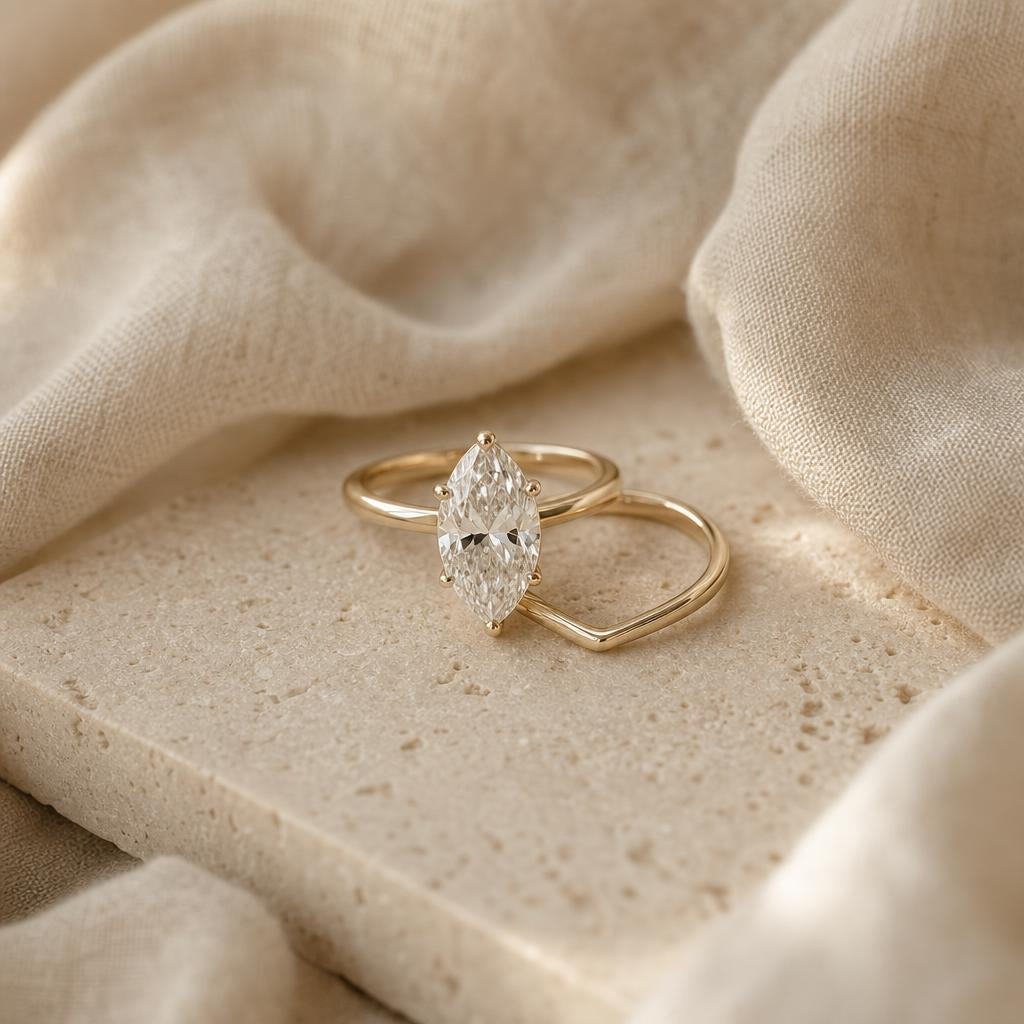
Wedding Bands for Marquise Cut Rings: Which Shapes Actually Sit Flush
The marquise cut is one of the most dramatic silhouettes in engagement ring design — long, pointed, and elongating on the finger in a way almost no other shape can match. But that same drama creates a genuine styling problem the moment you go looking for a wedding band. Those two tapered points are exactly where most straight bands leave a visible gap, and no amount of squinting in the mirror fixes it once the rings are actually on your hand.
The good news is that this is a solvable problem, not a rare exception — you just need to know which band shapes actually follow the curve of a marquise and which ones were never going to sit flush in the first place. Here's what to look for, starting with a few pairings worth trying first.


Why marquise rings are so hard to pair
Every wedding band pairing problem comes down to the same question: does the inside edge of the band actually follow the outline of the engagement ring, or does it just approximate a circle and hope for the best? A round solitaire is forgiving here — the shank is round, the band is round, and the two meet without much drama. A marquise is the opposite case. It tapers to a sharp point at both ends, and the shank width narrows right along with it. A straight band sized to fit comfortably under the widest part of the marquise will almost always leave a visible triangular gap at each point, because the ring simply isn't as wide there as it is at the center.
This isn't a flaw in the ring — it's just geometry. The same thing happens with pear and oval shapes to a lesser degree, but marquise exaggerates it because the taper is more extreme and the points are sharper. Knowing this going in means you can shop for the actual fix rather than trying six straight bands and wondering why none of them look right.
The two things that actually determine fit
1. Contour versus straight
A contour band is cut with a notch or curve that dips inward to trace the shape of the engagement ring's shank as it narrows toward the points. This is the single biggest factor in whether a band sits flush against a marquise. A straight band, no matter how delicate or how perfectly matched in metal tone, keeps a constant width along its entire length — which means it can only ever touch the marquise shank at the widest point, leaving open space everywhere else.
Worth knowing: "Curved" and "contoured" aren't quite the same thing. A curved band bends gently along its whole length (useful for comfort and for sitting close to a rounded stone). A contoured band is cut with a specific notch to match a specific ring's outline. For a marquise, you want the notch — a gentle curve alone usually isn't enough to close the gap at a sharp point.
2. Orientation of the marquise
A marquise set north-south (points toward your knuckle and toward your palm) creates a different gap pattern than one set east-west (points toward each side of your finger). North-south is the more traditional orientation and the one most stacking bands are designed around, since the points sit away from where a second ring would typically nest. East-west marquise settings are more forgiving in one sense — the band only has to clear the wide part of the stone, not navigate around two points — but they're less common, so fewer contour bands are built specifically for that layout.

The Forever Ring
A classic round pavé eternity band, sized flat and even along its entire length. It's a useful comparison point precisely because it isn't cut with a marquise-specific curve — worth trying alongside a contour option so you can see the gap difference for yourself before deciding.
Shop The Forever Ring →Which band shapes actually work
Not every "curved" band is built with a marquise in mind, so it helps to know what to look for by name.
Marquise-shaped stacking bands
The most direct fix is a band that uses marquise-cut stones itself, set in a row along a slim shank. Because the stones share the same silhouette as your center stone, the whole piece reads as an intentional pair rather than two rings that happen to sit near each other. This is the closest thing to a guaranteed match, since there's no guessing about whether the curve lines up — the shapes are identical.
Wishbone and V-shaped bands
A wishbone band dips into a soft V at its center, which is originally designed to sit flush under a single pointed or raised stone. For a marquise set north-south, a wishbone band can tuck neatly against one point while sitting flat everywhere else — it won't solve both ends at once, but for a single stacking piece worn on one side, it's a genuinely elegant option.
Curved and shadow bands cut to spec
Some bands are made to order with a custom notch traced from the actual engagement ring's profile. If you're buying a wedding band separately rather than as part of a matched set, ask specifically whether the band is contoured for a marquise silhouette — a general "curved band" description isn't the same guarantee.
Worth knowing: A ring guard or spacer can be a lower-commitment first step. Rather than replacing your search for a permanent wedding band, a guard sits between two rings and physically closes small gaps — useful if you already own a band you love but it doesn't quite clear the points.
What to avoid
Wide, flat bands are the classic mistake with a marquise. The wider the band, the more surface area has to somehow bridge the taper at the points — which means the gap becomes more visible, not less, as band width increases. Baguette-cut eternity bands present a related issue: the rectangular step-cut stones are set with hard, straight edges, so even a band that curves slightly will still show visible daylight where the baguette's flat side meets the marquise's tapering point.

The Devotion Ring
A continuous circle of baguette-cut stones with a clean, architectural line. Beautiful on its own or paired with a round or emerald cut, but worth trying on before committing if you're pairing it with a marquise — the straight-edged stones don't flex around a sharp point the way a curved band does.
Shop The Devotion Ring →A quick reference
| Band style | Fit against a marquise | Best for |
|---|---|---|
| Marquise stacking band | Excellent — matching silhouette | A near-guaranteed flush look |
| Contoured / notched band | Very good, if cut to spec | Buyers pairing a band separately |
| Wishbone / V-shaped | Good at one point | A single stacking piece on one side |
| Slim round pavé, gently curved | Fair — some gap likely | Layering further out in a stack |
| Straight, wide band | Poor — visible gap | Wearing alone, not stacked |
| Baguette eternity | Poor — straight edges | Pairing with round or emerald cuts instead |
✦ Pro tip: Try the band on with the engagement ring before buying, even if that means requesting a photo or a virtual try-on from wherever you're shopping. Gap issues are far easier to spot with both rings physically together than by comparing product photos side by side.
Building the rest of your stack
Once you've solved the point-gap problem with the ring closest to your marquise, the rest of the stack has much more flexibility. Bands further out don't need to trace the marquise's exact outline the way the innermost band does — by the second or third ring, you're layering for overall composition rather than fighting for a flush fit against one specific point. This is where you can bring in a contrasting metal tone, a different stone shape, or a wider statement piece without worrying about the same gap issue resurfacing.
Quick Takeaways
- Marquise rings taper to two sharp points, and straight bands can only ever touch the widest part of the shank — leaving a gap at both ends.
- Marquise-shaped stacking bands are the most reliable fix, since the silhouette matches exactly.
- Contoured bands work well if they're cut specifically to your ring's profile — a general "curved" description isn't the same guarantee.
- Wishbone and V-shaped bands solve the gap at one point, which is often enough for a single stacking piece.
- Wide, flat, or baguette-cut bands tend to show the most visible gap and are best saved for pairing with rounder or straight-edged center stones instead.
Frequently asked questions
Does a marquise ring always need a curved wedding band?
Not always, but it usually looks better with one. If you plan to wear the wedding band on a separate finger or don't mind a small visible gap, a straight band is still an option. For anyone stacking the two rings together, a contoured or marquise-shaped band will sit closer and photograph more cleanly.
What if I already own a straight band and don't want to buy a new one?
A ring guard or spacer is worth trying first. It sits in the gap between the two rings and can close much of the visible space without requiring you to replace a band you already like.
Is an east-west marquise setting easier to pair with a wedding band?
In some ways, yes — the band only needs to clear the widest part of the stone rather than navigate two points along the stacking edge. That said, fewer bands are designed specifically for that orientation, so you may be doing more trial and error to find the right fit.
Can a marquise-cut wedding band be worn on its own, without an engagement ring?
Yes. A marquise stacking band like the Petal Ring reads as a complete, finished piece on its own — the elongating shape works well solo, not just as a stacking companion.
A marquise center stone is one of the more distinctive choices you can make, and the styling considerations that come with it are a small price for that kind of drama on the hand. Once you know to look for a matching silhouette or a genuinely contoured notch — rather than assuming any curved band will do — finding a wedding band that actually sits flush becomes a much shorter search.


