

Wedding Bands for Heart-Shaped Rings: What Fits, What Doesn't, and Why
A heart-shaped ring is not a shy purchase. It has a point, a cleft, a silhouette that reads as deliberate from across a room — and it also happens to be the one center shape that makes wedding band shopping genuinely more complicated than the "just pick something round" version everyone else gets to have.
The good news: the fit logic is knowable, not mysterious. Once you understand where a heart-shaped stone actually needs clearance and where it doesn't, choosing the right band stops being guesswork. Here are four stacking bands worth knowing before we get into the why.

Why Heart-Shaped Rings Are Genuinely Trickier to Stack
Every other popular center shape — round, oval, cushion, emerald — has a continuous edge. A wedding band can sit flush against that edge because there's nothing for it to clear. A heart-shaped stone breaks that rule twice: there's a shallow V-shaped cleft at the top, where the two lobes meet, and a sharp point at the bottom, where they taper to a single tip.
A straight, flat-edged band pushed up against either of those spots doesn't sit flush. It either leaves a visible gap at the cleft, rocks against the point, or — worse — gets scratched by it every time your hand closes. None of that is a flaw in the ring. It's just geometry, and geometry has a fix.
Choosing a Wedding Band for a Heart Shaped Ring: The Actual Fix
The short version: you're looking for a band that either curves to trace the stone's shape, or one that avoids the contact points entirely. There are two reliable approaches, and most stacking bands worth owning fall into one of them.
Curved and contoured bands
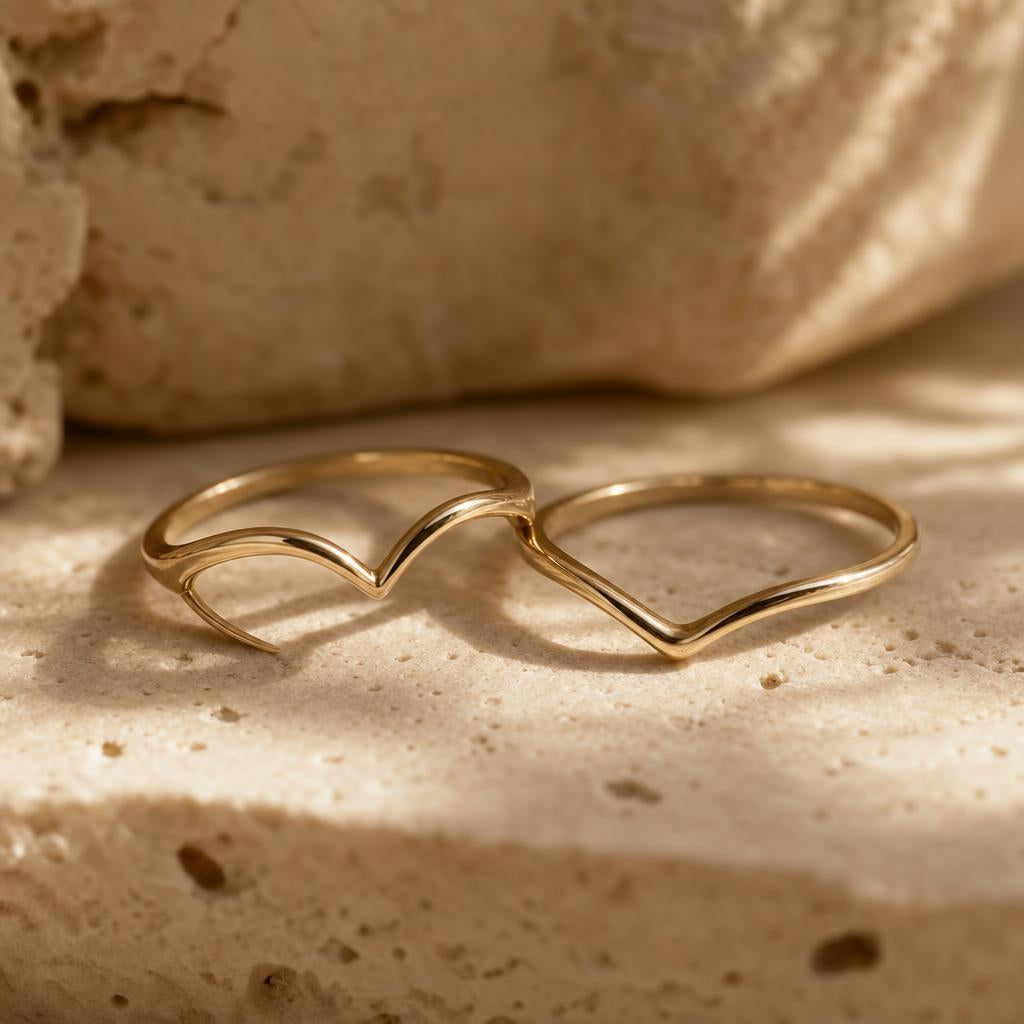
A curved wedding band is cut with a gentle dip or arch built into the metal itself, so it follows the outline of whatever it's sitting against instead of running in a straight line. Against a heart-shaped stone, a curved band traces the cleft at the top and clears the point at the bottom without a visible seam of empty space between the two rings. This is the closest thing to a custom fit you'll get from a ready-to-wear band.

The Wishbone Ring
Its gentle, curved profile is built to trace a dip rather than fight it — which is exactly the shape logic a heart-shaped stone calls for. A row of pavé stones keeps the sparkle continuous across the curve.
Shop The Wishbone Ring →Low-profile bands that skip the problem entirely
The second approach doesn't try to trace the stone at all. A bezel-set or channel-set band sits slightly lower and stacks a hair's width away from the engagement ring rather than pressed directly against it, which means the cleft and the point never come into contact with the band in the first place. It's a quieter solution, and it tends to wear better over years of daily stacking since there's no delicate point of contact catching on fabric or skin.

The Cherish Ring
A bezel setting holds each stone with a smooth, rubbed edge instead of raised prongs, so the whole band sits low and doesn't need to trace anything to look intentional next to a heart-shaped ring.
Shop The Cherish Ring →What Fits, What Doesn't
Here's the shape-by-shape logic in one place, so you're not relitigating it every time you try on a new band.
| Band Style | How It Reads Against a Heart-Shaped Ring |
|---|---|
| Curved or contour band | Traces the cleft and point — the closest to a flush, custom fit |
| Bezel-set band | Sits low and slightly apart — clears both contact points entirely |
| Channel-set band | Sleek and flat, works best stacked with a hair of space, not pressed flush |
| Wide, straight-edged band | Visible gap at the cleft — the shape most likely to disappoint |
| Thin, straight pavé band | Minor gap, but the thinness makes it far less noticeable |
Worth knowing: The gap at the cleft is usually the bigger issue, not the point. Most buyers assume the sharp tip is the problem, but a straight band actually loses more contact at the shallow V where the two lobes meet.
A Heart-Shaped Engagement Ring With a Wedding Band: What Actually Changes Day to Day
Beyond the fit itself, a heart-shaped stone changes how a stack behaves in daily wear. The point is the part most likely to catch on gloves, sweaters, and the inside of pockets, so whatever band you add should ideally sit close enough to give that point some structural backup rather than leaving it fully exposed on one side. This is less about aesthetics and more about longevity — a supported point is a point that's less likely to snag and twist the ring out of place over a year of wear.
Metal choice matters here too, though less than the setting style. A wedding band doesn't need to match the engagement ring's metal exactly to look intentional — a slightly warmer or cooler tone next to a heart-shaped stone can actually help the eye register the pairing as a deliberate style choice rather than an accident of what was in stock. What matters more is that the band's width and profile complement the stone's proportions: a heart-shaped stone with a wide, dramatic silhouette can carry a slightly bolder band, while a smaller or more delicate heart cut usually looks better against something thin.

The Infinity Ring
A delicate pavé line of stones with a clean, continuous edge — a dependable option when you'd rather stack with a sliver of space than force a flush fit.
Shop The Infinity Ring →If You Want Contrast Instead of a Perfect Trace
Not every buyer wants a band that disappears into the engagement ring's outline. A marquise-cut stacking band, for instance, plays against a heart shape rather than mirroring it — two romantic, pointed silhouettes sitting side by side instead of one trying to hug the other. It's a more editorial choice, and it works precisely because it doesn't pretend to solve the cleft-and-point problem; it just makes a different one irrelevant by contrast.
✦ Pro tip: If you're buying online, order a size and try the pairing on your own hand before deciding the fit is wrong. Photos flatten the gap at the cleft in ways that are hard to judge from a product image alone — what looks like a mismatch in a flat photo often reads as intentional the moment light hits both rings together.
Quick Takeaways
- Heart-shaped stones have two tricky spots: the cleft at the top and the point at the bottom.
- Curved or contour bands trace both — the closest thing to a custom fit off the shelf.
- Bezel-set and channel-set bands sidestep the problem by sitting low and slightly apart.
- A visible gap at the cleft is more common — and more noticeable — than a gap at the point.
- Matching metals is optional; matching proportions between stone and band width matters more.
Frequently Asked Questions
Do heart-shaped engagement rings need a special wedding band?
Not a special band exactly, but a deliberately chosen one. Because the stone has a cleft and a point instead of a continuous curve, a plain straight band is more likely to leave a visible gap than it would against a round or oval stone. Curved, bezel-set, or channel-set styles all solve this more reliably than a standard flat band.
What is the best wedding band shape for a heart shaped ring?
A curved or contour band is the most reliable choice if you want the two rings to sit flush against each other. If you'd rather stack with a little breathing room instead, a low-profile bezel-set or channel-set band works just as well without needing to trace the stone's outline at all.
Can you stack a straight band with a heart-shaped engagement ring?
Yes, and plenty of women do — it's a matter of preference, not a rule. A thin, straight pavé band leaves only a small, often barely noticeable gap at the cleft. It's a wider or thicker straight band, pressed flush, where the gap becomes hard to ignore.
Does the wedding band have to match the engagement ring's metal exactly?
No. What actually reads as intentional is proportion, not a perfect metal match — a band whose width and profile complement the stone's scale will look considered even in a slightly different tone. Focus on the setting style and width before you worry about matching metal precisely.
A heart-shaped ring was never meant to disappear quietly into a stack — it's the one shape that asks you to actually think about the pairing instead of defaulting to whatever's flat and thin. Once you know where the cleft and the point actually need clearance, the rest is just choosing which silhouette you'd rather wear every day.


