

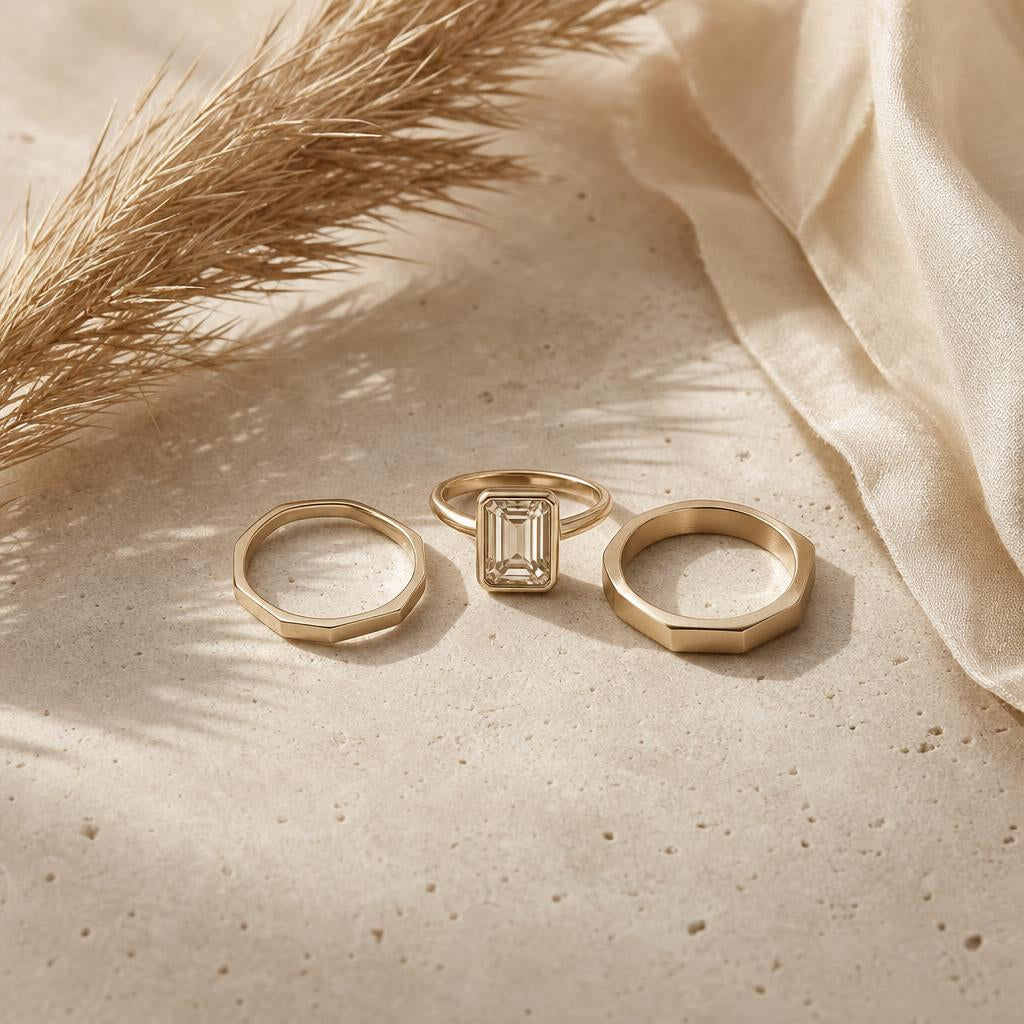
Radiant Cut Wedding Bands: Flush Fits, Curved Bands and What to Avoid
A radiant cut stone has corners — sharp, geometric, unmistakably rectangular — and that single detail changes everything about how a wedding band needs to sit next to it. Round stones forgive an imperfect pairing. Radiant cuts don't.
The good news: once you understand what a radiant cut actually asks for, getting the pairing right stops being a guessing game. Here are a few radiant cut pieces worth knowing first, including two we'll come back to throughout this guide.


What Makes a Radiant Cut Different to Band
Most engagement ring shapes are round, or close enough to round that almost any wedding band sits against them without much thought. A radiant cut is neither. It's a rectangular or square silhouette with trimmed corners and roughly seventy facets doing the work of a much more complex cut — which means the base of the ring, where a wedding band actually makes contact, isn't a smooth curve. It's a shape with edges.
That's not a flaw. It's the reason a radiant cut wedding band needs a little more intention than "whatever matches the metal." Two things tend to go wrong: a visible gap where the band can't follow the stone's straight edges, and a band that competes with the center stone instead of framing it. Both are avoidable once you know what to look for.
The Four Band Styles That Actually Work
Jewelers who specialize in radiant cuts tend to circle back to the same handful of pairings, for good reason — they're the ones that hold up in daily wear, not just in a photo.
Straight bands. A slim, straight band is the most traditional pairing for a radiant cut, and it works because the ring's own straight edges do most of the visual matching for you. This is the safest choice if your center stone sits reasonably high off the finger.
Curved or contoured bands. If your ring has a hidden halo or sits low against the hand, a straight band will leave a small gap at the base — the kind you notice every time you look down. A curved band dips to follow the setting instead, which is what closes that gap without needing a custom piece.
Matching eternity bands. Pairing an eternity band cut in a complementary shape — baguettes, for instance — creates a uniform, architectural look that leans into the radiant cut's geometry rather than softening it. The Devotion Ring's continuous baguette line is built for exactly this kind of pairing.
Plain metal bands. Sometimes the most confident choice is the quietest one. A simple polished band in a matching metal tone lets the radiant cut do all the talking, which is its own kind of statement.
✦ Pro tip: Keep the band width proportional to your center stone. A wide band can visually shrink a radiant cut's corners, while something in the 1.5mm–2mm range tends to let the shape read clearly from across the room.
Flush Fit vs a Deliberate Gap
There are two legitimate ways to wear a radiant cut with a second band, and neither one is wrong — they're just answering different questions. A flush fit means the wedding band sits directly against the engagement ring with no visible space, which is what most people picture when they think about stacking. Getting there usually means choosing a curved or contoured profile that's shaped specifically to hug your setting.
A deliberate gap is the other option, and it's more common than people expect. If your radiant cut sits on a high setting, a straight band with a small, intentional space between the two rings can actually look more considered than forcing a flush fit that wasn't built for your specific ring. Neither approach is more "correct" — the setting height decides which one will actually sit comfortably.

The Forever Ring
A slim, pavé half-eternity band that keeps its profile low — a straightforward option for a radiant cut sitting reasonably high off the hand.
Shop The Forever Ring →What to Avoid When Choosing a Radiant Cut Wedding Band
A few missteps show up more than any others, and each one is easy to sidestep once you know it's coming.
- Mismatched metal tones. Even a well-chosen band shape looks unfinished if the metal doesn't match — white gold against yellow, or a cooler rhodium finish next to a warmer plating. Keep the tones consistent unless you're deliberately building a mixed-metal look.
- A band that's too ornate. Radiant cuts read as modern and architectural. A heavily filigreed or rounded vintage band can fight that geometry instead of complementing it.
- Ignoring the setting height. This is the one that causes the most regret. Buying a straight band without checking how low your center stone sits is the single most common reason people end up with a gap they didn't expect.
- Sizing the band to the engagement ring alone. Wearing two rings together changes how each one fits. Try them on as a pair before finalizing a size, not just individually.
If you're shopping specifically for a radiant cut wedding band set — a pre-matched engagement ring and band sold together — the fit questions above are mostly solved for you, since the pairing was designed in tandem from the start. The tradeoff is less flexibility if your taste shifts later or you want to build your stack in stages.
Building the Rest of the Stack
A radiant cut pairs well with more than just a single wedding band, too. Its clean lines make it a strong anchor for building out a fuller stack over time, provided the pieces you add keep talking to that same geometric language rather than working against it.
The Infinity Ring's crossover silhouette is a good example of a piece that adds interest without disrupting the radiant cut's straight lines — the curve is intentional rather than accidental, so it reads as a deliberate design choice instead of a mismatch. Round pavé pieces like the Everlasting Ring, by contrast, soften the geometry slightly, which some people want and others don't. Neither is right or wrong; it comes down to whether you want your stack to feel uniform or layered.

The Aura Ring
A radiant-cut solitaire with a side halo — a second radiant option worth knowing if the Statement Ring's three-stone design isn't quite your style.
Shop The Aura Ring →Whichever direction you take it, the underlying principle stays the same: a radiant engagement ring with wedding band pairings that actually work are the ones chosen with the stone's setting height and edges in mind, not just its general shape.
Worth knowing: None of this is about compromise. A 925 sterling silver radiant cut ring set with moissanite is indistinguishable from a diamond at arm's length — it passes diamond testers and holds its brilliance under the same light a mined stone would. The band question is a styling decision, not a quality one.
Quick Takeaways
- Four band styles pair reliably with this shape: straight, curved/contoured, matching eternity, or plain metal — pick based on your setting height.
- Low or hidden-halo settings usually need a curved band to close the gap; higher settings can wear a straight band flush or with intentional space.
- Keep band width proportional (around 1.5mm–2mm) so the radiant cut's corners stay visible.
- Match metal tones unless you're deliberately mixing them, and always try the pair on together before sizing.
Frequently Asked Questions
What wedding band looks best with a radiant cut engagement ring?
There isn't a single answer, but a straight pavé band, a curved contoured band, or a matching eternity band all pair well — the right choice depends mostly on how high your center stone sits and whether you want a flush fit or a small deliberate gap.
Is a radiant cut a good choice for an engagement ring?
Yes. Radiant cuts combine the elongated silhouette of an emerald cut with the brilliance of a round cut, which gives them serious sparkle without losing the more architectural, modern shape a lot of buyers want.
What are the drawbacks of a radiant cut stone?
The main one is exactly what this guide covers — pairing. Because the stone has straight edges rather than a round girdle, wedding bands need a little more thought than a round cut would require. Beyond that, radiant cuts show inclusions slightly more than some other cuts, though that's less of a factor with a lab-created moissanite center, since clarity is consistent by design.
Do you wear a wedding band and engagement ring together?
Most people do, typically stacking the wedding band closer to the hand with the engagement ring on the outside — though plenty of women also wear them on separate hands or swap the order. There's no fixed rule; it's entirely about what feels comfortable and looks right to you.
A radiant cut ring rewards a little more planning at the band stage than a round stone would — but that planning is straightforward once you understand what the shape is actually asking for. Start with your setting height, choose a profile that respects the stone's edges rather than fighting them, and the rest of the stack tends to fall into place.


