

Types of Earring Settings: Why the Halo Works the Same Way It Does on a Ring
A halo doesn't just belong on an engagement ring. The same optical trick — a ring of small stones circling a center stone, pulling in extra light from every angle — works exactly as well an inch higher, on your ear. Most women who shop for earrings never hear the word "setting" used this precisely. They should. It's the difference between an earring that photographs as an afterthought and one that reads as considered.
Before you can choose well, it helps to know what you're actually choosing between. A halo is one setting among several, and each does a different job — some maximize sparkle, some maximize durability, some are built for an earlobe that's had enough of catching on scarves. Here's where a halo earns its place, and what else is worth knowing before you buy.


What a Halo Setting Actually Does
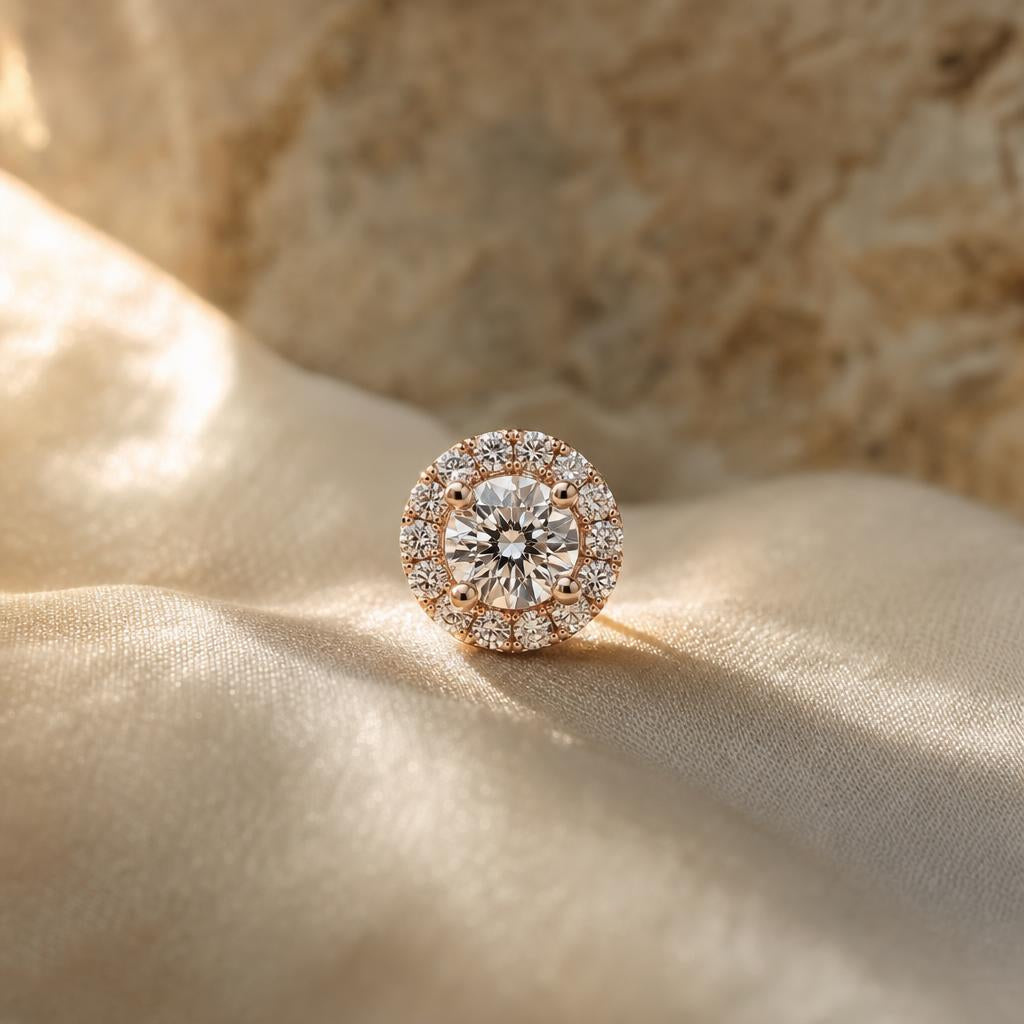
Strip away the jewelry-store language and a halo setting is simple: a circle of small accent stones surrounds a larger center stone, set close enough that light bounces between the two. The center stone reads bigger than its actual size because your eye registers the whole sparkling circle as one shape, not two. On a ring, this exact mechanic is why the halo setting became the most popular engagement ring style over the last decade — it's a way to make 1.5 carats look closer to 2 without changing the underlying stone. On an earring, the effect is even more immediate, because studs sit so close to the face that every bit of extra light they throw gets noticed first.
It's also worth being specific about what a halo is not. A halo isn't a size — it's a construction. A small halo stud and a large halo stud can carry the same center stone weight; the halo is doing the work of making one of them look more substantial. That's a useful thing to understand before you compare two listings that look nothing alike in photos but are, structurally, built the same way.

The Belle Stud Earrings
A round-cut center stone with a tight, classic halo — the setting at its most versatile, built for daily wear without losing the extra sparkle.
Shop The Belle →The Other Types of Earring Settings You'll See on a Listing
A halo is only one entry in a short list. Reading through the full range of types of earring settings makes it much easier to know what you're actually buying, especially once you're comparing pieces across different brands and listings.
Prong Setting
The most common setting for a solitaire stud: three, four, or six thin metal claws hold the stone in place while leaving nearly the whole surface exposed to light. It's the setting that lets a stone show off completely unobstructed — nothing frames it, nothing competes with it. The tradeoff is that prongs are the part of an earring most likely to snag on a hood or a hairbrush, so a higher prong count (six rather than three) tends to hold up better through daily wear.
Bezel Setting
Here the stone is wrapped, fully or partially, in a rim of metal rather than held by claws. It's the quiet, low-profile choice — sleeker, more modern-reading, and considerably more durable, since there's no exposed prong to catch or bend. A bezel does soften the sparkle slightly, since some of the stone's surface is covered by metal rather than open to light. Anyone who's had a prong catch on a sweater already understands the appeal.
Martini Setting
Shaped like the cone of a martini glass when you look at it from the side, this setting holds the stone in a narrow base with minimal visible metal, letting it sit unusually close to the earlobe. It reads as sleek and modern, though a heavier stone in a martini setting can occasionally tilt forward over time, which is worth knowing if you're deciding between this and a flatter basket setting.
Halo Setting
Back to where we started — a center stone ringed by smaller accent stones, built to maximize both perceived size and total sparkle. It's the most detailed of the common earring settings, and the one most likely to catch light from an angle a plain solitaire would miss entirely.
Worth knowing: None of this is a hedge against quality. Every Gemiros setting — halo, prong, or otherwise — holds a genuine simulated diamond, set in 925 sterling silver, that passes diamond testers. The setting changes how the stone reads. It doesn't change what the stone is.
Halo vs. Solitaire: The Comparison Worth Actually Making
Most first-time earring buyers land on this exact fork: a plain solitaire stud, or a halo. Neither is objectively better — they're built for different priorities. A solitaire in a prong setting is quieter and more minimal, the kind of stud you could wear to a client meeting without anyone registering "jewelry" before they register "you." A halo is louder in the best sense — more surface area catching light, a more substantial presence for the same underlying carat weight.
If you already own a solitaire stud and you're adding a second pair rather than replacing your only one, a halo is the more useful addition precisely because it does something your existing pair doesn't. The right call depends on what's already sitting in your jewelry box, not on which setting is objectively "better."

The Éclat Moissanite Stud Earrings
A round-cut moissanite stone held by a classic 6-prong setting — maximum light exposure, no halo, the setting built for buyers who want the stone to do all the talking.
Shop The Éclat →What Actually Determines Whether a Halo Works for You
Three things matter more than trend cycles here. Face shape and hair styling first — if you wear your hair back or short, a halo's extra surface area gets seen constantly, which makes it worth the investment; if your ears are usually covered, a plainer solitaire might get more actual use. Skin sensitivity second — a halo has more total metal-to-skin contact than a solitaire, so if you already know sterling silver agrees with you, that's one less thing to think about (if you're not sure yet, it's worth checking whether sterling silver works for sensitive ears before you commit to a more detailed setting).
Third, and most practically: what you already own. A halo pairs beautifully as a second or third pair precisely because it reads differently from a plain stud, which makes layering multiple pairs in the same ear look deliberate instead of accidental.
None of this requires you to memorize gemology. It requires knowing that "halo" describes a structure, not a marketing word, and that the structure has a specific, provable effect: more light, more perceived size, more presence per carat. That's not a subjective style opinion — it's how the setting is built.
Quick Takeaways
- A halo setting surrounds a center stone with smaller accent stones, making it read larger and catch more light than the same stone alone.
- The main types of earring settings are prong, bezel, martini, and halo — each trading off sparkle, durability, and how much metal is visible.
- A halo is a construction, not a size — two halo studs can hold the same center stone weight but look completely different.
- A halo works especially well as a second or third pair, adding real visual contrast to a stud you already wear daily.
Frequently Asked Questions
Does a halo setting make an earring look bigger?
Yes — a halo surrounds the center stone with smaller accent stones set close enough that your eye reads the whole circle as one larger shape, so the stone appears more substantial than the same stone set alone.
What is the strongest setting for an earring?
Bezel settings are generally the most durable, since the stone is wrapped in a rim of metal with no exposed prongs to catch or bend. Prong settings show off the most stone but are the most likely to snag on clothing or hair over time.
What's the difference between a halo and a hidden halo?
A standard halo sits visibly around the center stone and is obvious from the top view. A hidden halo tucks that same ring of accent stones underneath the center stone's setting, so it's only visible from the side — a subtler version of the same effect.
Are halo earrings more expensive than solitaire earrings?
The extra accent stones and detailed setting work typically make halo earrings cost more than an equivalent plain solitaire, though the gap is far smaller than most buyers expect — nowhere near what a jewelry store markup would suggest for the added detail.
The next time a listing photo makes an earring look bigger than its carat weight suggests, you'll know exactly why — and you'll know it's not a photography trick. It's the setting doing precisely what it was built to do.


