

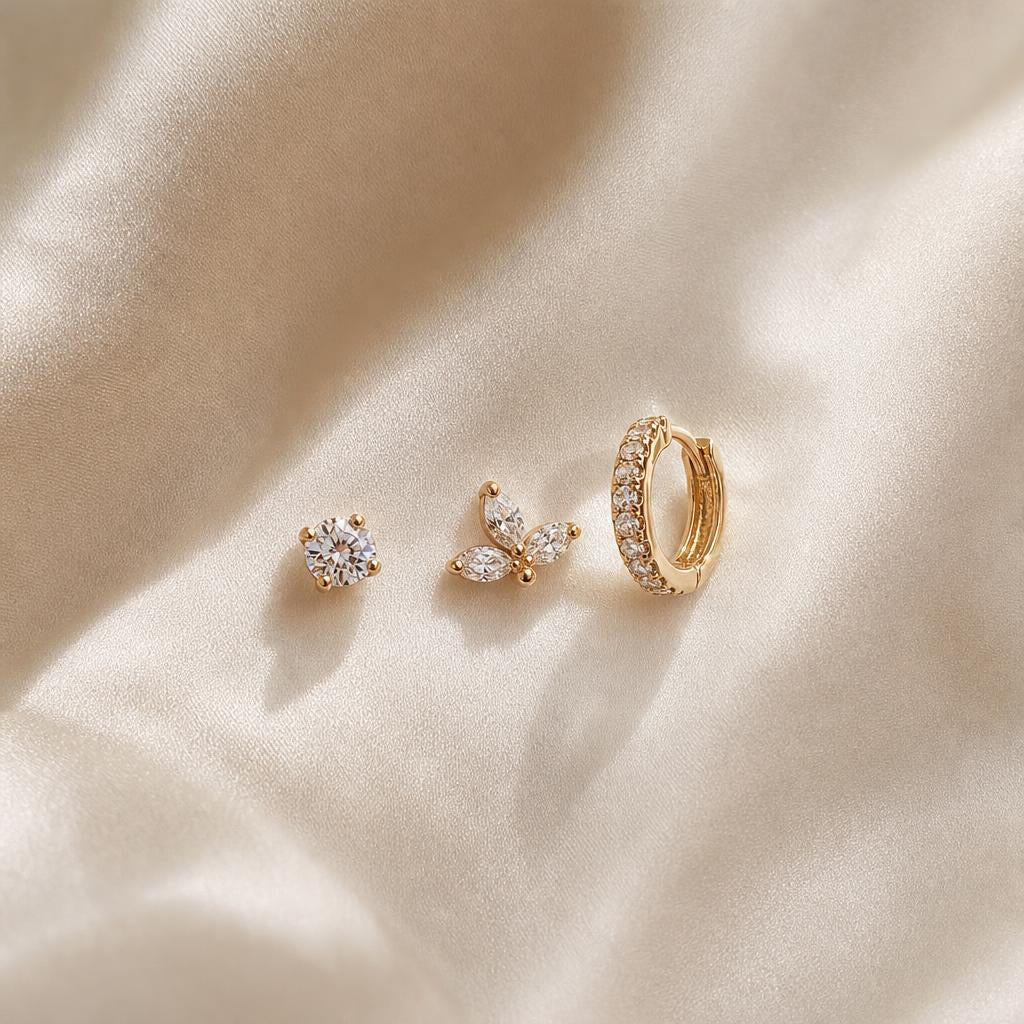
Earring Stack Ideas: How to Layer Earrings Without It Looking Cluttered
One ear, one hole, one pair of studs — that was the rule for a long time. It isn't anymore. A well-built ear stack reads as more intentional than a single matched pair ever did, and the woman wearing it isn't following a trend so much as she's finally decided her jewelry box doesn't have to sit half-used in a drawer.
The good news is that building one doesn't require six new piercings or a stylist. It requires a handful of pieces that are actually built to sit together — the right sizes, the right finishes, the right sense of restraint — and a formula for arranging them so the result looks curated instead of accidental. Here's where to start.


Why One Pair Isn't the Whole Story Anymore
For most of modern jewelry history, earrings were sold and worn as a single unit: one pair, matched, in and done. That made sense when a second piercing was rare and a third was practically a statement of rebellion. It doesn't make as much sense now, when multiple lobe piercings are common and the ear itself has become something closer to a small, changeable canvas.
What changed isn't the ear. It's the expectation. A woman who owns four or five pairs of earrings used to rotate them — one pair today, a different pair tomorrow. Building a stack means she wears several of them at once, and the whole collection starts working harder than any single pair could on its own. It's the same shift that happened with rings years ago: once stacking became normal, a ring stopped being one decision and started being a set of decisions that work together.
Worth knowing: You don't need multiple piercings to build a stack. A single lobe piercing can hold two or three studs in a row, and most of the formula below works the same way whether you have one hole or four.
The Formula Behind Every Good Earring Stack Idea
Search "earring stack ideas" and the examples all start to look different on the surface — some minimal, some maximal, gold, silver, mixed — but underneath, nearly every one follows the same three rules. Understand these and you can build a stack from pieces you already own, not just ones sold as a matched set.
1. Start With a Centerpiece
Every stack needs a piece the eye lands on first — usually the boldest or largest in your lineup. In a lobe piercing, that's often a solitaire stud with real presence, like a round or oval cut set in a simple prong mount. Everything else in the stack gets built around it, not competing with it.
2. Scale Down as You Move Up or Out
Once the centerpiece is placed, the rest of the pieces should get progressively smaller or quieter — smaller stones, thinner bands, simpler settings. This is the detail most first attempts get backwards: two equally loud pieces sitting side by side don't read as a stack, they read as a collision. A huggie hoop earns its place next to a statement stud precisely because it's quieter, not because it matches.
3. Keep One Finish Dominant
Mixing textures is what makes a stack look curated instead of thrown together, but only if one finish still leads. A stack that's roughly two-thirds silver with one contrasting piece reads as deliberate. A stack that's an even split of finishes and shapes usually reads as indecisive — like you couldn't choose, so you wore all of it.

The Dewdrop Stud Earrings
A marquise pearl silhouette that's built for the quiet end of a stack — the piece that adds texture without pulling focus from your centerpiece stud.
Shop The Dewdrop →Sterling Silver Earring Stack Combinations That Actually Work
If you're shopping with a single lobe piercing and want the shortest possible path to a finished-looking stack, these three combinations hold up in practice, not just in a photo.
- The everyday stack: one solitaire stud as the centerpiece, one huggie hoop directly behind it. Two pieces, low effort, reads as put-together the moment you put it on.
- The dimensional stack: a halo stud up front, a plain huggie hoop behind it, and a small pearl or marquise stud tucked in last for texture. This is where the "scale down" rule earns its keep.
- The quiet-hoop stack: two huggie hoops of slightly different widths worn together, no stud at all. Less common, genuinely striking, and proof that a stack doesn't have to include a solitaire to feel finished.
A sterling silver earring stack specifically has one practical advantage over mixing finishes: it never fights itself. Every piece already sits on the same base metal, so the only decisions left are shape and scale — which is exactly the part of the formula above that actually matters.

The Vivara Moissanite Huggie Hoop Earrings
A pavé huggie sized to sit close to the lobe, which is exactly what makes it work behind a bolder centerpiece stud instead of competing with it.
Shop The Vivara →You Don't Need a Matching Pair for Every Slot
Here's the part that trips people up most: a stack doesn't require every piece to have a twin waiting in the other ear. Once you're wearing three or four earrings total, exact symmetry stops being the goal — balance is. Mismatched earrings work inside a stack for the same reason odd numbers work in a gallery wall: the eye doesn't expect perfect repetition, so a thoughtful imbalance reads as more considered, not less.
That said, there's a difference between deliberate asymmetry and a stack that just happened by accident. If you're trying it for the first time, keep one thing constant across both ears — same finish, same general scale — and let only the smallest, quietest piece be the one that differs.
✦ Pro tip: If you're nervous about mismatching, start by keeping your centerpiece identical in both ears and only vary the second, smaller piece. It's a low-risk way to test the idea before you commit to full asymmetry.
Building the Stack Without Overbuying
You don't need an entirely new collection to put a stack together — most women can build one from pairs already sitting in a jewelry box, plus one or two new pieces chosen specifically to fill a gap. Before buying anything, look at what you already own and ask which role it's missing: a centerpiece, a quiet second piece, or something with texture.
If you are starting from nothing, buying pieces individually rather than as a pre-bundled set gives you more control over scale and finish — you're building toward your own three rules above, not someone else's preset combination. It also means every piece still works on its own, on the days you only want to wear one.
Quick Takeaways
- Start with one centerpiece, then scale everything else down in size and volume from there.
- Keep one finish dominant — roughly two-thirds of the stack — so mixed textures still read as deliberate.
- Keeping every piece in the same silver finish is the easiest starting point, since there's no clashing metal to plan around.
- Mismatched earrings work inside a stack when the centerpiece stays consistent and only the smaller piece varies.
- Build from what you already own first, then buy to fill the specific gap — centerpiece, quiet piece, or texture.
Frequently Asked Questions
What is the 2/3 rule for earring stacking?
It's a simple ratio for keeping a mixed stack from looking chaotic: roughly two-thirds of the pieces share one dominant finish or scale, while the remaining third is where you introduce contrast — a different texture, a smaller stone, or an asymmetrical piece. It's a guideline, not a hard limit, but it's a useful gut check if a stack you've built feels busy.
How many earrings do I need for a good stack?
Two is enough to read as a stack rather than a single pair — a centerpiece stud plus one huggie hoop is the fastest combination to get right. Three pieces per ear is the more common sweet spot once you want visible dimension, and it's also the most forgiving number to work with, since it naturally gives you room for a centerpiece, a mid-size piece, and one quiet detail.
Can I wear two different earrings in the same ear without it looking messy?
Yes, as long as they're doing different jobs rather than competing for the same one. A stud and a huggie hoop read as complementary because they occupy different visual weights; two studs of similar size and sparkle sitting next to each other usually don't. The scale-down rule is what keeps two or more pieces in one ear from turning into visual noise.
Do sterling silver earring stacks tarnish?
925 sterling silver can develop a light patina over time with any jewelry, but it's not fragile — it holds up to daily wear, and a quick polish restores the shine when needed. Keeping pieces dry before swimming or showering and storing them separately so they don't scratch each other are the two habits that matter most for a stack you're wearing every day.
A good stack isn't about owning more earrings — it's about making the ones you already reach for work harder together. Start with one centerpiece, add pieces with a specific job in mind, and let the formula do the rest. The result should look like it took no effort at all, even though you know exactly why it works.


