

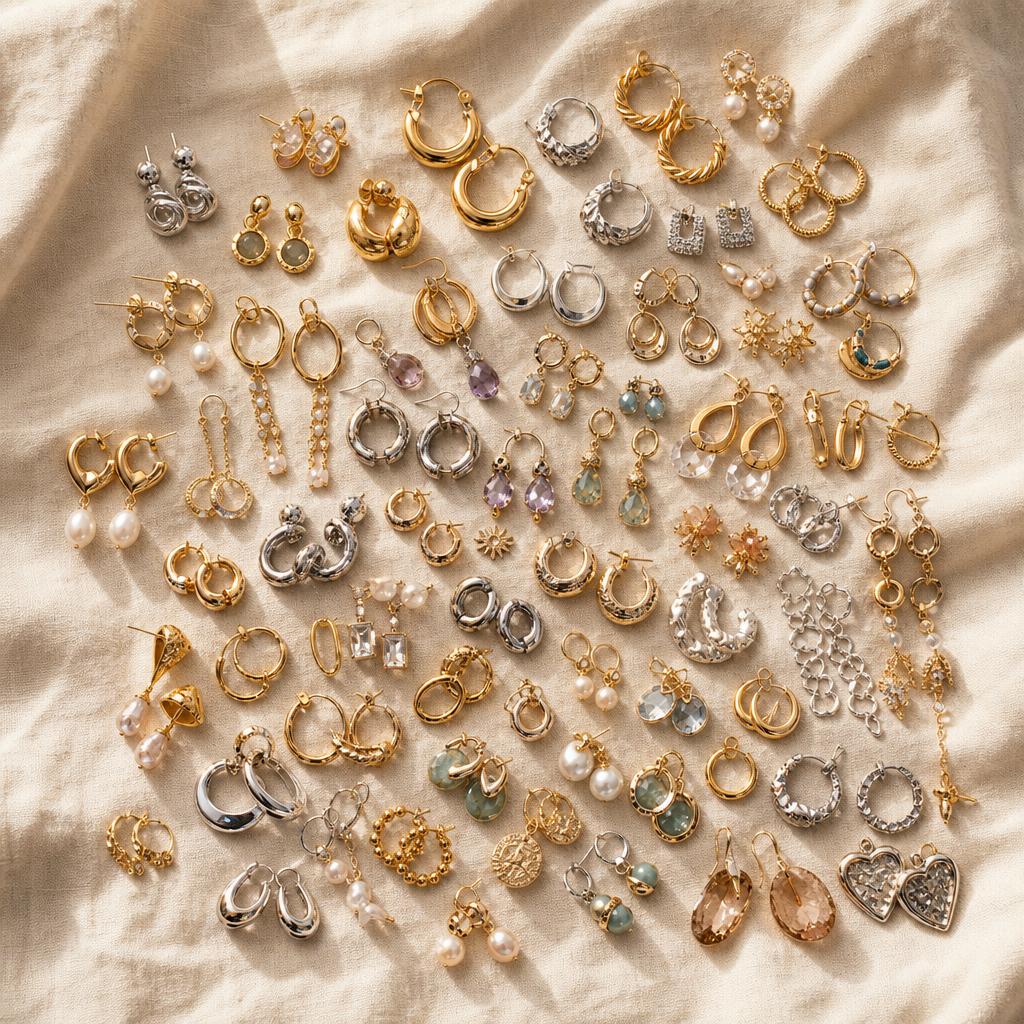
Statement Earrings: How to Build a Maximalist Ear Look That Doesn't Read as Costume
Somewhere along the way, "less is more" became the default answer to every jewelry question — and a lot of women who actually love a full ear stopped trusting their own eye. Maximalist earrings aren't a phase or a trend cycle you'll age out of. They're a decision: more sparkle, more shape, more of you, worn on purpose instead of by accident.
The difference between a maximalist ear look that reads as intentional and one that reads as cluttered almost never comes down to how much jewelry is involved. It comes down to how it's chosen. Here's how to build a bold, layered ear — and which pieces actually earn their place in it.


What Actually Counts as a Statement Earring
A statement earring isn't defined by size the way most people assume. It's defined by attention — a piece built to be the first thing someone notices, whether that's because of its scale, its shape, or the way it catches light differently than everything around it. A single oversized drop earring is a statement piece. So is a halo stud sized and set to throw more brilliance than a plain solitaire ever could. What makes it a statement isn't inches. It's intent.
This matters because a lot of women rule themselves out of maximalist styling for the wrong reason — they assume it requires pieces they'd never actually wear to work, to dinner, to their own life. It doesn't. The Henrietta studs above are a good example: a princess-cut halo that reads as considerably bolder than a plain stud, worn exactly like one. No dangling, no risk of catching on a scarf, just more visual weight where your ear already expects an earring to be.
The Case for Layering Instead of Buying One Giant Piece
The fastest way to a maximalist ear isn't a single oversized find — it's layering earrings you already understand how to wear. A hoop at the lobe, a stud further up, a third piece somewhere in between. Each one is easy to wear alone. Stacked together, they read as considerably more deliberate than one large earring ever could, because the eye reads repetition and rhythm as intentional in a way it doesn't read a single big statement.
This is also the more forgiving way to build the look. A single oversized piece has to be exactly right — the right scale, the right shape, the right weight against your face — or it misses. A layered ear made of two or three smaller pieces gives you room to adjust: swap one stud for another, add a hoop, take one away. You're never one wrong purchase away from starting over.

Isabella Stud Earrings
A pear-cut halo with genuine drop-earring drama, worn like a stud. It anchors a layered ear without needing anything else to dangle.
Shop Isabella Stud Earrings →Building a Stack: Anchor, Volume, Sparkle
A maximalist ear that actually holds together tends to follow the same loose framework, whether it's fully planned or built over months of buying pieces you liked. Three roles, not necessarily three earrings each:
Anchor: The piece closest to the lobe, worn most often, chosen for versatility over drama — a hoop or a simple stud that can carry the rest of the look on quiet days.
Volume: The piece that adds shape — a princess halo, a pear silhouette, anything with a distinct outline that reads from across a room, not just up close.
Sparkle: The piece that does the least visual work and the most literal work — smaller, brighter, there to catch light rather than attention.
Assigning each earring a job is what separates a curated stack from a drawer's worth of jewelry thrown on at once. It also means you can build the look gradually. Buy the anchor first. Add volume when you find the right piece. Sparkle is almost always last, because it's the easiest to get right and the easiest to swap out later.
What to Wear on One Ear vs. Both
Maximalist doesn't require matching. A genuinely stacked look often means slightly different combinations left and right — one ear carrying an extra piece, the other kept a touch quieter to balance it. Symmetry reads as safe. A deliberate asymmetry, even a small one, is often what tells people the look was chosen rather than defaulted into.
Where Bold Tips Into Overdone — and How to Stay on the Right Side of It
The line between a considered maximalist ear and one that feels like too much isn't about quantity. It's about coherence. Bold statement earrings work when every piece shares something — a metal tone, a stone shape, a level of formality — even if none of them match exactly. The moment a stack mixes wildly different finishes with no thread connecting them, it stops reading as a point of view and starts reading like an accident.
The other tell is weight versus proportion. A stack sized for your actual ear and face shape looks deliberate at any scale. One sized to a Pinterest photo shot on someone with a completely different frame usually looks borrowed rather than owned — heavy in the wrong places, unbalanced in others. Try the full stack before committing to it, not piece by piece in isolation.
✦ Pro tip: Build your stack in front of a mirror with all the pieces at once before buying anything new. What reads as balanced on a flat lay photo rarely reads the same way on an actual ear.
Sizing Statement Pieces to Your Face, Not the Trend
Oversized statement earrings get treated like a single category, but scale isn't one-size-fits-all — it's proportional. A piece that looks striking on a longer face can overwhelm a rounder one, and the reverse is just as true. The fix isn't going smaller across the board. It's choosing shapes that echo your own — an oval or pear silhouette tends to elongate, while a rounder halo softens angles rather than fighting them.
The Octavia studs above are a useful test case for this: an oval-cut halo sized to read as genuinely bold from across a room, but shaped to sit close and clean against the ear rather than swing or dangle. That combination — real visual weight, minimal movement — is often the easiest way into maximalist styling for anyone who's never worn anything louder than a plain stud.
Mixing Metals and Textures Without Losing the Plot
A fully maximalist jewelry wardrobe eventually wants to mix metal tones, and that's fine — Gemiros pieces are available across platinum-tone, 18k gold, and rose gold finishes specifically because a one-metal rule stops being interesting fast. The trick is committing to a ratio rather than an even split: roughly two pieces in one tone for every one in the other, so the eye reads a dominant palette with a deliberate accent, not indecision.

Vivara Moissanite Huggie Hoop Earrings
A pavé moissanite huggie built for stacking — close to the lobe, low-profile, and bright enough to hold its own next to bigger pieces.
Shop Vivara Moissanite Huggie Hoop Earrings →Every piece in a stack like this is 925 sterling silver with rhodium, 18k gold, or rose gold plating, set with moissanite or simulated diamonds that pass a diamond tester and read as genuine sparkle from across a room — not a softer version of the real thing, just the real thing at a price that lets you build a full stack instead of agonizing over one piece.
Quick Takeaways
- A statement earring is defined by intent and attention, not just size — a bold halo stud counts as much as an oversized drop.
- Layering two or three earrings usually reads as more deliberate than one giant piece, and gives you far more room to adjust later.
- Assign each piece a role — anchor, volume, sparkle — to build a stack that holds together instead of one that feels random.
- Coherence, not quantity, is what separates maximalist from overdone: share a metal tone, a stone shape, or a formality level across the stack.
- Scale to your own face and ear, not a photo — proportion is what makes bold pieces look owned instead of borrowed.
Frequently Asked Questions
What actually makes an earring a "statement" piece?
Attention, not size. A statement earring is built to be the first thing someone notices — through scale, shape, or brilliance — which means a bold halo stud can read as a statement piece just as much as a large drop earring can.
Are statement earrings still in style, or is the trend fading?
They've moved past "trend" status into a permanent styling category — the specific silhouettes shift with the season, but bold, deliberate ear looks have held steady demand for years rather than cycling out. What's changed is the framing: fewer single dramatic pieces, more layered stacks built from several smaller ones.
Do bold earrings make you look older or younger?
Neither, on their own — proportion does the work, not boldness itself. A statement piece sized and shaped to echo your own face reads as polished at any age. The pieces that age a look are the ones sized for a trend photo instead of the person actually wearing them.
How many earrings is too many for one ear?
There's no fixed number — a two-piece stack can look maximalist if the pieces are bold enough, while a four-piece stack of very delicate ones can still read as understated. What matters is whether every piece has a clear role. If you can't explain why a piece is in the stack, it's usually the one to remove.
Can you mix metal tones in a maximalist ear stack?
Yes — a fixed one-metal rule is exactly the kind of outdated constraint maximalist styling exists to push past. The version that works is a deliberate ratio, roughly two pieces in a dominant tone for every one accent piece, rather than an even split that reads as unplanned.
None of this requires overhauling your jewelry box overnight. Start with one earring you already trust — a hoop, a simple stud — and build outward one considered piece at a time. A maximalist ear isn't a single purchase. It's a collection with a point of view, and the point of view is yours.


