

Moissanite Earrings vs. Diamond Earrings: What's the Real Difference
There's a particular kind of quiet confidence that comes from knowing exactly what's in your ears — not guessing, not hoping no one asks, just knowing. Moissanite and diamond earrings get compared constantly, usually by someone trying to sell you one by quietly talking down the other. This isn't that. Here's what actually separates moissanite earrings from diamond earrings, what changes in how each one catches light and holds up to daily wear, and which one earns a permanent spot in your rotation.
Both are genuine, defensible choices on their own terms. The real question isn't which one is "better" in the abstract — it's which one matches how you actually want your earrings to look and behave, day after day, without a second thought about whether they'll hold up.


Moissanite vs. Diamond: The Core Differences
Start with the chemistry, because everything else follows from it. A diamond — mined or lab-grown — is pure carbon. Moissanite is silicon carbide, a naturally occurring mineral so rare in nature that virtually every stone in circulation today is grown in a lab under controlled conditions. They are two different gemstones with two different origin stories, not one trying to pass as the other.
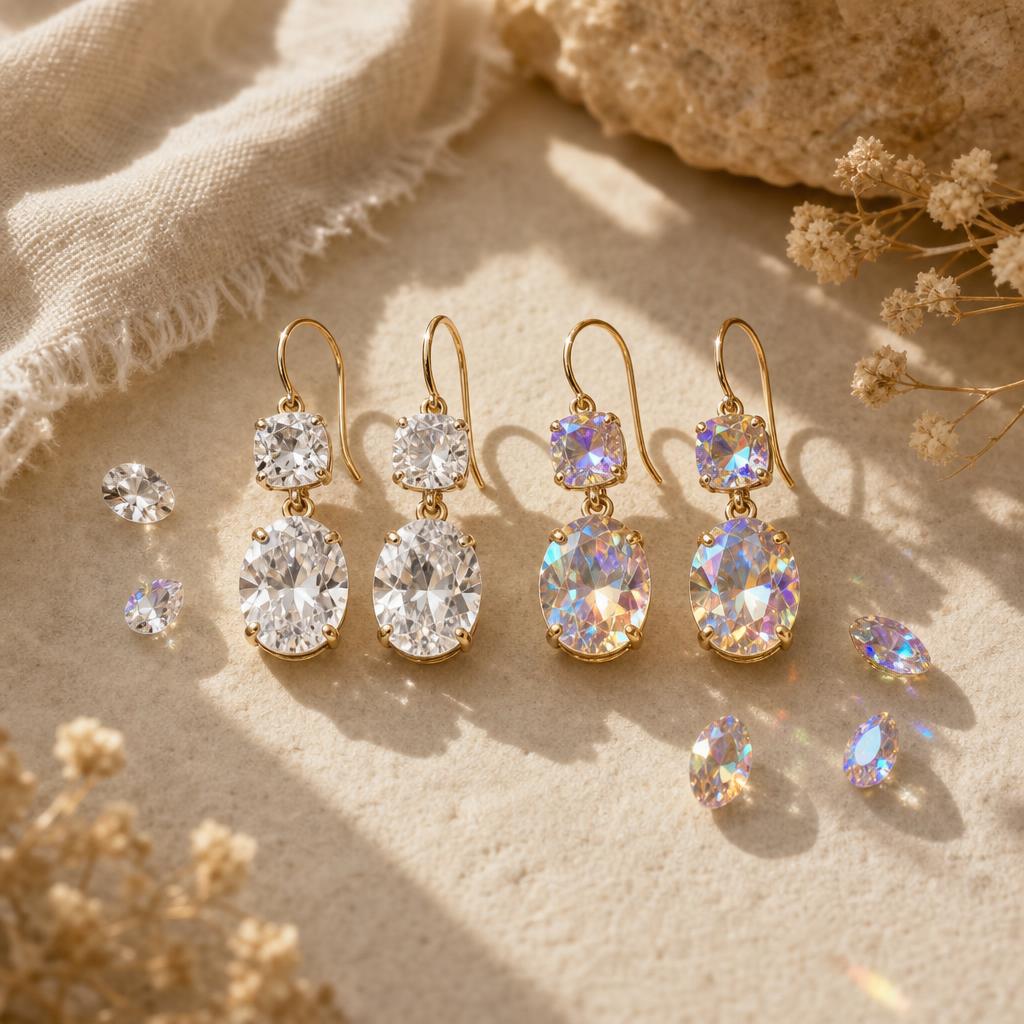
That difference in composition changes how light behaves inside each stone. Moissanite bends light more aggressively than diamond, which means it throws off more rainbow-colored flash — what jewelers call "fire" — under direct light. Diamond's brilliance reads whiter and more restrained by comparison. Neither is more "correct." One reads as a sharper flash of color, the other as a cooler, steadier sparkle. Preference here is genuinely just preference.
Price philosophy matters here too, even without naming numbers. The old rule said a stone's worth was tied to its rarity and its markup — that a "real" gemstone had to cost a fortune to mean anything. Moissanite quietly rejects that rule. It's not a discount version of anything; it's a stone that happens to deliver more visible sparkle per carat than almost any other gemstone on the market, priced the way it is because lab-grown production is efficient, not because the stone itself is lesser. Choosing it isn't a compromise — it's declining to pay a premium that was never really about the gemstone in the first place.
| Trait | Moissanite | Signature Simulated Diamond |
|---|---|---|
| Composition | Silicon carbide | Cubic zirconia, precision-cut |
| Hardness (Mohs scale) | 9.25–9.5 | 8–8.5 |
| Light behavior | Higher fire, colorful flashes | Bright, classic white brilliance |
| Everyday durability | Excellent — resists scratching | Excellent — resists scratching |
| Setting | 925 sterling silver | 925 sterling silver |
Both hold up to daily wear far better than most people assume. Neither one is precious in the fragile sense — you can wear either pair through a full week without babying it.
Is Moissanite a Diamond?
No — and it was never trying to be one. Moissanite has its own name, its own crystal structure, and its own place in fine jewelry that predates most of the marketing built around it. It isn't a diamond wearing a costume; it's a distinct gemstone that happens to compete extremely well on brilliance. That distinction matters, because it means you're not settling for a compromise when you choose it — you're choosing a stone with its own credentials.
What that means at the ear: moissanite passes a standard diamond tester, because thermal diamond testers measure heat conductivity, and moissanite conducts heat almost identically to diamond. No jeweler doing a quick check is going to flag it. What they'll notice, if anything, is how much fire it throws — which usually reads as impressive, not suspicious.

The Éclat Moissanite Stud Earrings
A classic 6-prong solitaire setting built to let round-cut moissanite do the talking — the stud pair to reach for when you want maximum sparkle with zero effort.
Shop The Éclat →Studs, Hoops, or Both? Choosing Your Silhouette
Once you've settled on a stone, the second decision is shape. Studs are the safer everyday choice — they sit close to the ear, work under a blazer or a swimsuit strap alike, and never compete with whatever else you're wearing. A well-cut solitaire pair genuinely does more heavy lifting in a jewelry rotation than almost anything else you own, because it goes with everything and asks nothing of you.
Hoops are the more expressive option. Moissanite hoop earrings in a pavé huggie setting give you continuous sparkle around the whole curve of the ear rather than one fixed point of light — more movement, more presence, a slightly bolder statement without tipping into "statement earring" territory. Neither shape is more correct than the other; a lot of women end up keeping one of each in rotation, switching depending on whether the day calls for quiet or a little more presence.
Caring for Moissanite, Day to Day
Moissanite doesn't ask for much. A warm-water rinse with a drop of mild dish soap and a soft toothbrush, done every few weeks, keeps the facets clear of the lotion and skincare residue that dulls sparkle over time. Store each pair separately rather than tossed loose in a drawer — not because moissanite scratches easily, but because letting stones knock against harder metal edges is a bad habit worth avoiding regardless of what you're wearing. Beyond that, there's genuinely nothing special to do. No soaking rituals, no jeweler visits, no annual maintenance.
Worth knowing: Moissanite is rated 9.25–9.5 on the Mohs hardness scale, just below diamond's 10 — durable enough that neither studs nor hoops need special-occasion treatment. Wear them to the gym, on a flight, through a full workday. They're built for it.

The Vivara Moissanite Huggie Hoops
Round-cut moissanite set in a sleek pavé huggie silhouette — the hoop that reads polished at your desk and just as right out at dinner.
Shop The Vivara →Why Choose Our Signature Simulated Diamond Instead
If moissanite's colorful fire isn't the look you're after, our Signature Simulated Diamond earrings are cut for a cooler, whiter brilliance closer to what you'd expect from a mined diamond — the classic sparkle, without the classic markup. The Ophelia and Stella studs are both cut to that standard: indistinguishable from a diamond to the eye, and built to pass the same scrutiny.

The Astraea Stud Earrings
Six-pointed, 2.0-carat round-cut stones set for maximum brilliance — the pair that does the most work when you want to feel dressed without trying.
Shop The Astraea →Which One Should You Actually Buy?
The moissanite vs. diamond decision doesn't actually need to be a hard one. If you want maximum fire and a slightly warmer, more colorful sparkle, go with moissanite. If you want the cool, classic white brilliance people associate with a traditional diamond, go with our Signature Simulated Diamond. Both are set in the same 925 sterling silver, both are nickel-free and built for sensitive ears, and both are priced so you can own more than one pair without a second thought.
If you're still torn, think about your existing jewelry box rather than the stone in isolation. Someone who already leans warm-toned — gold plating, amber accents, warmer undertones in makeup and clothing — often finds moissanite's fire feels more at home. Someone whose wardrobe skews cool and minimal tends to gravitate toward the steadier white brilliance of a simulated diamond. Neither instinct is wrong; it's just about what actually looks right against the rest of what you already wear. This isn't a decision with a bad answer. It's a decision about which kind of sparkle you want catching the light today.
Quick Takeaways
- Moissanite is a distinct gemstone (silicon carbide) — not a diamond, and not trying to be one.
- Moissanite throws more colorful "fire"; simulated diamond gives a cooler, whiter classic brilliance.
- Moissanite passes a standard diamond tester and rates 9.25–9.5 on the Mohs hardness scale.
- Studs work for everyday wear; hoops bring more movement and presence.
- Both options are set in 925 sterling silver and built for daily wear.
Frequently Asked Questions
Will moissanite pass a diamond tester?
Yes. Standard thermal diamond testers measure how quickly a stone conducts heat, and moissanite conducts heat at a nearly identical rate to diamond — which is why it registers as "diamond" on the vast majority of testers jewelers use. It isn't slipping past anything; it's simply a stone with genuinely comparable thermal properties.
Is moissanite considered fake?
No. Moissanite is a real, named gemstone with its own chemical identity — silicon carbide — not a diamond imitation. Fake implies it's pretending to be something it isn't. Moissanite has never needed to pretend; it earns its sparkle on its own terms.
Can moissanite earrings be worn every day?
Yes. At 9.25–9.5 on the Mohs hardness scale, moissanite is second only to diamond in durability — well above sapphire, and far above cubic zirconia or glass. Sleep in them, shower in them, wear them through a full week without a second thought.
Is moissanite worth it?
If what you want is maximum sparkle for the price, yes — moissanite delivers more fire per carat than almost any other stone on the market, at a fraction of what a comparable diamond would cost. The value case isn't complicated: you get more visible brilliance, not less, and there's no premium being paid for scarcity that has nothing to do with how the stone actually looks.
Do stud earrings suit everyday work wear?
Yes — a well-cut solitaire stud is one of the most versatile pieces you can own, in either stone. It reads as polished in a meeting, doesn't overwhelm a video call, and pairs with anything from a blazer to a weekend T-shirt without looking out of place either direction. If you only own one pair of earrings, this is the shape to own it in.
However you land — moissanite's colorful fire or our Signature Simulated Diamond's classic brilliance — the point is the same: you're choosing a stone on its own merits, not settling for one because the other option was priced out of reach. That's the whole idea.


