

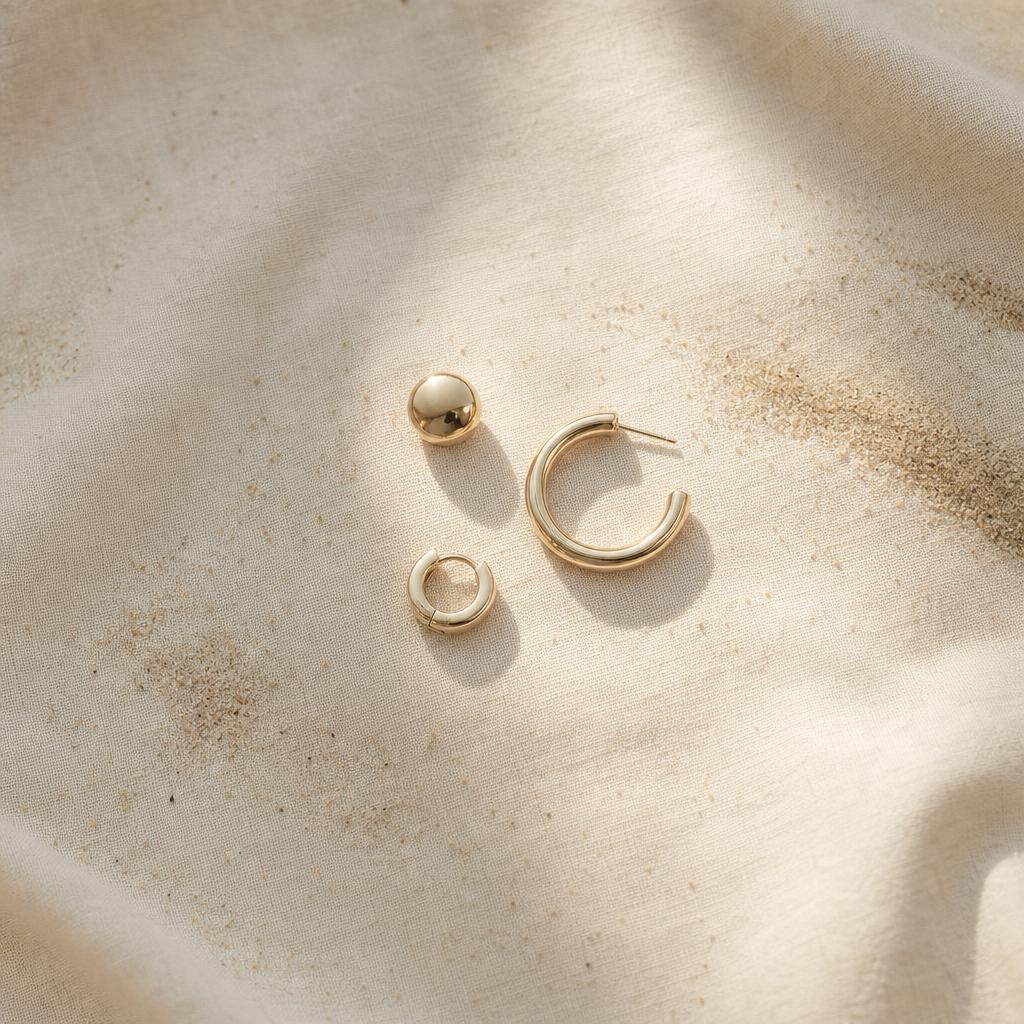
Stud, Hoop, or Huggie: The Types of Earrings You'll Actually Wear
You already know a stud from a hoop when you see one. What gets fuzzy is the earring in between — the small circle that sits so close to your lobe it barely reads as a hoop at all. That one has a name, and knowing it isn't optional vocabulary if you shop for earrings online: get it wrong and you'll order something that photographs beautifully on someone else's ear and sits completely wrong on yours.
Before we get into what separates them, here's a quick look at how the three styles actually show up across a real collection — the kind you build one purchase at a time, not the kind you buy all at once.


The Stud: The Earring That Disappears Into Your Ear
A stud is the simplest construction there is — a stone or shape mounted on a straight post that goes through the lobe and locks in place with a back. Nothing hangs, nothing swings, nothing moves when you turn your head. That's the entire appeal. A stud sits flush against the lobe and reads as part of your face rather than an accessory competing with it, which is exactly why it's the style most women reach for on a day they don't want to think about their earrings at all.
Within "stud," there's more range than the word suggests. A solitaire stud is a single stone on a plain setting — clean, understated, done. A halo stud surrounds that center stone with a ring of smaller accent stones, which makes it look larger without changing the actual carat weight. There are also cluster studs, built from several smaller stones grouped together instead of one dominant center — a different kind of sparkle, more textured than a single point of light. Knowing these types of stud earrings apart matters mostly when you're comparing two products that look similar in a thumbnail but read completely differently once they're actually on.
The Hoop: A Continuous Circle, Front to Back
A true hoop is a continuous piece of metal that starts at the front of the lobe, curves around, and re-enters at the back — a full circle, or close to it. Hoops are defined by that unbroken sweep, and by how much they move: even a modest hoop catches light and motion in a way a stud never will. That's the trade-off buyers are actually weighing when they compare the two, more than size — a hoop introduces movement to your look, a stud doesn't.
The Huggie: The Small Hoop That "Hugs" the Lobe
This is the one that trips people up. A huggie is technically a small hoop — but instead of swinging free, it wraps tightly against the lobe, following its curve so closely that it barely extends past the ear at all. The name says it plainly: it hugs. Where a standard hoop dangles and moves with you, a huggie stays put, which is why so many women who love the look of a hoop but not the feel of one gravitate toward huggie earrings instead. Less catching on scarves and phone calls, same continuous-circle silhouette, a completely different everyday experience.
If you've ever tried to tell huggie earrings and hoop earrings apart from a product photo alone, this is the actual distinction to look for: does the earring sit flush against the lobe, or does it hang below it with room to swing? Flush and close is a huggie. Hanging and mobile is a hoop. Everything else — metal color, stone, size — is secondary to that one structural fact.

The Stella Stud Earrings
A round-cut solitaire in 925 sterling silver — the kind of stud that's meant to disappear into every outfit rather than announce itself.
Shop The Stella Studs →How to Actually Tell Them Apart When You're Shopping Online
Product photos flatten a lot of detail, so here's the quickest way to sort a listing into the right category before you buy:
- Does it have a visible post and back? That's a stud, regardless of what the center design looks like.
- Does it form a full circle and hang below the lobe? That's a hoop.
- Does it form a circle but sit flush, close to the ear, with almost no drop? That's a huggie.
Worth knowing: Some listings use "huggie hoop" as a single compound name — that's not a separate fourth category, just a more precise way of saying "a hoop-shaped earring built to hug the lobe" rather than swing.
Material matters here too, and it's worth checking before size or shape. Every stud, hoop, and huggie in the Gemiros line is set in 925 sterling silver, which is what actually determines how an earring wears over months of daily use — not just how it looks in a single photo.

The Isabella Stud Earrings
A pear-cut center stone framed in a halo setting — proof that a stud can carry real drama without ever leaving the lobe.
Shop The Isabella Studs →Which One Actually Fits Your Day
None of these styles is objectively "better" — they're built for different amounts of movement and attention, and the right one depends on what your day actually involves, not what looks best in a single photo.
Studs are the default for anyone whose hands are near their face all day — calls, meetings, a job that has you talking with your hands. They don't catch on anything, don't need adjusting, and read as finished the moment they're in. Huggies are the middle ground: enough visible metal to feel like a real earring choice, without the swing of a true hoop getting in the way of a scarf, a phone, or a workout. Hoops are the ones you choose on purpose, for the days you want the earring to actually move — a night out, a photo, an outfit that's otherwise simple enough to let a little motion carry it.
Sensitive ears change the calculus slightly, since irritation has more to do with metal purity than with which of these three shapes you pick. If reactive ears have kept you in a narrow rotation of "safe" earrings, it's worth reading the difference between what's actually hypoallergenic and what's just labeled that way — the shape you love shouldn't be the thing you have to give up.
Building a Small Collection, Not Just Buying One Pair
Most women don't end up owning one type of earring — they end up with a rotation, and the three types of earrings covered here are exactly the range that rotation should cover. A stud for the days you want to disappear into your outfit. A huggie for the days you want a little more presence without extra effort. A hoop for the days you're dressing on purpose. Buying with that rotation in mind, rather than one style at a time, is usually what turns a jewelry box into something you actually reach into instead of one you keep adding to without using.
Quick Takeaways
- A stud has a post and back and sits flush against the lobe with no movement.
- A true hoop forms a continuous circle and hangs below the lobe, moving as you do.
- A huggie is a small hoop built to hug the lobe closely instead of swinging free.
- "Huggie hoop" isn't a fourth category — it's just a more precise name for a close-fitting hoop.
- Material (like 925 sterling silver) affects daily wear more than shape does.
Frequently Asked Questions
What's the difference between huggie and hoop earrings?
A hoop hangs below the earlobe and swings freely as you move. A huggie is technically still a hoop shape, but it's built to sit flush and close against the lobe instead — far less movement, same continuous-circle silhouette.
What is a stud earring, exactly?
A stud is any earring style built on a straight post that passes through the lobe and secures with a back. The design on the front — a single stone, a halo, a cluster — can vary widely, but the flush, no-movement construction is what makes it a stud.
Are huggie earrings still in style?
Yes — huggies have moved from trend to staple. Their appeal isn't seasonal: they offer the visual interest of a hoop with the comfort and security of a smaller, closer-fitting shape, which is why they've held steady in daily rotations rather than fading in and out.
Can you wear huggies all the time, including while you sleep?
Their close, low-profile fit is exactly why many women treat huggies as their everyday default — there's little hardware to catch on a pillow or scarf compared to a swinging hoop. As with any earring, comfort during sleep still comes down to the individual piece and your own ears.
Do studs, hoops, and huggies all work for first ear piercings?
Studs are typically the easiest starting point for a fresh piercing, since the flush, stationary fit means less contact and movement while healing. Hoops and huggies are better saved for once a piercing has fully settled.
The names matter less than the fit — but once you can tell a stud from a hoop from a huggie at a glance, shopping for earrings online stops being a guessing game. You'll know exactly what you're ordering before it ever arrives, which is really the whole point of learning the types of earrings in the first place.


