

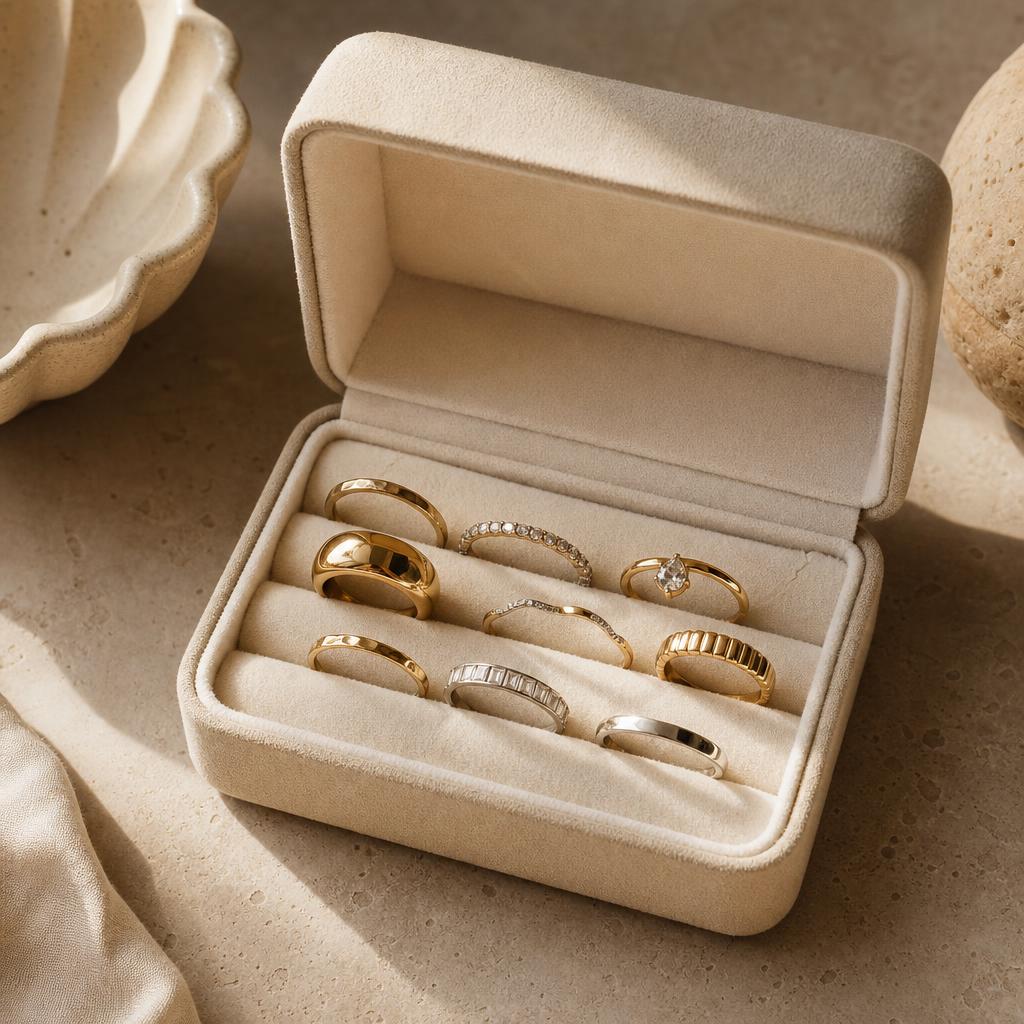
The Tenth Ring: What Changes Once You Have a Real Ring Collection
Your first ring was about a moment. Somebody proposed, or you finally hit "buy" on the one you'd been staring at for months, or you decided you were done waiting for an occasion to feel special. Whatever the reason, ring one arrives with a story attached. Ring ten does not. By the time you're reaching for a tenth ring, you're not chasing a moment anymore — you're building a ring collection, and that's a completely different exercise.
The taste shift is real, and it's worth naming before you buy anything else. Here's what actually changes once you're past the counting stage, and a few pieces worth having on hand while you figure it out.


Ring One Is an Event. Ring Ten Is a Point of View.
Nobody agonizes over their first ring the way they think they will. You want it to look expensive, you want it to catch light, you want people to notice. That's not shallow — it's just where you start. The first ring is proof of concept: proof that you can have the look without the markup, proof that nobody can tell the difference, proof that the whole "you need to spend three months' salary" idea was always just a rule nobody actually asked for.
Somewhere around ring four or five, the questions change. You stop asking "does this look expensive" and start asking "does this look like me." That's the real turning point, and it's the one nobody warns you about when you buy your first piece.
What Actually Changes Once You Have a Ring Collection
It isn't just a drawer with more rings in it. It's a set of decisions that start talking to each other. A hidden halo you bought for drama has to sit next to a plain band you bought for rest days. A vintage-inspired piece with a twisted shank has to make sense next to something sharp and modern. Once you're choosing pieces that need to coexist, you're not shopping for a single ring anymore — you're editing a wardrobe, and editing requires a completely different kind of confidence than the first purchase ever did.
That confidence tends to show up as restraint, not excess. The woman on her tenth ring is not buying the biggest stone in the catalog because she can. She's buying the setting that's actually missing from her rotation — a bezel because everything else is pavé, a solitaire because everything else has a halo, a stacking band because she finally admitted she wears three rings at once and none of them are speaking to each other. Restraint, here, doesn't mean playing it safe. It means every new piece has to earn its place instead of just adding volume.
There's also a quieter shift happening underneath the styling logic: permission. The first ring often comes with some version of an occasion attached — an anniversary, a promotion, a birthday that felt like it deserved marking. By ring ten, the occasion has stopped mattering. You don't need a reason anymore. You see a setting that fills a gap in your collection, and you buy it on a Tuesday for no reason beyond wanting it, which is exactly the point.

The Stella Ring
The plain round solitaire that anchors an entire collection — the ring you reach for when everything else in the drawer feels like too much for the day.
Shop The Stella Ring →The Setting You No Longer Need to Justify
Early on, every ring purchase comes with a small internal defense. This one looks expensive enough. This one won't read as trying too hard. This one will pass. That defensiveness fades once you've worn a few pieces daily and realized nobody has ever once asked to inspect your jewelry. The 925 sterling silver holds up. The moissanite and simulated diamonds are indistinguishable from the real thing to the naked eye, and they pass diamond testers — that part was never actually in question, even if it felt like it the first time.
So the tenth ring gets bought for a completely different reason than the first one. Not to prove something, but because a cushion-cut hidden halo is the one silhouette missing from an otherwise round-and-oval lineup, and that gap has been quietly bothering you for months. It's a small, specific kind of satisfaction — closing a gap nobody else would even notice — and it's a satisfaction the first ring you ever bought was never built to give you, because the first ring wasn't answering a question. It was making a statement.
There's a practical side to this too, one that rarely gets talked about outright: durability stops being a question mark somewhere around ring five or six. The sterling silver base doesn't discolor skin, the plating holds up under daily wear, and a full year of warranty coverage means the "will it hold up" fear that shaped the first purchase has, by the tenth, quietly resolved itself. What's left is just taste — which settings you reach for, which ones sit in the box, and which ones you somehow always come back to no matter what else is in rotation.

The Duchess Ring
A cushion-cut center with a hidden halo underneath — the confident, later-stage purchase for a collection that's already covered the basics.
Shop The Duchess Ring →Worth knowing: The Ophelia Ring is routinely mistaken for a piece that costs $15,000 or higher. That's not an exaggeration built for a caption — it's the actual reaction it gets, hidden halo and all, at a fraction of that number.
The Four Rings Every Collection Actually Needs
Ask ten women what belongs in a proper collection and you'll get ten different answers, but the honest shortlist tends to repeat itself: a hero piece with real presence (your Ophelia or your Duchess), a quiet daily solitaire you don't think twice about wearing to the gym, a stacking band or two that can flex between minimal and layered, and one piece that's purely emotional — bought for no practical reason other than you loved it. That fourth ring is the one that makes the whole thing feel like yours instead of a checklist someone else wrote.
None of this has to happen in order, and it definitely doesn't have to happen on someone else's timeline. The whole point of buying for yourself is that there's no registry, no waiting for permission, no explaining the purchase to anyone. A partner buying a gift can follow a checklist. A woman building her own collection is allowed to buy out of order, skip the "expected" pieces entirely, and land somewhere none of the guides predicted — because the only opinion that has to agree with the final result is hers.
How to Stack Without It Looking Like an Accident
Stacking is where most collections either come together or start to look cluttered, and the difference usually comes down to restraint rather than rules. A stack that works has a hierarchy — one dominant piece, one or two supporting bands, and enough breathing room between stones that the eye actually knows where to land. A stack that doesn't work is just three loud rings competing for the same finger.
✦ Pro tip: Keep metal tones consistent within a single stack — mixing platinum-finish and rose gold on the same finger reads as unintentional, not eclectic. Save the metal mixing for different hands.
Width matters more than most people expect. A wide statement band next to an equally wide eternity ring will fight for space and neither one wins. Pair a wide hero piece with genuinely thin stacking bands, like the Everlasting, and the whole hand reads as deliberate instead of crowded.
Quick Takeaways
- Ring one proves the look. Ring ten refines the point of view.
- Buy for the gap in your collection, not for the biggest stone available.
- A real collection needs a hero piece, a daily solitaire, a stacking band, and one purely emotional buy.
- Keep metal tones consistent within a single stack, and pair wide pieces with genuinely thin ones.
Frequently Asked Questions
How many rings is actually too many to wear at once?
There's no fixed number, but most stylists land somewhere around three to five rings across both hands before a look tips from intentional into cluttered. The tell isn't the count — it's whether each piece still reads as a distinct choice or the whole hand blurs into noise.
What are the "four rings" every woman is supposed to own?
The shorthand varies, but the version that actually holds up is: a hero piece with real presence, a quiet solitaire for every day, a stacking band that flexes between minimal and layered, and one ring bought purely because you loved it. Together they cover the full range a real collection needs to function.
Are stacked rings still in style, or has the trend moved on?
Yes — stacking has stayed a steady favorite rather than a passing trend, largely because it lets one collection do the work of several: minimal on a Tuesday, layered for an event, without buying anything new.
What's the real rule for stacking rings without it looking messy?
Pick one dominant piece and let everything else support it. Keep the supporting bands thinner than the hero ring, match your metal tones within the stack, and stop before the eye loses track of where the hand actually ends and the jewelry begins.
A ring collection built well doesn't announce itself piece by piece — it reads as one coherent decision, even though it took years and a dozen small purchases to get there. The tenth ring isn't proof you've spent more. It's proof you finally know exactly what you like, and you stopped needing anyone else's opinion on it a while ago.


