

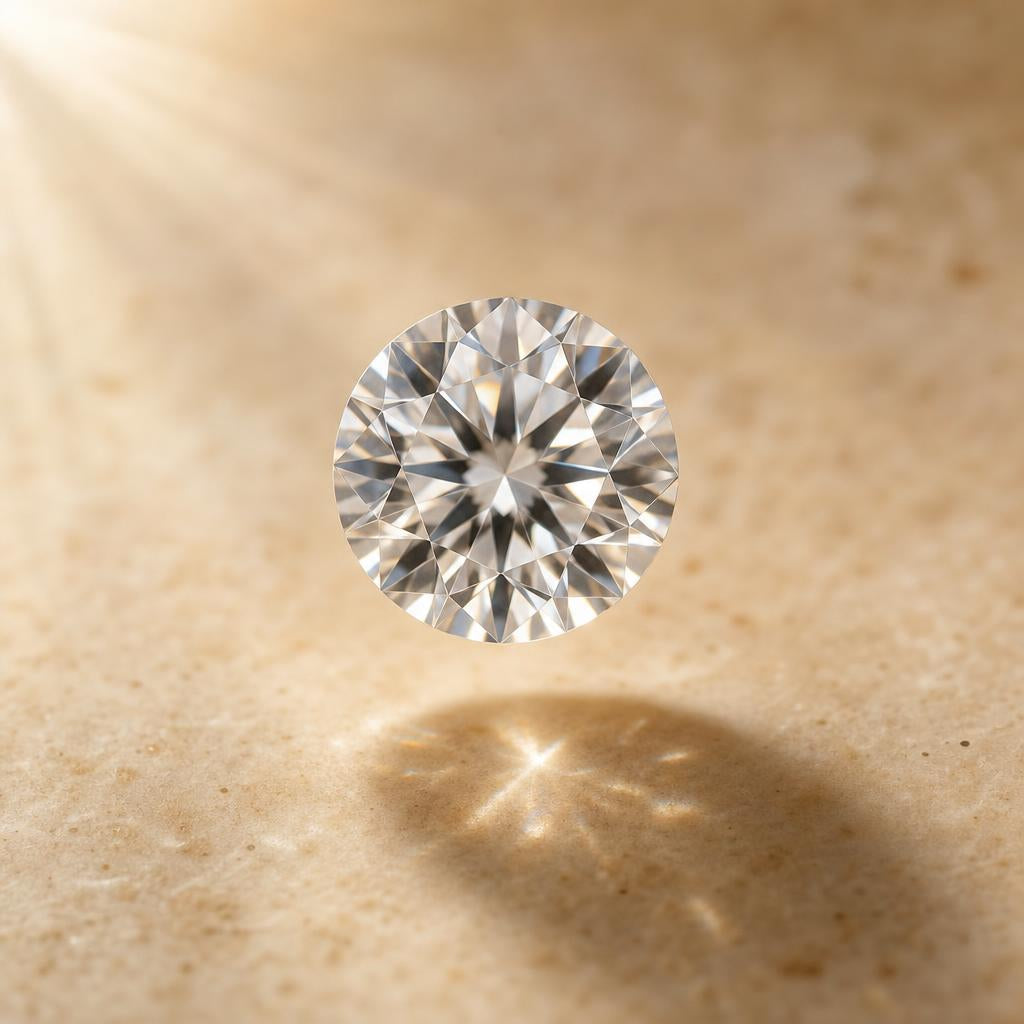
Tension Settings Explained: The Floating Stone Look, and What to Know Before You Buy
There's a particular kind of ring that stops people mid-sentence: the stone looks like it's floating, held by nothing but the metal's own tension, light pouring through it from every angle. It's called a tension setting, and it's one of the most photographed engagement ring styles on Pinterest — right before it becomes one of the most Googled "should I actually buy this?" questions in jewelry.
Here's the honest version of what a tension setting actually is, what it takes to live with one day to day, and why the settings Gemiros builds around instead give you nearly the same visual effect without asking you to accept the trade-offs.


What a tension setting actually is
A tension setting holds its center stone with pressure alone. There's no basket, no prongs reaching up over the stone, no metal cradling it from below — just two ends of a specially engineered band pressing inward on the stone's girdle with enormous, precisely calibrated force. The result is that signature "floating" look: a stone suspended in open air, catching light from angles a traditional setting would block.
It's a genuinely clever piece of engineering, and it photographs beautifully. It's also a setting built around a set of compromises most retailers mention only in passing, if at all.
What it takes to actually own one
The band has to be thick — usually at least 2 to 2.5 millimeters of solid metal — because that thickness is what generates and holds the pressure keeping the stone in place. A dainty, low-profile band simply isn't structurally possible in a true tension setting, no matter how the design is styled.
Resizing is the bigger issue. Every tension setting is calibrated to one exact size — the pressure holding the stone is engineered for that specific circumference. Change the size, and you change the tension. Most jewelers won't touch a true tension ring for resizing at all; the ones who will typically have to remake the setting from scratch rather than simply stretch or shrink the band the way they would with a prong or halo ring.
Worth knowing: Because so much of the stone's edge sits exposed with nothing bridging or protecting it, a hard knock against a countertop or doorframe carries more risk in a tension setting than in a setting where the girdle is tucked behind metal.
None of this makes a tension setting a bad piece of jewelry. It makes it a specialized one — closer to a fashion statement you commit to as-is than a ring built to move with you through resizing, daily wear, and whatever the next decade brings to your hands. That distinction matters more than most retailers are willing to say out loud, mostly because it's easier to sell the floating-stone photo than to explain what happens five years in.
Tension setting vs. the settings built for daily life
Laid out side by side, the trade-off becomes easy to see. A tension setting wins on novelty. A hidden halo or solitaire wins on almost everything you'll actually experience after the first month of wearing it.
| Factor | Tension Setting | Hidden Halo / Solitaire |
|---|---|---|
| Resizing | Rarely possible without remaking the mount | Standard resize, same day or two |
| Band thickness | Must stay thick (2mm+) to hold pressure | Can be slim or substantial, by design choice |
| Stone protection | Girdle fully exposed on both sides | Girdle partially or fully shielded |
| Light performance | Maximum — nothing blocks the stone | Near-maximum, with hidden halo adding extra sparkle |
| Everyday durability | Vulnerable to impact chipping or loosening | Built for daily wear, gym bags, and doorframes |
If you already love the floating-stone look
Some readers already know a tension setting is exactly what they want, trade-offs and all — and that's a legitimate choice for someone who's weighed it with clear eyes. If that's you, a few things are worth confirming before you buy: ask directly how the stone is calibrated to the band, whether the jeweler who made it will still be reachable in ten years for adjustments, and what happens if the stone ever needs re-tensioning. A setting this specialized is only as good as the person who built it and their ability to service it later.
✦ Pro tip: If it's the visual effect you're after rather than the mechanism itself, ask to see a hidden halo ring under the same lighting as a tension setting. Most people are surprised how close the two read from a normal viewing distance — one just happens to also survive a decade of actual wear.
Why Gemiros builds around different settings instead
The visual promise of a tension setting — maximum light, minimum visible metal, a stone that seems to hover — is a real and worthwhile thing to want in a ring. It's just not the only way to get it. A hidden halo does something remarkably similar: a secondary row of pavé sits tucked beneath the center stone, invisible from above, doing the work of amplifying size and brilliance without a single visible prong competing for attention. From the front, the center stone reads as pure, floating sparkle. From the side, it's fully protected.

Ophelia
An oval center stone set in a hidden halo with a 4-prong mount — engineered for the same light-maximizing effect a tension setting chases, minus the resizing ceiling. Indistinguishable from a diamond, and built to be resized as your life changes, not around it.
Shop Ophelia →A well-cut 4-prong solitaire earns a similar case. The prongs are slim by design, angled to grip the stone at its strongest points rather than smother it, which means far more of the stone's surface stays exposed to light than most people assume. It's the setting jewelers reach for when durability actually matters — because it can be resized in an afternoon, not remade from scratch.

Lumière
A 4-carat round brilliant simulated diamond in a refined 4-prong solitaire — the setting built for everyday wear, not just the photograph. Passes diamond testers. No one will know it isn't a mined stone, including your jeweler.
Shop Lumière →There's also a material argument worth being direct about. True tension settings depend on the center stone being exceptionally hard — traditionally a mined diamond, because the pressure at the contact points is intense enough that a softer stone risks chipping over time. Gemiros' moissanite centers score a 9.25 on the Mohs scale, second only to diamond itself, which is part of why they hold up beautifully in secure prong and halo settings. It's simply not the same engineering problem a true tension mount is solving for, and there's no reason to inherit a fragile setting to prove a point about a stone that's already durable.
The quiet upside no one advertises
925 sterling silver, rhodium or 18k gold plated, hypoallergenic and nickel-free — the base every Gemiros ring is built on doesn't ask you to think about any of this. A hidden halo or a well-built solitaire will still be sitting comfortably on your hand a decade from now, unbothered by a knock against a doorframe, ready to be resized the year your ring finger changes. That's not a compromise. It's the setting doing exactly what it's supposed to do, for as long as you wear it.
Quick Takeaways
- A tension setting holds its stone with calibrated metal pressure alone — no prongs, no basket, no metal underneath.
- True tension rings are difficult or impossible to resize without remaking the setting entirely.
- The band has to stay thick (2mm+) to generate enough pressure, and the exposed girdle carries more impact risk.
- A hidden halo or 4-prong solitaire delivers a similar light-maximizing, low-metal look with none of those trade-offs.
- Moissanite's 9.25 Mohs hardness holds up beautifully in secure settings — there's no need to inherit a fragile mount to prove the stone can handle it.
Frequently Asked Questions
What is a tension setting on a ring?
A tension setting holds a center stone using the calibrated pressure of the metal band itself, rather than prongs or a bezel. The band's two ends squeeze the stone's girdle from opposite sides with enough force to hold it securely, creating the appearance that the stone is floating in open air.
Are tension set rings safe to wear every day?
A well-engineered tension setting can hold a stone securely under normal conditions. The bigger everyday concern is the exposed girdle — because so little of the stone is covered by metal, a sharp knock against a hard surface carries more risk of chipping or loosening the stone than it would in a setting with fuller coverage.
Can a tension set ring be resized?
Rarely, and almost never easily. The pressure holding the stone in place is calibrated to one specific band circumference, so changing the size changes the tension. Most jewelers who work on tension settings at all will remake the mount rather than adjust the existing one.
What's the most secure setting for an engagement ring?
Settings that fully surround or partially cover the stone's girdle — like a halo, hidden halo, or a well-built 4- or 6-prong solitaire — tend to offer the most day-to-day security, since they distribute protection around more of the stone's surface and can be resized without rebuilding the entire setting.
Does a hidden halo really look like a tension setting?
Not identically, but the visual goal overlaps more than most people expect. Both settings are designed to maximize how much of the center stone reads as pure sparkle rather than metal. A hidden halo achieves it by tucking a secondary row of pavé beneath the stone instead of removing the metal supporting it entirely — so from a normal viewing distance, the center stone appears to float in a very similar way.
The floating-stone look is worth wanting. It just doesn't require signing up for a ring you can never resize. A hidden halo or a properly built solitaire gives you the same maximum-light effect, holds up to the life you actually live in it, and grows with you — which, in the end, is the more intelligent trade to make.


