

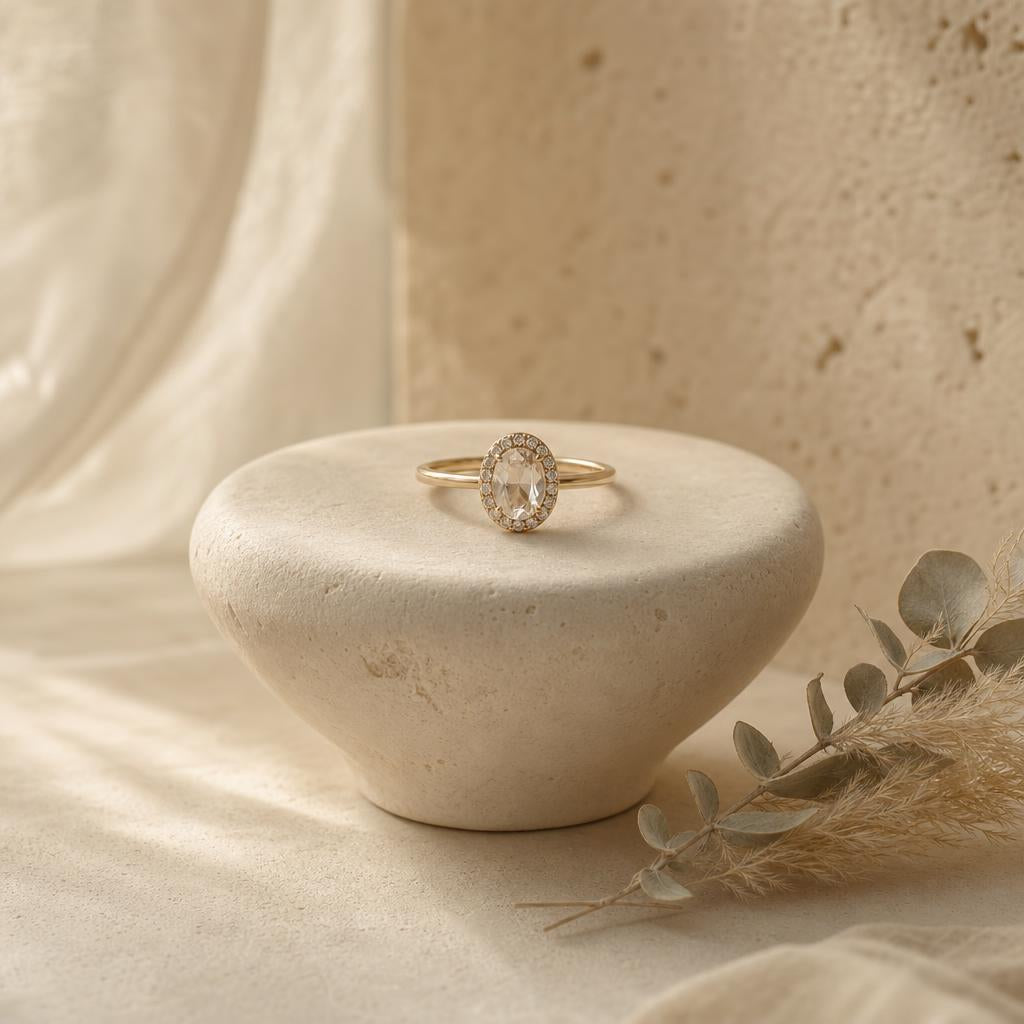
Sustainable Jewelry and Simulated Stones: Why Ethical Buying Is Less Complicated Than You Think
Somewhere along the way, "ethical jewelry" turned into a research project — mining certifications, carbon footprints, supply chain audits, a dozen open browser tabs before you'd even picked a stone shape. It doesn't have to be that complicated. The most straightforward ethical decision in fine jewelry today isn't a certification you have to verify. It's a stone you don't have to mine at all.
Simulated diamonds sidestep almost every question mined stones raise — where it came from, who dug it up, what it cost the ground to get it out — while still delivering the fire and clarity a diamond is supposed to have. Before we get into why that matters, here's a look at four pieces that show the range of what a sterling silver, simulated-diamond collection can actually look like.


Why "ethical jewelry" got so complicated
Ask ten people what makes a piece of jewelry ethical and you'll get ten different answers — conflict-free certification, small-batch production, recycled metal, fair labor practices, carbon offsets. All of it matters. None of it is simple to verify from a product listing. Mined diamond supply chains pass through so many hands between the ground and the display case that even the retailers selling them often can't tell you with certainty everything that happened along the way.
That opacity is exactly what pushed a lot of buyers toward simulated diamond rings in the first place — not as a downgrade, but as a way to skip the whole question. A stone that was never mined doesn't need a certificate proving it wasn't mined unethically. The ethics are built into the material itself.
What simulated stones actually solve
A simulated diamond — cubic zirconia or moissanite, depending on the piece — is grown or manufactured rather than extracted. There's no excavation, no displaced earth, no question of which mine it passed through or under what labor conditions. It's the most direct way to remove the two things that make mined-diamond ethics so hard to nail down: origin and extraction impact.
Worth knowing: "Simulated" and "lab-grown" aren't the same thing. Lab-grown diamonds are chemically identical to mined diamonds but grown in a controlled setting — they still require significant energy input. Simulated stones like cubic zirconia and moissanite are different materials engineered to mimic a diamond's optical properties, generally with a smaller footprint and a meaningfully lower price.
That distinction matters because it's the difference between "still mining, just differently" and "not mining at all." For buyers who want the second option, simulated stones are the more direct route.

The Échelon Ring
A sharp asscher-cut solitaire with deeply layered step cuts — a quiet way to wear a bolder stone without a single mined carat behind it.
Shop The Échelon Ring →The real footprint of a diamond ring
It's worth being specific about what mining a single carat of diamond typically involves: tons of earth moved, water diverted, and — for many operations — a supply chain that's genuinely difficult to trace end to end, no matter what the paperwork says. None of that shows up in a product photo. It shows up months or years later, if a buyer goes looking.
| Consideration | Mined diamond | Simulated stone |
|---|---|---|
| Extraction impact | Significant — land, water, energy | None — nothing is mined |
| Supply chain traceability | Difficult to verify fully | Straightforward — manufactured, not sourced |
| Visual brilliance | High | Comparable, especially in moissanite |
| Typical price point | Thousands per carat | Well under $200 for a full ring |
None of this is an argument that mined diamonds are indefensible — plenty of buyers have real reasons to want one. It's simply that if the goal is to remove ethical guesswork from the equation entirely, a stone that was never extracted is the cleanest way to do it. It's also, not incidentally, the reason more women are choosing simulated diamonds and not apologising for it.
What "sustainable" means beyond the stone
The stone is only part of the picture. The metal underneath it matters just as much, and it's where a lot of jewelry — including plenty marketed as "eco-friendly" — quietly falls short. Thin gold plating over base metal wears through in months, which means the ring gets replaced, which means more resources spent making a second ring to do the first one's job.
A ring built on solid 925 sterling silver with rhodium or 18k gold plating, done properly, holds up under daily wear for years rather than months. Buying one durable piece instead of replacing a flimsy one three times over is its own quiet form of sustainability — less packaging, less shipping, less metal mined or refined in total, even if no single purchase looks dramatic on its own.
✦ Pro tip: If you're evaluating any ring for how long it'll actually last, check the base metal and plating type before the carat weight. A well-plated sterling silver ring worn daily will usually outlast a poorly made gold-plated one by years.
Building an intentional collection instead of buying more
There's a second layer to sustainable jewelry that has nothing to do with the stone: how much of it you actually buy, and why. A single well-made ring worn for years does less environmental and financial damage than five trend pieces bought and abandoned within a season. This is less about restriction and more about intention — choosing pieces you'll actually reach for, rather than accumulating jewelry that spends most of its life in a drawer.
That's a big part of what's driving the shift toward simulated stones among buyers who are otherwise unbothered by price. It's not that $169 is all they can spend — it's that spending less per piece means each purchase can be more deliberate, more varied, more suited to an actual outfit or mood, without the psychological weight of a four-figure decision hanging over it. For more on that shift, how to build a jewelry wardrobe that makes sense lays out the practical side of it.

The Regent Ring
A princess-cut center wrapped in a halo with intricate milgrain edges — the kind of piece that reads as considered rather than impulsive.
Shop The Regent Ring →Choosing pieces built to actually last
Longevity isn't just a marketing word — it's the single biggest lever any buyer has over how sustainable a piece of jewelry ends up being. A ring worn daily for a decade has a fundamentally smaller footprint per year of wear than one replaced every eighteen months, regardless of what either was made from.
A few things to check before buying, regardless of where a ring comes from:
- Is the base metal solid sterling silver, or a thin plate over something else?
- Is the plating rhodium or 18k gold, and is it thick enough to resist daily wear?
- Is the setting secure enough that the stone won't loosen with normal use?
- Is the piece nickel-free, so it won't need replacing due to a reaction?
None of these questions require a mining certificate to answer. They just require reading the listing carefully — something worth doing regardless of which stone you choose.
Is this actually simpler, or just different marketing?
It's a fair question, and worth asking directly. The honest answer is that simulated stones don't eliminate every consideration a thoughtful buyer might have — they eliminate the hardest one. Extraction impact and supply chain opacity are the two issues that are genuinely difficult for an individual buyer to verify, no matter how much research they do. A stone that was never mined removes both from the equation entirely, which is a real simplification, not just a rebrand.
What's left after that — metal quality, plating durability, how many pieces you actually need — are all questions you can answer yourself, with a listing and a little attention, rather than questions that require trusting a certificate you can't independently check.
Quick Takeaways
- Simulated stones remove extraction impact and supply chain opacity — the two hardest ethical questions to verify in mined diamonds.
- "Simulated" and "lab-grown" are different things; simulated stones like cubic zirconia and moissanite are manufactured, not mined at all.
- Metal quality matters as much as the stone — solid sterling silver with real plating outlasts thin gold-plated pieces many times over.
- Buying fewer, better-made pieces you'll actually wear is its own form of sustainability, independent of the stone.
- None of this requires researching certifications — it requires reading a listing carefully.
Frequently Asked Questions
Is a simulated diamond actually more sustainable than a mined one?
In terms of extraction impact, yes — a simulated stone was never mined, so there's no land disturbance, water use, or extraction energy tied to it at all. It sidesteps the parts of a mined diamond's footprint that are hardest to measure or verify.
What's the difference between simulated and lab-grown diamonds?
Lab-grown diamonds are real diamonds, chemically identical to mined ones, just grown in a controlled setting rather than the earth. Simulated stones — cubic zirconia and moissanite — are different materials engineered to mimic a diamond's brilliance, typically at a much lower cost and footprint.
Does buying a less expensive ring actually help sustainability, or is that a stretch?
It helps in a specific, practical way: lower cost per piece makes it easier to buy fewer, better-considered pieces you'll actually wear for years, instead of replacing cheaper, lower-quality jewelry repeatedly.
How can I tell if a ring is actually built to last, regardless of the stone?
Check the base metal (solid sterling silver holds up better than plated base metal), the plating type and thickness, whether the setting is secure, and whether it's nickel-free. These details matter more for longevity than the stone itself.
Is it wrong to want a mined diamond even knowing all this?
Not at all — plenty of buyers have personal, sentimental, or practical reasons for choosing a mined stone. The point isn't that one choice is morally superior; it's that if simplicity and lower impact are what you're after, a simulated stone gets you there directly.
Ethical jewelry shopping doesn't have to mean a spreadsheet of certifications and caveats. Sometimes the simplest answer really is the right one: choose a stone that was never mined, choose a metal built to last, and buy fewer pieces you'll actually reach for. That's not a compromise on quality or on conscience — it's just a more honest way to shop.


