

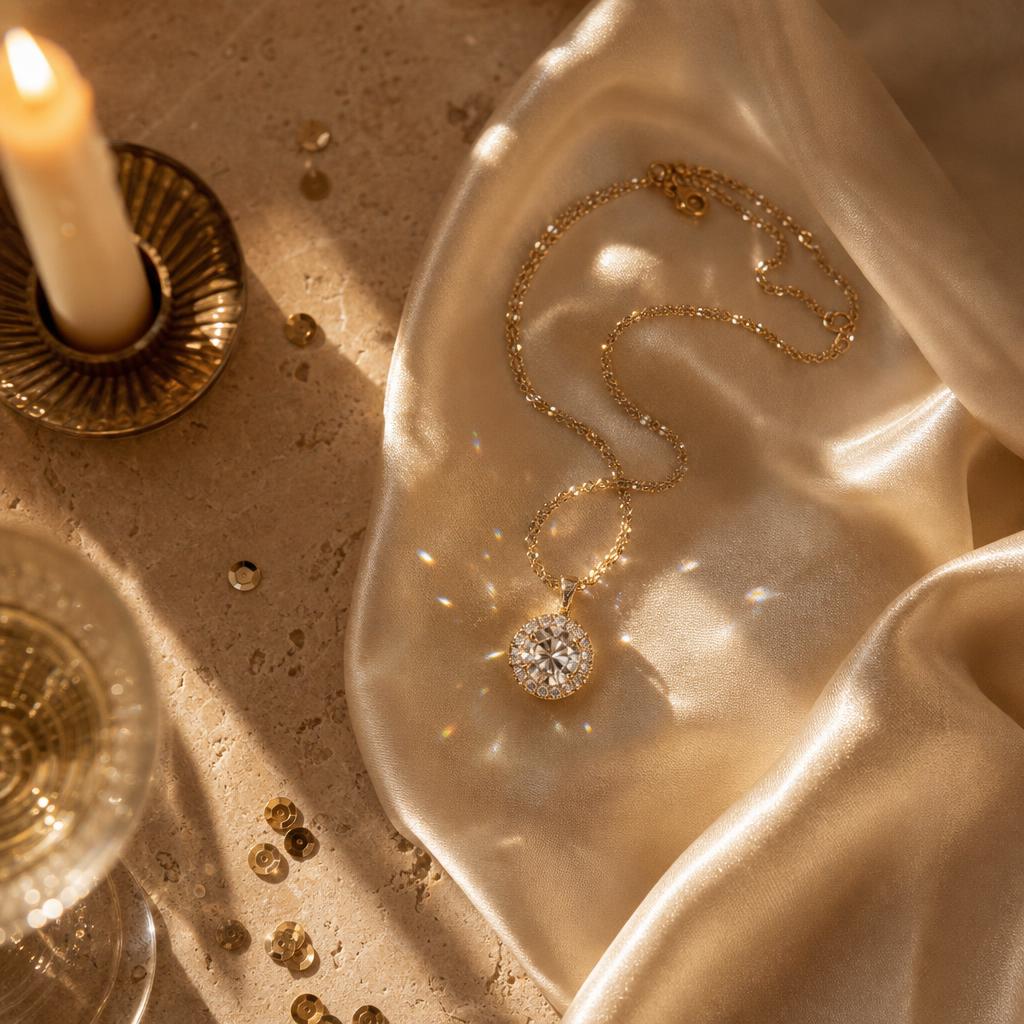
Sparkly Necklaces for New Year's Eve: What Actually Catches the Light
Under normal light, almost any necklace looks fine. Under the lighting you'll actually be standing in on New Year's Eve — string lights, low bars, a single lamp in someone's overcrowded apartment, a phone flash going off every four minutes — most necklaces go flat. The ones that don't share a specific set of traits, and none of them have anything to do with how much the piece cost.
Before you default to whatever chain you already own, it's worth understanding what actually reads as sparkle once the sun goes down and the photos start. Then, a few pieces worth considering if you're starting from scratch.


What Actually Makes a Necklace Sparkle Under Low Light
A sparkly necklace isn't really about size. It's about how many angles the stone has to catch light from, and how much of that light gets reflected straight back at whoever's looking. A flat, smooth chain has almost nothing to work with — there's no facet to break the light apart, so it just looks dull the moment the room dims. A faceted stone, by contrast, is doing the opposite job on purpose: every cut surface bounces light in a different direction, which is exactly why a solitaire pendant photographs brighter than a plain gold rope even in the same lighting.
This is also why setting matters as much as the stone itself. A halo setting — a ring of smaller stones surrounding a center one — multiplies the number of light-catching surfaces without needing a bigger center stone. A cascade of multiple stones does something similar by giving the eye more than one point of brightness to land on. Both outperform a single small stone in a plain setting, even when the total carat weight is close.

The Éclat Moissanite Necklace - Gold
A round-cut moissanite set in a classic 6-prong solitaire — moissanite bends light differently than a diamond does, throwing off more rainbow flash, which is exactly the kind of movement that reads well under string lights and phone flash.
Shop The Éclat Moissanite Necklace →Gold or Silver: How Metal Tone Changes What You Actually See
Warm light — candles, string lights, most bar and restaurant lighting — flatters gold. It picks up the warmth already in the light source and looks richer for it, which is part of why a gold statement necklace tends to photograph so well at evening parties specifically. Cooler, whiter light (bright venues, some photo booths, daylight-balanced flash) does the opposite favor for silver, which reflects that crisper light back cleanly instead of absorbing it the way gold does.
Neither is more "sparkly" in an absolute sense — they're just tuned to different lighting. If you already know your New Year's plans involve candlelight and low bars, gold will do more work for you. If you're headed somewhere brighter, or you're layering with silver jewelry you already own, a silver statement necklace will read just as bright without fighting your other pieces. The honest answer to "gold or silver for New Year's Eve" is: whichever one matches the room you'll actually be standing in.

The Solène Necklace - Gold
A row of round-cut simulated diamonds stationed along a fine gold chain — for anyone who wants the light-catching effect without a single dominant stone doing all the work.
Shop The Solène Necklace →Solitaire, Halo, or Cascade: Which Style Actually Reads at a Party
A single solitaire pendant, like the Ophelia, works because it commits to one clear point of brightness — the eye knows exactly where to look, and at 5.5 carats it doesn't need help getting noticed. The Ophelia looks like something that costs $15,000 or higher. It doesn't. That gap is the whole point of an evening necklace done right: the visual impact is the thing you're paying for, not a certificate.
A cascade, like the Crescendo's trio of stones, gives you three smaller points of light instead of one large one — it reads as more movement, which suits a night that involves actual movement (dancing, hugging people at midnight, the general chaos of a party). A halo setting, like the Belle, sits in between: one center stone with a ring of smaller ones doing supporting work, so it photographs bigger than its actual carat weight without being as loud as a full cascade.
None of these choices is more "correct" than the others. They're just different tools for different versions of the same night — quiet dinner versus dance floor versus somewhere in between.
How Much Is Too Much on a Night Built for Sparkle
New Year's Eve is one of the few nights where "too much jewelry" is a genuinely hard line to hit, but it exists. A useful gut check: pick one piece to be the loudest thing you're wearing, and let everything else support it. If your necklace is doing the heavy lifting — a solitaire, a halo, a cascade — keep your earrings closer to studs and skip the stacked rings. If your ring or earrings are the statement for the night, a finer chain necklace, like the Solène, adds light without competing for attention.
This isn't really a rule about restraint. It's a rule about making sure the eye has somewhere clear to land, which is what actually makes an outfit look considered rather than accidental.
Matching the Necklace to the Neckline You're Actually Wearing
A high neckline — turtlenecks, crewnecks, most sweaters — gives a pendant nowhere to sit if the chain is too short, so anything you choose needs enough length to fall below the collar rather than getting swallowed by it. A plunging or off-the-shoulder neckline does the opposite: it opens up space for a shorter pendant to sit exactly where the eye is already going, which is why a solitaire on a shorter chain tends to look more deliberate there than a long one would.
The celestial North Star pendant is a good example of a piece that works across more necklines than most, because a starburst shape reads clearly whether it's sitting high on a crewneck or lower against an open collar — the shape itself is doing the work, not the length of the chain it's on.
What About Wearing It the Next Day, Too
The best New Year's Eve pieces aren't one-night purchases. A 925 sterling silver or gold-plated necklace set with moissanite or a simulated diamond isn't a costume piece you retire on January 2nd — it's indistinguishable from a diamond, hypoallergenic, and built to be worn again the next time you need something that catches light. Buying for one night and one night only is how jewelry boxes end up full of things nobody reaches for twice.
Quick Takeaways
- Facets and settings create sparkle, not carat size alone — a halo or cascade outperforms a plain chain regardless of price.
- Gold flatters warm, low light; silver reads brighter under cooler, brighter light. Match the metal to the room.
- Pick one piece to be the loudest thing you're wearing, and let the rest support it rather than compete.
- Chain length should match your neckline — longer for high necklines, shorter for open ones.
- Choose something you'll actually wear again after January 1st, not a one-night piece.
Frequently Asked Questions
What type of necklace actually sparkles the most under low light?
Faceted stones set in halo or multi-stone settings outperform plain chains and flat pendants, because each facet and each additional stone creates another surface for light to bounce off. A moissanite center stone throws off even more rainbow flash than a diamond-cut simulant, which is part of why it photographs so well under string lights and flash.
Is sterling silver jewelry actually real, or does it look cheap under bright light?
925 sterling silver is genuine silver, not a stand-in for something else — it's the same base metal used across fine jewelry, just paired here with moissanite or simulated diamonds instead of mined stones. It holds up under bright light exactly the way you'd expect real silver to, because that's what it is.
Are statement necklaces still in style for going out?
Yes — statement pieces never really left, they just cycle between being layered with other jewelry and worn alone. For a night with photos involved, a single statement necklace worn without competition from other pieces is the most current way to wear one right now.
How do I know if I'm wearing too much jewelry at once?
A simple version of the rule: let one piece be the loudest thing on your body, keep a second piece present but quieter, and leave a third area of your look (hands, ears, or neck) close to bare. Once every piece is trying to be the loudest, the eye stops knowing where to look, which reads as more chaotic than glamorous.
Should I buy a necklace specifically for New Year's Eve, or wear something I already own?
If what you own already photographs well under low light, wear it. If you've noticed your usual pieces going flat in photos from past parties, that's a sign to look for something with more facets or a halo setting rather than assuming the problem is the outfit. Buy a piece built to catch light generally, not one styled for a single night, so it earns its place in the rotation afterward.
The through-line here isn't really about New Year's Eve specifically — it's about understanding what makes any piece of jewelry actually catch light, then choosing accordingly. Get that part right and the necklace works just as well in January as it did at midnight.


