

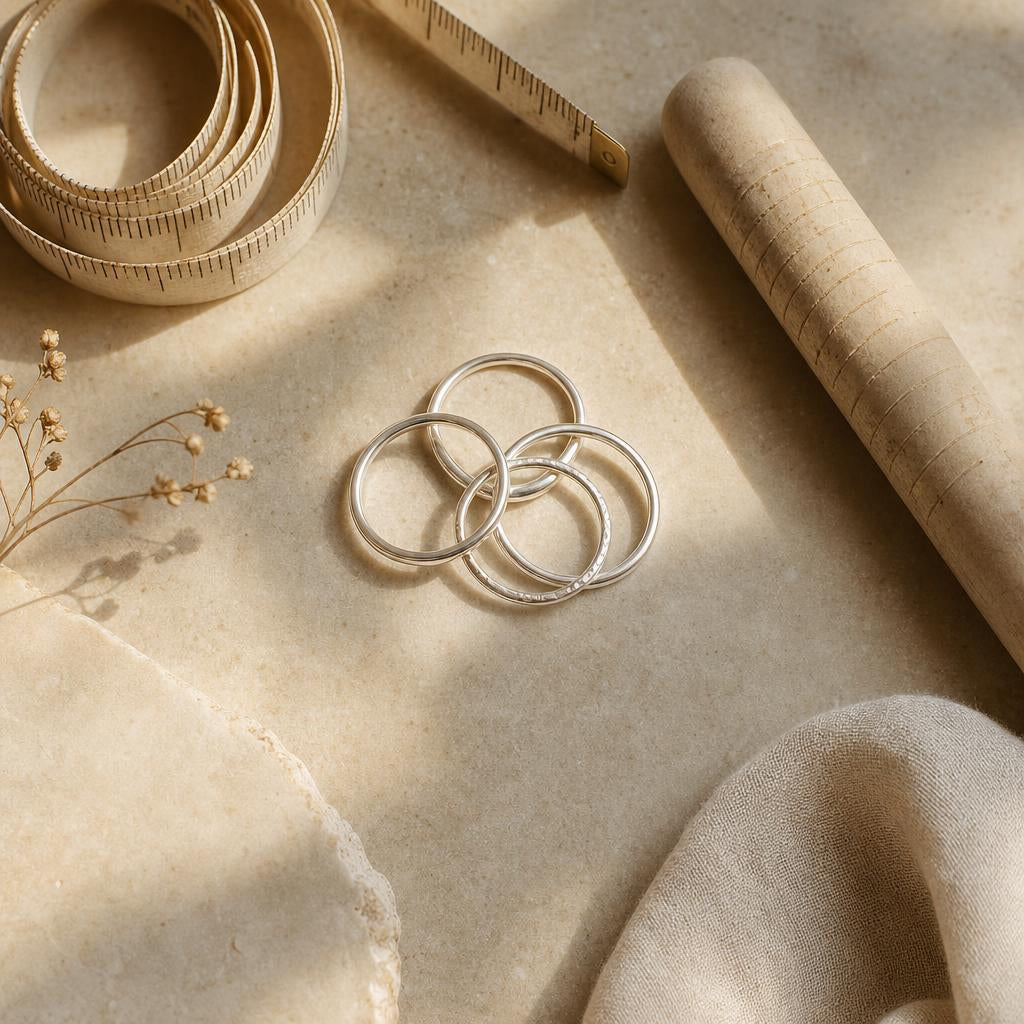
Sizing a Ring Stack: Why the Bands Around Your Engagement Ring Need Their Own Fit Logic
You already know your ring size. You've worn your engagement ring for months, maybe years, and the number is second nature — you could recite it half asleep. So when you finally start building a stack around it, it feels reasonable to assume every other ring just... follows suit. Same size, same finger, same fit. Except that's rarely how it actually plays out once the bands start going on together.
Stacking rings behave differently than solo rings, and the sizing logic that worked for your engagement ring doesn't automatically carry over. Here's what actually changes once you're wearing two, three, or four rings on the same finger — and how to size each piece so the whole stack sits the way it looks in the photos you've been saving.


Your engagement ring size isn't automatically your stacking size
This is the part that surprises most people: the size that fits your engagement ring perfectly can feel completely different once a second or third band joins it. Your finger has a certain amount of real estate between the base of your finger and your first knuckle, and every ring you add is competing for the same few millimeters of space. A single ring has room to breathe. A stack doesn't.
When you size a stack, you're not just accounting for how each ring fits on its own — you're accounting for how the combined width of every band together fits over your knuckle on the way on, and then settles at the base of your finger once it's past. Those are two different measurements, and a lot of stacking frustration comes from buyers who only ever considered the first one.
The knuckle problem nobody mentions until it's too late
Here's the mechanic that trips people up: your knuckle is almost always wider than the base of your finger. A single ring sized correctly for your knuckle will usually spin loosely at the base — which is fine, because one ring's weight and friction against your finger keeps it roughly in place. Stack three rings together, though, and the combined bulk changes how the whole group moves. A stack sized purely for a comfortable slide over the knuckle often ends up loose and rotating at the base, with the rings twisting out of alignment throughout the day.
The opposite problem is just as common. Buyers who size tightly for a snug fit at the base of the finger sometimes find the stack won't clear the knuckle at all once a second or third band is added — each ring makes the knuckle pass a little harder than the one before it.
Worth knowing: If you're building a stack gradually — buying one band now, another in six months — always try the new piece on over your existing rings before you buy, not on its own. A band that fits beautifully solo can behave completely differently once it has company.
Band width changes the math more than you'd expect
Width is the variable most people underestimate. A 1.5mm band and a 3mm band in the same numerical size will not sit the same way once they're stacked — the wider band takes up more of that limited real estate between knuckle and base, and it changes how much clearance the rings on either side of it actually have.
This matters most with crossover and statement pieces, where two bands are fused or interlaced into a single ring that reads visually as two but sizes as one solid, wider unit.

The Destiny Ring
The Destiny's two pavé bands cross and weave into a single silhouette, which means it occupies more finger space than its slim profile suggests. If you're planning to stack it alongside your engagement ring, try it on with your other pieces in place before committing to a size — the crossing point is where clearance tends to run out first.
Shop The Destiny Ring →As a general rule, the more bands you plan to stack, the more you should lean toward thinner profiles for at least some of the pieces. A stack made entirely of wide, substantial bands will fight itself for space; a stack that mixes one wider anchor piece with slimmer supporting bands tends to size — and sit — far more predictably.
Setting style matters as much as width
It isn't only about how wide a band is — it's about what sits on top of it. Bezel settings, like the one used on bezel-set stacking rings, sit lower and smoother against the finger than a raised pavé or prong setting does, which means they tend to clear a knuckle more easily and nest closer to a neighboring band. A channel-set baguette design, on the other hand, has a flatter top but a more rigid structure, so it doesn't flex or angle the way a soft pavé band can when it's squeezed between two other rings.
If your stack includes a mix of setting styles — which most interesting stacks do — expect the sizing logic to shift slightly for each one. The size that lets a smooth bezel band glide past your knuckle isn't necessarily the size a textured, raised setting needs to do the same job comfortably.
✦ Pro tip: When you're trying on a potential stacking piece in store or at home, always test it in the actual position you intend to wear it — next to your engagement ring, not on a bare finger. A band that feels perfect alone can feel entirely different once it's doing its real job.
What actually happens when you get it wrong
Sizing a stack incorrectly doesn't usually mean a ring falls off. It's subtler than that. A too-loose stacking band will spin so that its stones face your palm instead of forward, or slide down until it's resting awkwardly against the ring below it instead of sitting flush at the base of your finger. A too-tight one will leave a visible pressure mark, feel stiff by the end of the day, or make it genuinely difficult to remove the whole stack in one motion — which matters more than it sounds, especially if you take your rings off before washing your hands or applying lotion.
Neither problem is dangerous, but both undercut the entire point of a stack: rings that are meant to look and feel like one considered, cohesive piece instead read as slightly off, and you notice it every time you look down.
Building a stack that's designed to be sized as one
Statement pieces that combine multiple stones across a single, wider silhouette deserve particular attention, because they're effectively pre-stacked — the sizing decision has already been partially made for you by the ring's own design.

The Amore Ring
A row of oval stones linked by delicate connections gives The Amore real visual weight, so it reads as a substantial piece even before another ring joins it. If you're pairing it with a slim supporting band rather than another statement ring, you'll usually get a cleaner, more comfortable stack than combining two wide pieces side by side.
Shop The Amore Ring →The same logic applies to any ring with an intricate surface pattern, like alternating marquise and round stones. These pieces have more surface variation than a plain band, which means their actual "footprint" against a neighboring ring can be slightly larger than the numerical size suggests — another reason to always test the full stack together rather than sizing each piece in isolation.
A simple system for sizing a stack correctly
- Start with your base ring's true size. Confirm your engagement ring or anchor piece still fits the way it should before adding anything else — swelling, weight changes, and simple wear can shift this over time.
- Add pieces one at a time, in person if you can. Try each new ring on with everything you already wear, not on a bare finger. What feels right solo can feel completely different in company.
- Mix your widths deliberately. Pair at least one slim band with any wider statement piece to keep the total stack from crowding your knuckle.
- Reassess as the stack grows. A two-ring stack and a four-ring stack are different sizing problems. Don't assume a piece that worked at stage two will still be the right call at stage four.
- When in doubt, size for the knuckle, not the base. A stack that's slightly looser at the base of your finger is a minor styling quirk. A stack that won't comfortably clear your knuckle is a daily frustration.
Quick Takeaways
- A stack's combined width competes for the same space a single ring uses alone — size for the group, not just the individual piece.
- Your knuckle is almost always wider than the base of your finger; a stack sized only for a comfortable slide-on can end up loose once it settles.
- Setting style affects clearance as much as width does — smooth bezel settings nest more easily than raised or textured ones.
- Mixing at least one slim band into a stack of wider pieces makes the whole group easier to size and wear.
- Always try new stacking pieces on with your existing rings in place, not on a bare finger.
Frequently asked questions
Should stacking rings be sized bigger than my engagement ring?
Not necessarily bigger — but often reconsidered. Some buyers find they need a slightly larger size for at least one piece in the stack to comfortably clear their knuckle once multiple bands are combined. It depends on band width, setting style, and how many pieces you're wearing together, which is why trying the full stack on before buying matters more than defaulting to your usual number.
Can I mix ring sizes within the same stack?
Yes, and it's common. A wider statement piece and a slim supporting band don't always need to be identical sizes to sit well together, especially if there's a noticeable difference in width or setting height between them. The goal is how the stack behaves as a whole, not matching numbers across every piece.
How do I know if my stack is sized correctly?
A well-sized stack clears your knuckle without real effort, doesn't spin so that stones face your palm during normal movement, and sits flush at the base of your finger without gapping between pieces. If you're fighting the stack on or off, or repositioning it throughout the day, that's usually a sign one piece needs a different size.
Do wider bands need a different size than thin ones?
Often, yes. Wider bands take up more room passing over the knuckle, which can make the same numerical size feel tighter than a thin band would. If you're adding a substantially wider piece to an existing stack, it's worth trying it on rather than assuming your usual size will translate directly.
A stack is only as good as its worst-fitting piece — one band that spins, gaps, or pinches is enough to undo the effortless look the rest of the stack is working toward. Take the extra few minutes to size each new piece in context, and the whole thing will wear the way it was designed to: like it was always meant to go on together.


