

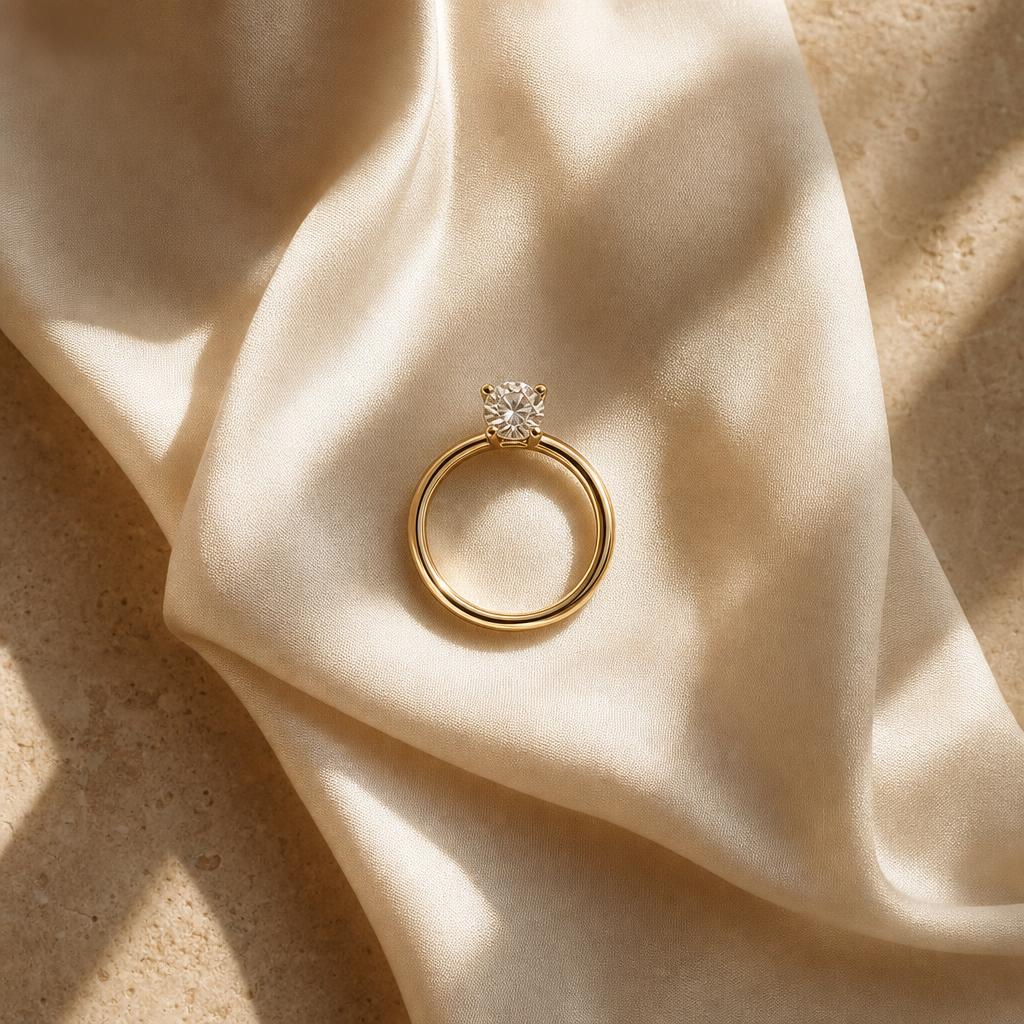
The Self-Engagement Ring: What Women Actually Choose at 25
No one proposed. There was no anniversary, no milestone birthday, no reason anyone else would recognize. She just decided, on an ordinary Tuesday, that she was done waiting for someone else's timeline to catch up with what she already knew she wanted.
That decision has a shape. It usually starts with a search that looks a lot like "self engagement ring" — and it usually ends somewhere unexpected: not with a dainty trinket, but with something that looks exactly like the ring she'd have chosen if someone else were doing the choosing.


What a Self-Engagement Ring Actually Is
Strip away the internet's fascination with the term and the ring itself is a simple thing: a ring, in the classic engagement-ring shape — a single stone, a clean band, real presence on the hand — bought by the woman who's going to wear it. No proposal attached. No permission required. The stone shapes are the same ones you'd find on a bridal registry: round, oval, emerald, pear. The construction is the same. The only thing missing is someone else's hand in the decision.
That's a meaningful distinction, and worth naming directly: this isn't a smaller, quieter version of an engagement ring, worn as a consolation prize while she waits for the "real" one. It's the same category of ring, chosen on her own authority, for her own reasons. The ring doesn't know — and doesn't care — who put it there.
Why She's Buying at 25, Not Waiting for a Timeline That Isn't Hers
Twenty-five is an interesting inflection point. It's usually the first year a woman has a real paycheck, real independence, and a real sense of what she likes — not what she's supposed to like. It's also, statistically, still years before many of her peers get engaged. The old script says she waits. The women actually buying yourself a ring at this age have quietly rejected that script, and they're not being dramatic about it. They've just noticed that the size of the stone on their hand was never actually tied to whether someone else loved them.
This is where the three Gemiros pillars show up in real behavior, not just in copy. She's intelligent — she's done the math on what a jewelry store markup actually buys, and it isn't more sparkle. She's modern — the idea that a ring has to be given to mean something is a rule she's simply stopped following. And she's unapologetic — she isn't choosing her own ring as a rebellion or a statement to anyone in particular. She's buying it because she wants it, and that's the whole explanation she owes.

The Solis Ring
A 1.5-carat round center stone on a half-pavé band — sized for a woman who wants a ring she'll actually wear every single day, not save for occasions.
Shop The Solis Ring →What She Actually Chooses (and What She Skips)
The pattern is more consistent than you'd expect. Women shopping for a diamond ring for myself tend to gravitate toward classic silhouettes over anything trend-driven — solitaires, clean bands, stones that read as substantial without tipping into costume-party territory. It makes sense: this ring has to work with everything. It's going into the office, onto a first date, into a family dinner where someone's aunt will absolutely ask about it. It needs to look considered, not like a phase.
What tends to get skipped is anything overly precious or fragile-looking — filigree for filigree's sake, settings with a lot of visual noise. The instinct, again and again, is toward pieces that could plausibly have been chosen by anyone with excellent taste and a real budget, because that's exactly who's choosing them.
Telling People (or Not)
One detail catches women off guard the first time it happens: the compliments. A ring in a classic solitaire shape reads as significant whether or not there's a story behind it, and people notice it the way they notice any well-chosen ring — with a second glance, sometimes a question. The honest answer, when someone asks, is usually short. "I bought it for myself" tends to land better than any longer explanation, mostly because it doesn't actually need defending.
Some women mention it outright. Others let people assume what they assume and correct it only if it comes up directly. Neither approach is more "correct" than the other — the ring doesn't come with an obligation to explain itself, and the story behind it is exactly as public as she wants it to be. What doesn't tend to happen, in practice, is the awkwardness people worry about in advance. Most conversations move on within a sentence or two, because most people are complimenting the ring, not investigating its origin story.

The London Ring
A 3-carat emerald-cut center stone on a smooth, unadorned band — quiet, architectural, and built for a woman who wants old-money presence without a single unnecessary detail.
Shop The London Ring →The Two Questions She's Actually Asking
Underneath the style decisions, there are really only two questions worth answering honestly, and they're the same two questions every ring buyer eventually asks: will it look cheap, and will it hold up.
Worth knowing: Every Gemiros ring is set in 925 sterling silver with rhodium, 18k gold, or rose gold plating, and centered with a moissanite or CZ stone that's indistinguishable from a diamond to the naked eye — it passes diamond testers. No one is going to clock the difference across a dinner table, including her jeweler. The metal is hypoallergenic and nickel-free, so it won't discolor skin or irritate sensitive fingers, and it's backed by a one-year Gemiros warranty.
Neither fear needs soothing. Both get answered directly, with facts, and then the conversation moves on — which is exactly how the woman asking them wants it handled.
How Much Ring Is Enough
There's no universal answer here, but there is a useful reframe: the goal isn't to spend as much as a traditional engagement ring costs. It's to get the look and the presence of one without accepting that the two have to be tied together. A well-chosen solitaire in sterling silver and moissanite can carry a room the same way a mined-diamond equivalent would — the difference shows up on the price tag, not on the hand.
✦ Pro tip: If you're ordering online, measure an existing ring that fits your intended finger well rather than guessing. Gemiros rings come in whole sizes only, so if you land between two, size up rather than down — a ring that's slightly loose is a quick trip to a jeweler for a plastic guard; one that's too tight isn't wearable at all.
It's also worth saying plainly that this isn't really a budget decision so much as a values one. Two rings can look nearly identical side by side and mean completely different things to the women wearing them — one bought because a jewelry store convinced her that price equals worth, the other bought because she'd already figured out that it doesn't. The second version tends to be the more confident one on the hand, regardless of what either actually cost.
Building Toward It, Not Just Buying It
For a lot of women, this ring becomes the anchor piece of a much bigger habit — the first "real" purchase in a jewelry collection that keeps growing on her own terms. It's rarely the last ring she buys herself. It's usually just the first one that felt like it counted, and it tends to set the tone for every piece that follows: chosen because she wanted it, not because an occasion demanded it.
That's a different kind of milestone than the ones most gift guides are built around. There's no card to sign, no surprise to stage-manage, no one else's opinion to factor in before checkout. It's just a decision, made on her own schedule, that happens to come with a ring attached.
Quick Takeaways
- The ring uses the same shapes and construction as a traditional engagement ring — solitaire, clean band, real presence.
- Most women choose classic cuts (round, oval, emerald, pear) over trend-driven styles, since the ring needs to work everywhere.
- 925 sterling silver with moissanite or CZ is indistinguishable from a diamond to the naked eye and passes diamond testers.
- There's no "right" amount to spend — the goal is the look and the presence, not matching a mined-diamond price tag.
- It's rarely the only ring she buys for herself — usually just the first one that felt like it counted.
Frequently Asked Questions
Is it bad luck to buy your own engagement ring?
No — there's no tradition, superstition, or rule that applies here beyond the ones people invent after the fact. An engagement ring style has always just meant a specific category of ring. Choosing it for yourself doesn't change what it is or how it looks on your hand.
Is it strange to buy a ring like this for yourself?
Less every year. What used to be an unusual choice is now a well-established one — the same way self-purchased jewelry in general has become ordinary rather than remarkable. The only real requirement is that you like the ring.
What finger should I wear a self-purchased ring on?
Whichever one you want. Many women choose their right hand specifically to avoid any confusion about relationship status, but there's no rule requiring it — plenty wear it on the left hand exactly where a traditional engagement ring would sit.
Does it need to look different from a traditional engagement ring?
Not at all. Most women choose the exact same silhouettes — solitaires, halos, three-stone settings — because those styles simply work. There's no separate "self-purchase" aesthetic to conform to.
How do I know what ring size to order?
Measure an existing ring that already fits the finger you plan to wear it on, or wrap a strip of paper around the base of the finger and match the length to a printable sizing chart. Gemiros ships in whole sizes only, so when you're between two, size up.
Whatever prompted the search — a birthday with no plans attached, a bonus that felt like it should go somewhere permanent, or just the quiet realization that no one was coming to do this for her — the ring that shows up at the end of it tends to look remarkably similar to the one she'd have picked out with someone else standing next to her. That's not a coincidence. It was never about who was doing the choosing. It was always about the ring.


