

Second Marriage Rings: Styles That Feel Personal, Not Repeated
The first time, you probably didn't have much say in what "your style" even meant. Maybe you chose the ring you thought you were supposed to want, or the one that matched what everyone else your age was wearing, or the one that simply felt safe. This time is different — not sadder, not smaller, just different. And the ring you choose now gets to reflect that.
There's no rulebook for a second marriage ring, which is exactly the point. You're not obligated to repeat a silhouette, a stone shape, or a metal tone just because it's "traditional." Here are a few directions worth considering — starting with four styles that move in genuinely different directions.


Why a Second Ring Doesn't Have to Look Like the First
There's a quiet pressure that shows up around second engagements that nobody quite names out loud: the sense that the new ring should somehow apologize for existing, or slip in as unobtrusively as possible so as not to invite comparison. It's worth saying plainly — it doesn't have to do either of those things. This ring isn't a replacement. It's not competing with anything. It's simply the ring that belongs to this relationship, at this point in your life, and it's allowed to look completely unlike whatever came before it.
In practice, that freedom tends to show up in three places: the cut of the stone, the meaning built into the setting, and where and how the ring is actually worn. None of these have to match old decisions. All three are worth rethinking on purpose, rather than by default.
Start With What the First Ring Wasn't
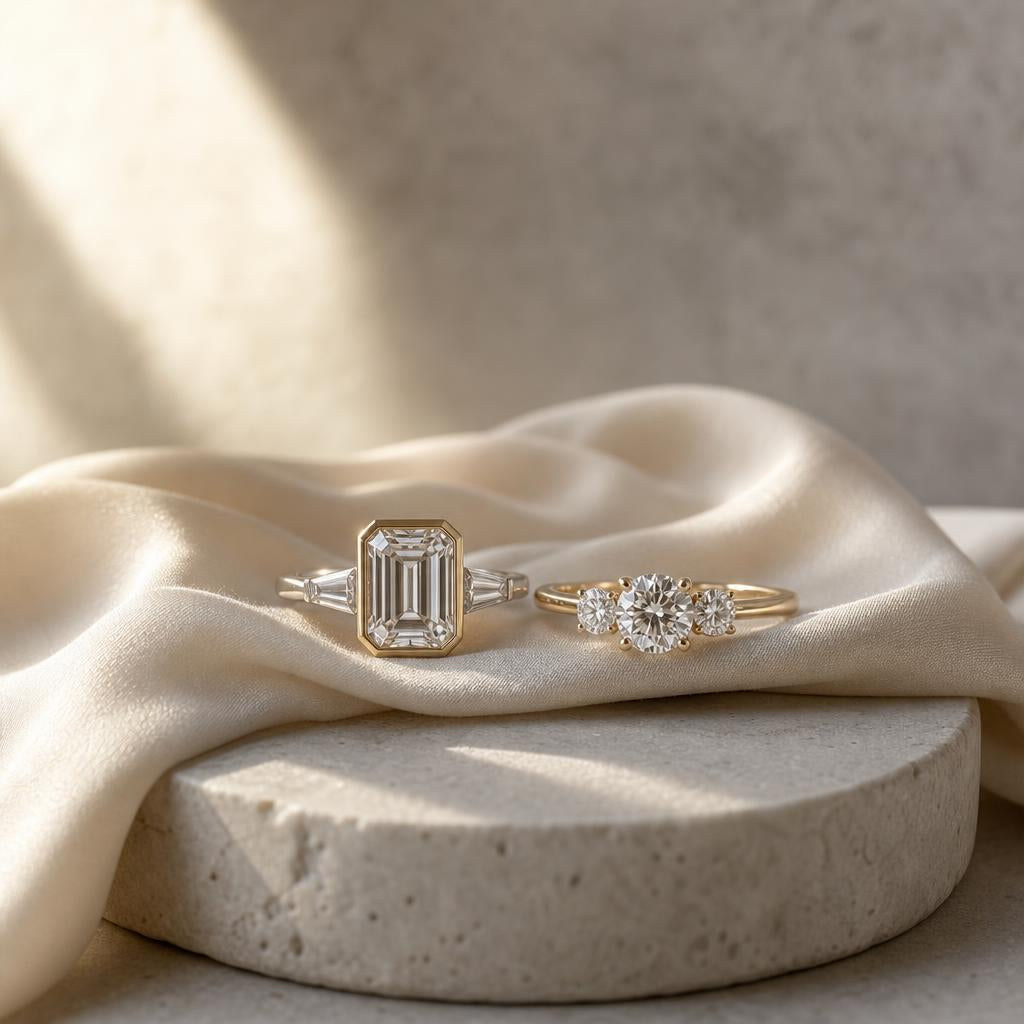
One of the simplest ways to find a style that feels genuinely new is to think backward. If your first ring was round and classic, an asscher cut like The Astrid Ring or The Échelon Ring reads as an entirely different category of jewelry — sharper, more architectural, with the kind of step-cut facets that catch light in broad, deliberate flashes rather than a scattered sparkle. It doesn't try to look bigger or more traditional. It just looks like a different decision, made by a different version of you.
If your first ring was quiet, this is your permission to go bold
A wide, structured stone with clean geometric lines has a confidence to it that a smaller, more delicate setting simply doesn't carry. If the first ring in your life was chosen to blend in, there's something genuinely satisfying about choosing one now that has no interest in doing that.
If your first ring was traditional, this is your permission to go unconventional
Not every stone has to sit north-south on the hand. The Ondine Ring sets its pear-cut center stone in a striking east-west orientation — sideways, essentially — which changes the entire visual rhythm of the hand when you're gesturing, typing, or simply resting it on a table. It's a small structural choice that reads as unmistakably intentional.

The Cherish Ring
For a different kind of statement, The Cherish reimagines the eternity band with individually bezel-set stones — each one held in its own frame rather than lost in a continuous row. It's modern, low-profile, and genuinely built for daily wear, which makes it a strong option for anyone who wants meaning without spectacle.
Shop The Cherish Ring →Let the Symbolism Be Different Too
A first engagement ring often carries a single, simple meaning: this is the beginning. A second one gets to carry something more layered, and a lot of women find that a three-stone ring gives them somewhere to put that complexity. The traditional reading — past, present, and future — takes on real weight the second time around, when "past" isn't hypothetical anymore. The Juliette Ring leans into this with a pear-and-heart side-stone arrangement that feels considered rather than generic, more like a piece of jewelry with a point of view than a default engagement ring shape.
Worth knowing: You don't need to explain the symbolism to anyone. Plenty of women choose a three-stone setting simply because they like the proportions — the meaning is there if you want it, and invisible if you don't.
If three-stone settings feel too literal, an art deco setting offers a different kind of storytelling — not through symbolism, but through era. Art deco design has always been about structure, symmetry, and confidence, which happens to make it a fitting visual language for a chapter that isn't your first draft.
Where and How You Wear It Says Something, Too
Some women choose to wear a second engagement ring exactly the way they wore the first — same hand, same finger, same stacking logic. Others use the moment to rethink that entirely. There's genuinely no wrong answer here, and it's worth sitting with the question rather than defaulting to habit. A few women skip the traditional hand altogether and wear a bold, unconventional stone as a right-hand ring instead, which sidesteps the comparison question entirely by simply not putting the new ring in the same visual position as the old one.
If you do want the classic left-hand placement, a marquise-cut halo brings a softer, more romantic energy that reads as vintage without being a repeat of anything you may have worn before — especially if your first ring skewed modern or minimal.

The Victoria Ring
An elongated marquise center stone surrounded by a halo of pavé, set with the kind of whimsical, old-world detail that feels closer to an heirloom than a trend. If your instinct this time is toward softness rather than sharp lines, this is where to start looking.
Shop The Victoria Ring →You Don't Owe Anyone a Familiar Choice
It's worth naming the quieter worry underneath all of this: that choosing something different will read as a statement about the past, rather than simply a preference in the present. It won't, at least not to anyone whose opinion should matter here. Most people barely register ring details beyond "is there a ring." The only person who's going to look at this ring every single day is you, which is really the whole argument for choosing the one you actually want rather than the one that feels the least noticeable.
The same logic applies if you're the one buying this ring for yourself, ahead of or entirely separate from a proposal. There's a growing, entirely reasonable trend of women buying themselves a ring at exactly this stage of life — not as a placeholder for something else, but as the actual thing they wanted. If that's closer to your situation, the same permission applies: choose the shape, the setting, and the symbolism that feels true to where you are now, not to what a ring is "supposed" to look like.
Budget freedom is part of this too
One quieter benefit of a second ring: you likely already know, this time, roughly what you actually want to spend and why — rather than guessing at what an engagement ring is "supposed" to cost. Worth working through the numbers honestly before you shop, so the ring you choose is based on what feels right rather than what feels obligatory.
Quick Takeaways
- A second ring doesn't need to reference or avoid the first one — it just needs to reflect you now.
- Architectural cuts like asscher or east-west settings read as an intentional departure from a more traditional first ring.
- Three-stone and vintage-inspired settings offer built-in symbolism, but you're never obligated to explain it.
- Where you wear it — same hand or a deliberate right-hand placement — is entirely your call.
- If you're buying it for yourself, the same freedom applies. No occasion required.
Frequently Asked Questions
Is it in poor taste to choose a completely different style for a second engagement ring?
No. There's no etiquette rule requiring continuity between rings, and most people won't clock the difference at all. Choosing a different cut, setting, or metal simply reflects that you're a different person making a different choice — which is exactly what's happening.
Should I wear a second engagement ring on the same hand as the first?
Only if you want to. Many women keep the traditional left-hand placement; others intentionally shift to the right hand or a different stacking arrangement to give the new ring its own visual identity. Both are common and both are correct.
What ring styles feel the most different from a classic round solitaire?
Step-cut shapes like asscher, east-west orientations like a sideways pear, and three-stone settings all read as visually distinct from a traditional round solitaire, both in silhouette and in the way they catch light.
However you approach it — bold and architectural, quietly symbolic, or simply the ring you always wanted and never let yourself choose before — the only real requirement is that it feels like yours. That's not a small thing. It might be the entire point.


