

The quiet appeal of vintage-inspired rings: art deco, milgrain and filigree styles worth knowing
There is something about a vintage-inspired ring that feels immediately different from the moment you put it on. It carries a sense of history — of craft, of intention — that a clean modern solitaire simply cannot replicate. The milgrain edging. The geometric cutwork. The delicate filigree that seems to belong to another era entirely. And yet it sits on a twenty-first-century hand and looks exactly right.
Vintage-inspired rings have never been more popular, and not just among the romantic or the nostalgic. They appeal to anyone who wants a ring with genuine personality — something that looks considered and individual rather than interchangeable. This guide covers the three main aesthetics driving the trend — art deco, milgrain, and filigree — explains what each actually looks like in practice, and shows a selection of styles from the Gemiros collection worth knowing about.
What makes a ring "vintage-inspired"?
The term gets used loosely, but in ring design it refers to anything that deliberately draws on the aesthetic vocabulary of earlier eras. The three most influential periods for contemporary jewellery design are the Art Deco era (roughly 1920 to 1940), the Edwardian period that preceded it (1900 to 1915), and the broader Victorian era of the nineteenth century. Each left behind a distinct visual language that still shapes what designers reach for when they want a ring to feel less contemporary and more timeless.
It helps to know the difference between the three main craft details you will encounter:
- Art Deco refers to a design movement, not a specific craft technique. The hallmarks are geometric forms, bold symmetry, stepped lines, and a preference for angular cuts — particularly asscher, emerald, and baguette. Art Deco rings look architectural. They are built to make an impression.
- Milgrain is a finishing technique: a row of tiny beaded metal dots applied to the edge of a setting or along the band. It is most associated with Edwardian jewellery, and it has the effect of making a ring look hand-finished and artisanal, even at modest price points.
- Filigree is delicate openwork metalwork — fine wire twisted and bent into intricate patterns. True filigree is labour-intensive to produce, but contemporary rings often achieve a similar effect through casting techniques that replicate the lacy, ornamental quality without the handcraft cost.
All three can appear on the same ring, or you might find just one. The common thread is that vintage-inspired rings have detail — texture, edge work, layered elements — that plain modern settings deliberately strip away.
Art Deco: the geometry of glamour
If you want a vintage ring that commands attention rather than inviting close inspection, Art Deco is probably your aesthetic. The movement emerged in the 1920s as a reaction against the ornamental excess of Victorian jewellery — and paradoxically, in its rigour and geometry, it ended up being just as striking. Where Victorian rings sprawled outward in curves and flowers, Art Deco rings went vertical and angular. Every element earned its place.
The cut most associated with Art Deco is the asscher: a square step-cut with deeply layered facets that create a hypnotic depth when you look directly into the stone. Unlike brilliant cuts, which are engineered to maximise flash, asscher cuts produce a more measured, sophisticated sparkle — sometimes described as a hall-of-mirrors effect. It is not a cut for people who want maximum dazzle. It is a cut for people who want to look interesting.

The Astrid Ring
A 3-carat asscher-cut simulated diamond sits at the centre, flanked by a geometric stepped setting that pulls every element into tight, deliberate symmetry. The Astrid is what Art Deco looks like when nothing is compromised — dramatic, structured, and entirely its own thing.
Shop The Astrid Ring →Worth knowing: Asscher cuts show inclusions more readily than brilliant cuts because their facets are larger and less chaotic. In a simulated diamond — where the stone is precision-manufactured rather than naturally grown — this actually works in your favour: you get all the architectural clarity of the cut without worrying about what lies beneath the surface.
Milgrain: the detail you notice on second look
Milgrain is one of those design elements that rewards close attention. From a distance, a milgrain setting simply looks refined — the edges are clean, the proportions are right, and everything sits together well. Get closer, and you see the row of tiny beads running along the rim of the bezel or the shoulder of the band, and suddenly the ring has texture and history in a way that no plain setting can quite match.
The technique originated in Edwardian jewellery, where fine platinum work and lacy, ornamental detail were the order of the day. Edwardian rings were made for candlelight and close quarters — they rewarded the kind of inspection that happened across a dinner table. Milgrain was the finishing touch that distinguished a ring made with care from one made for convenience.
Today, milgrain appears on everything from solitaire settings to halo rings to wedding bands, and it has the useful quality of making a ring look significantly more expensive than it is. It is also a detail that photographs extremely well — the beads catch the light at multiple angles and create a subtle shimmer even in flat photography.

The Regent Ring
A 1.25-carat princess-cut centre stone sits within a classic halo, and the milgrain edging runs the full perimeter of the setting — precise, fine, and unmistakably Edwardian in spirit. The Regent is the kind of ring that reveals something new every time you look at it.
Shop The Regent Ring →Victorian and floral: the romantic end of the spectrum
If Art Deco is about structure and milgrain is about finish, Victorian-inspired ring design is about feeling. Marquise cuts. Petals. Curves. The sense that a ring is telling a story rather than simply sitting on a finger. Victorian jewellery was unashamedly sentimental, and that sentiment is exactly what makes Victorian-inspired designs still resonate — especially for engagement rings, where a ring is expected to carry some emotional weight.
The marquise cut is the most distinctively Victorian shape in modern ring design: long, pointed at both ends, it elongates the finger and creates a silhouette that no other cut quite matches. Paired with a halo and pavé shoulders, it becomes something slightly fantastical — a ring that could have belonged to a painting.

The Victoria Ring
A marquise-cut centre stone set in a full halo with pavé detailing along the band — elegant, pointed, and quietly spectacular. The Victoria is for anyone who wants a ring that feels like it has always existed and always will.
Shop The Victoria Ring →The floral direction takes a softer approach. Where marquise rings are dramatic, floral-influenced designs are romantic in a more literal sense — petals, symmetrical blooms, the idea of the ring as garden rather than geometry. The Fleur Ring captures this well: a radiant-cut centre stone set within a frame of radiating petals that manages to feel both feminine and substantial.

The Fleur Ring
A 3.5-carat radiant-cut stone in a halo designed around soft floral geometry — vintage glamour with a feminine twist that wears beautifully for occasions or every day.
Shop The Fleur Ring →The vintage band: when the setting does the work
Not every vintage ring announces itself through the stone. Some of the most interesting styles are understated on the face but intricate in the shoulders and band — the round cut remains elegant and timeless at the centre while the setting around it carries all the vintage personality. This is a particularly good approach if you want a ring that reads as classic from across a room but rewards closer attention.
A pavé-set vintage band — where tiny stones run along the shoulders and sometimes the full band — captures this balance well. The round cut is universally flattering and never dates; the vintage band gives it character without asking the wearer to commit fully to a period aesthetic. It can be styled dressed up or dressed down without looking misplaced in either direction.

The Beatrice Ring
A brilliant round-cut simulated diamond on a pavé-detailed vintage band — the kind of ring that earns the description "classic" without ever being boring. Available in silver, gold, and rose gold.
Shop The Beatrice Ring →Emerald cuts and Art Deco in miniature
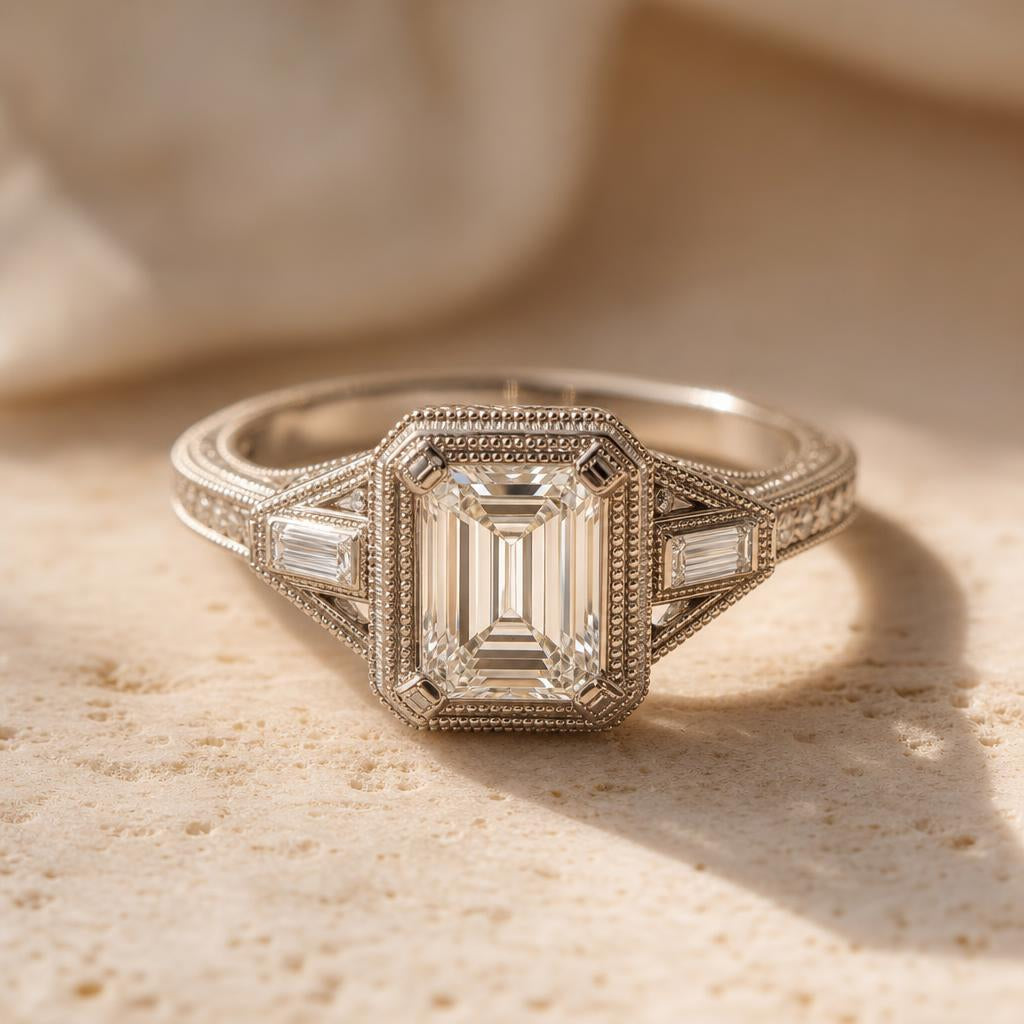
The emerald cut occupies an interesting position in vintage ring design: it belongs to the Art Deco era in the sense that its stepped facets and geometric profile suit that period exactly, but it never reads as obviously vintage the way an asscher does. An emerald cut is more quietly sophisticated — it whispers rather than announces. The Harlow Ring takes the emerald cut and places it in a halo setting that bridges the vintage reference and the contemporary finish: recognisably classic, but not costumed.

The Harlow Ring
An emerald-cut centre stone in a halo setting with clean vintage lines — the kind of ring that borrows from the past without disappearing into it. Elegant, elongating, and deceptively understated.
Shop The Harlow Ring →Why simulated diamonds work so well for vintage styles
There is an argument to be made that vintage-inspired ring designs are actually better suited to simulated diamonds than to mined stones — and it is not a stretch. The visual language of Art Deco, milgrain, and filigree design is fundamentally about the setting: the metalwork, the proportions, the surface detail. The stone is the centrepiece, but the ring as an object is defined by what surrounds it.
This matters because the quality of cut and clarity that a simulated diamond offers — precision-manufactured to be free of inclusions, cut to exacting proportions — means the stone itself performs exactly as designed. When the aesthetic of the ring is this carefully considered, you want the stone to behave predictably. You want light to enter and return the way it should, and you want the same results in every light condition. A simulated diamond gives you that consistency in a way that natural stone simply cannot guarantee without paying significantly for high-quality grading.
✦ Practical note: Milgrain detailing is particularly susceptible to over-polishing — jewellers who buff rings too aggressively can round off the tiny beads and lose the effect over time. For everyday wear, clean vintage-inspired rings with a soft cloth and mild soap, and avoid ultrasonic cleaners which can loosen pavé stones in ornate settings.
Choosing between the aesthetics
If you are drawn to vintage rings but not sure which direction suits you, these rough guides might help:
- Art Deco suits people who respond to architecture and bold design. If you like buildings, geometric patterns, and things that are deliberately structured, Art Deco ring design will feel like your natural language. The asscher or emerald cut, a stepped setting, strong symmetry.
- Milgrain is a detail more than a full aesthetic, and it works across other styles — it can appear on a solitaire, a halo, a band. If you want a ring that quietly signals craftsmanship without committing to a period look, milgrain is the safest choice: it adds visual interest without demanding much from the rest of your wardrobe.
- Victorian and floral suits people who lean toward romantic dressing — who reach for florals, textures, and layers in clothing and want their ring to feel consistent with that. The marquise cut, in particular, is one of the most romantically charged silhouettes in ring design: nothing else quite elongates the hand in the same way, and nothing else says "I chose this deliberately" quite as clearly.
Quick Takeaways
- Art Deco rings favour angular cuts (asscher, emerald), strong geometry, and stepped settings — the look is bold and architectural
- Milgrain is a finishing detail — tiny beaded edges — that can appear on any style and quietly signals artisanal care
- Victorian-inspired designs use marquise cuts, floral framing, and soft curves to create the most romantic ring silhouettes in the category
- Simulated diamond rings perform especially well in vintage settings because precision-manufactured stones behave consistently in complex, detail-oriented designs
- The vintage band approach — classic round cut, ornate shoulders — is the most versatile entry point if you want vintage personality without a full period commitment
Frequently asked questions
Is an asscher cut the same as an emerald cut?
No, though they are close relatives. Both are step cuts with concentric rectangular facets, but the asscher is square where the emerald cut is rectangular. The asscher has a more compact, symmetrical look; the emerald cut is more elongating. Art Deco design used both, but the asscher is more strongly identified with the period.
What does milgrain actually look like in person?
Up close, milgrain looks like a very fine row of tiny metal beads — uniform in size, running precisely along the edge of the setting. In photographs, it reads as a slight shimmer or texture along the rim. It is a detail that tends to look best in person, where the eye can appreciate the scale and regularity of the work.
Can vintage-inspired rings be worn as travel rings?
Yes — and this is one of the strongest arguments for simulated diamond vintage rings specifically. Wearing a vintage-inspired simulated diamond ring while travelling means you get the full visual impact of an ornate, detailed setting without any anxiety about loss or damage. The rings in this guide are built to travel: sturdy settings, precision stones, and none of the stress of wearing something irreplaceable.
Do vintage-inspired rings work with modern wedding bands?
They can, though it takes some thought. The most important consideration is the height and profile of the vintage ring — many Art Deco and milgrain settings sit higher off the finger than contemporary designs, which can make it harder to find a band that sits flush. A narrow, simple band in the same metal tone usually solves the problem; curved or contoured bands may struggle with more ornate vintage profiles.
Vintage-inspired rings are, above everything else, rings with a point of view. The aesthetic is not for everyone — and it is not supposed to be. If you find yourself gravitating toward the detail, the texture, the sense of something made rather than simply manufactured, that is the ring telling you something worth listening to.


