

Wearing a ring on your right hand: how to choose one that looks deliberate, not accidental
Your left hand already has its story. The right hand is where you get to write your own — and it turns out to be one of the most overlooked opportunities in jewellery.
There is a meaningful difference between a ring that happens to be on your right hand and one that was put there with intention. The first category includes forgotten purchases that never quite worked on the left, pieces that arrived as gifts and found no particular home, and travel rings that made it back from holiday but never made it back to the drawer. The second category is what we're actually talking about here: a ring chosen for the right hand, styled for that finger, with a clear visual reason for being there. Knowing the difference is what changes what you end up buying — and whether you actually reach for it.

The right hand has always been its own story
In many parts of the world, the right hand has traditionally been where women wore the jewellery that was simply theirs. Not gifts tied to a relationship status, not symbols of a future they were waiting on, but pieces chosen because they liked them. The dinner ring, the cocktail ring, the signet ring: all of them found a natural home on the right hand long before the phrase "right-hand ring" became a marketing category.
That heritage gives the right hand a specific kind of energy. It's personal in a way the left often isn't — the left carries convention, expectation, the agreed-upon language of relationships. The right carries none of that. Which means a ring worn there can afford to be a little bolder, a little more individual, a little further from the expected silhouette. There's no framework dictating what it should look like, which is either daunting or liberating depending on how you approach it.
The most useful thing to understand is what you're actually choosing between. A ring on the right hand isn't competing with anything else. It isn't trying to complement an engagement ring, sit flush against a band, or match the shape of a stone that already exists. It's a ring chosen on its own terms. The question worth asking isn't "does this work with my left hand" — it's "does this look like I meant to wear it."
What makes a right-hand ring look deliberate
There's a quality that distinguishes the rings that work best on the right hand from the ones that don't, and it's harder to name than it seems. It's not about size or sparkle or how expensive the ring looks. It's something closer to visual self-sufficiency — the sense that this ring doesn't need anything next to it to read correctly.
Rings that look deliberate on the right hand tend to share a few characteristics. They have a clean, strong silhouette. They read as a specific choice — a step cut rather than the default round brilliant, a geometric band rather than a plain one, an Art Deco design that carries its own period confidence. They don't borrow their visual language from the engagement ring tradition, which means they don't risk looking like an engagement ring that was repurposed or redirected.
Rings that read as accidental on the right hand tend to be either too small — a delicate ring that disappears against the other fingers — or too derivative, meaning a round brilliant solitaire that looks exactly like a more familiar category of ring. Scale matters more than you'd expect, particularly on the index and middle fingers, which can carry more visual weight than the ring finger without looking out of place.
Worth knowing: Most people's right hand runs slightly larger than their left, particularly after a day of activity. If you plan to wear your right-hand ring on the ring finger, sizing up by half a size from your usual left-hand size will usually give a more comfortable fit throughout the course of the day.
Step cuts: why they read as confident choices
Round brilliant cuts are the most popular stone shape in the world, which is also one of their limitations on the right hand. Because they're so closely associated with engagement rings, wearing a round brilliant solitaire on the right can occasionally read as a ring that didn't quite make it to the left — a placeholder, or an unintentional duplicate. It doesn't always read this way, but it's a risk worth being aware of.
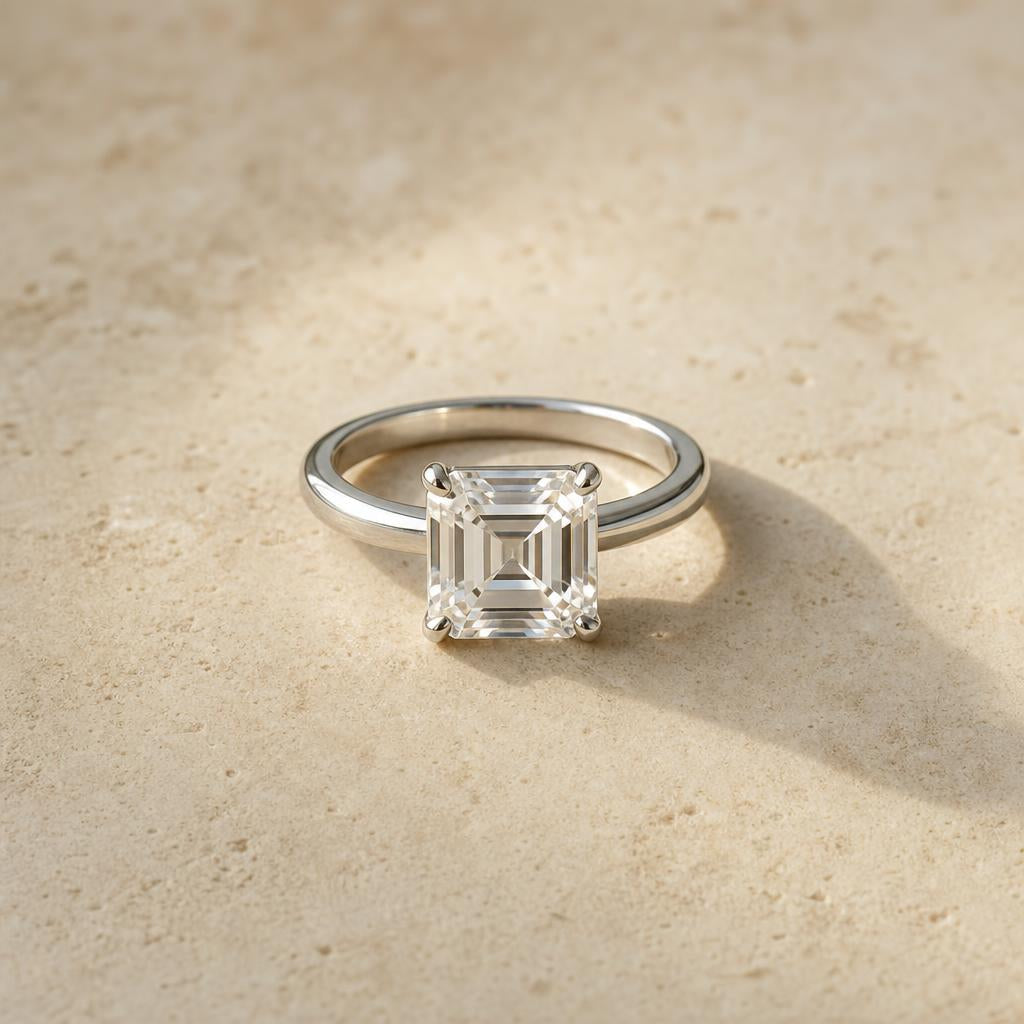
Step cuts sidestep this entirely. Asscher cuts, with their square outline and deeply layered parallel facets, create a different kind of visual effect — a hall-of-mirrors depth rather than the outward explosion of a brilliant cut. They're immediately recognisable as a specific, considered choice. Emerald cuts do something similar: the long rectangular stone with its parallel facets has a cool, architectural quality that reads as fashion rather than ceremony.
An asscher or emerald cut solitaire on the right index or middle finger is one of the cleanest right-hand ring choices there is. The geometry holds its own without supporting elements, the setting doesn't need to be elaborate, and the overall effect is the kind of quiet confidence that tends to attract the most genuine compliments.

The Échelon Ring
A 1.25-carat asscher-cut simulated diamond in a clean solitaire setting. The deeply layered step cuts create a hall-of-mirrors effect that reads as architectural and considered — excellent on the right index or middle finger where the geometry has space to be itself.
Shop The Échelon Ring →When scale is the whole point
One thing the right hand offers that the left rarely can: open space. An engagement ring on the left is usually flanked by a wedding band, often a stacking ring, sometimes both. The visual landscape is busy, which means individual pieces have to negotiate with everything around them.
The right hand, unless you're deliberately building a stack, tends to have that open space around it. Which means a ring with a genuinely large centre stone — something in the 3 to 4 carat range — has room to be entirely itself. It doesn't need to sit flush against anything. It doesn't get compared to a ring on the neighbouring finger. It just occupies its finger with the full presence it was designed to have.
This is where statement rings come into their own. A large oval centre stone with architectural side details, worn on the right index finger, reads as a deliberate choice in a way that the same ring on the left rarely could — because on the left it would invite comparisons and questions, and on the right it simply gets to exist on its own terms.

The Empress Ring
A 3.5-carat elongated oval centre stone flanked by two tapered baguette side stones. The baguettes add architectural weight without softening the silhouette — this ring reads as a deliberate choice from across the room, and wears best on the right index or middle finger where the scale has room to land.
Shop The Empress Ring →The Art Deco connection
There's a historical reason why Art Deco jewellery feels so naturally at home on the right hand. The period that produced those angular settings, those step-cut stones, those milgrain borders and geometric frames was also the period when women were most actively asserting new freedoms — including the freedom to choose their own jewellery, wear it on the hand they preferred, and not wait for it to arrive as a gift.
A vintage-inspired Art Deco ring on the right hand carries a trace of that original energy. It doesn't look like an engagement ring. It doesn't look like a wedding band. It looks like something chosen on its own terms — which, in terms of the right-hand ring's core appeal, is exactly right. The dramatic centre stones, the angular side details, and the stepped settings of Art Deco designs are all shapes that read as complete without anything next to them.

The Astrid Ring
A 3-carat asscher-cut simulated diamond set in a dramatic Art Deco-inspired design with flanking side stones. The deep step cuts and angular side detail give it a period confidence that makes it look discovered rather than purchased — one of the most naturally right-hand ring styles we carry.
Shop The Astrid Ring →Full bands, eternity rings, and the quieter approach
Not every right-hand ring needs to announce itself. A full eternity band — where stones circle the ring completely — occupies an ambiguous zone on the left hand. Is it a wedding band? An anniversary ring? An eternity ring that's waiting for context? On the right hand, none of that ambiguity applies. It's simply a ring that goes all the way round, chosen because of how it looks and how it feels to wear.
Baguette eternity rings have particular appeal for the right hand. The flat, rectangular faces of baguette stones repeat in a clean geometric pattern that looks intentional from every angle. There's no front that has to face the right way. There's no back that reveals an unadorned band. The ring looks the same however it sits on your finger, which is the kind of visual consistency that always reads as considered.
A slim pavé eternity ring is similarly well-suited. Worn on its own on the right middle finger, it reads as a quiet, deliberate choice. Worn alongside a second ring of complementary width, it starts to build a stack that looks like it was planned. The Devotion and The Beloved both work this way — each one earns its place individually, but they have genuine potential as a pair.

The Beloved Ring
A vintage-inspired pavé eternity band set with a continuous row of brilliant round stones. Slim enough to wear alongside a second ring or quietly on its own, it's the kind of right-hand ring that gets noticed slowly — but consistently.
Shop The Beloved Ring →Quick Takeaways
- The right hand has no conventions — use that freedom to choose something based purely on how it looks on you.
- Step cuts (asscher, emerald) read as deliberate because their geometry stands alone without needing a supporting design context.
- Scale works differently on the right hand — a larger stone has no comparison ring next to it, so it can simply be itself.
- Eternity bands and full-circle rings lose any left-hand ambiguity when worn on the right, and read as exactly what they are: a personal choice.
- Art Deco and vintage-inspired styles have a natural home on the right hand, connected to a long history of women choosing jewellery entirely for themselves.
- Size up half a size for the right ring finger — most people's right hand runs slightly larger than their left.
Frequently asked questions
Which finger on the right hand works best for a ring?
There's no rule, but the index and middle fingers are the most common choices for right-hand rings because they're highly visible and can carry more visual weight without the ring reading as ceremonial. The ring finger works well for a quieter piece — a slim band or a delicate eternity ring. The pinky is best suited to a signet ring or a slim stacking band.
Can I wear a large solitaire on my right hand if I already have one on my left?
Yes, though choosing a different stone shape tends to look more considered. If your left-hand solitaire is a round brilliant, a step cut — asscher or emerald — on the right reads as a deliberate counterpart rather than a duplicate. Two identical shapes on opposite hands can look like one is waiting to move across.
Should my right-hand ring match the metal tone of my left?
Matching metal tones across both hands tends to look more considered. Silver on the left and gold on the right can work if the contrast is intentional — part of a deliberate mixed-metal approach — but if it's just how things ended up, it can read as two rings from different moments in your life that haven't been introduced. Sticking to the same metal tone is the simpler, safer default.
What's the difference between a right-hand ring and a cocktail ring?
A cocktail ring is a specific style — large, statement, designed for evening wear — that emerged from 1920s party culture. A right-hand ring is simply any ring worn on the right hand, including understated everyday pieces, slim eternity bands, and delicate solitaires. Cocktail rings have always had a natural home on the right hand, but not all right-hand rings are cocktail rings.
The right hand is one of the better arguments for buying a ring simply because you like it. There's no occasion required, no milestone to mark, no conversation to have with anyone else before you do it. A ring that looked good, sat well, and seemed like the obvious choice once you found it: that's the entire brief. Everything else is just deciding which kind of deliberate you want to be.


