

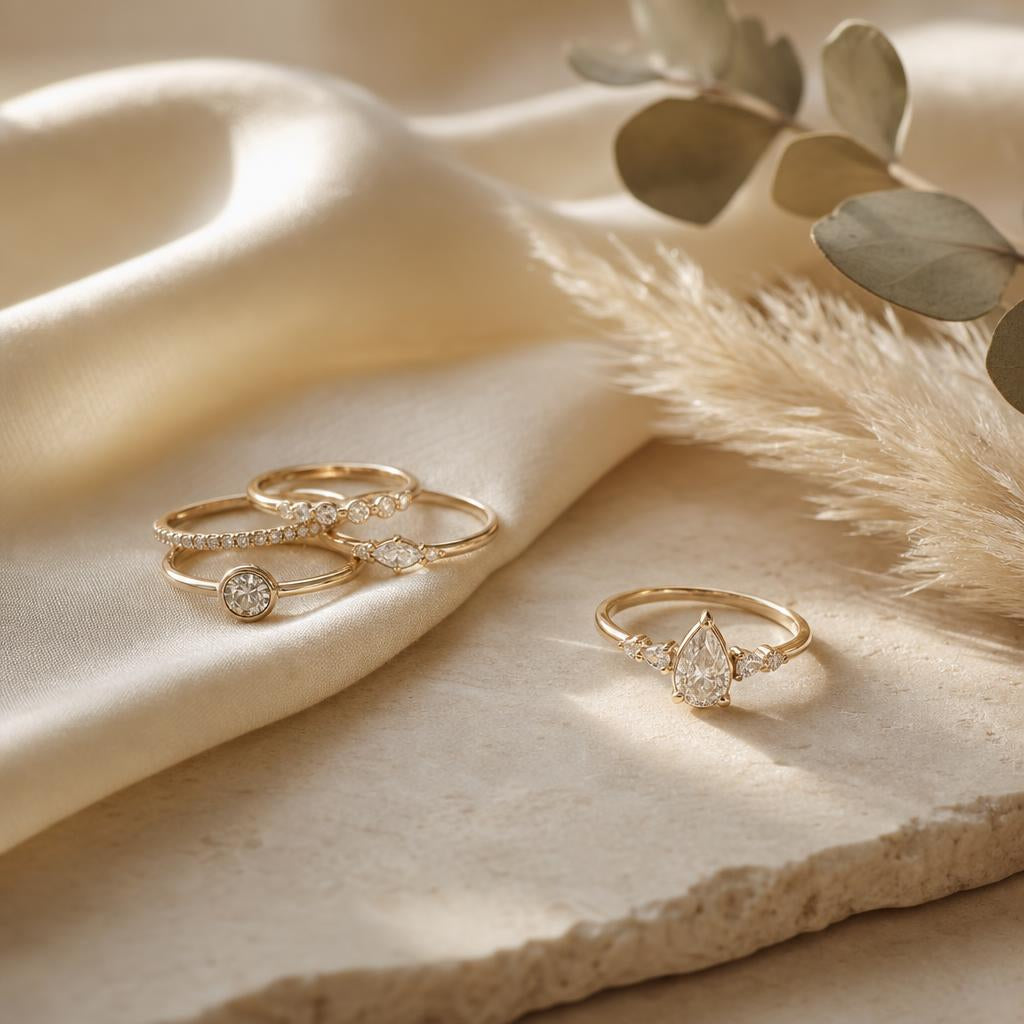
Rings for Short Nails: The Stone Shapes and Band Widths That Actually Look Proportionate
Short nails have a way of making every ring decision feel higher-stakes. Without length to visually stretch the finger, a stone that reads as elegant on a long, tapered nail can suddenly look like it's swallowing the hand — and a band that felt delicate in a photo can feel like it's fighting your whole silhouette. None of this means short nails and beautiful rings are incompatible. It means the rules shift slightly, and once you know which shapes and widths actually work in your favor, dressing your hands gets a lot easier.
The good news: some of the most flattering ring styles for short nails are also some of the most versatile, everyday-wearable pieces you can own. Here's a closer look at the shapes, settings and proportions worth reaching for first.


Why Short Nails Change the Whole Equation
A manicure does more visual work than most people give it credit for. Long, tapered nails elongate the finger before a ring ever enters the picture — they draw the eye up and out, which is exactly why so many engagement ring editorials feature almond or coffin-shaped nails. Short nails don't do that work for you. The finger reads as its natural length and width, which means the ring itself has to carry more of the visual lengthening.
This isn't a bad thing. It just means a few specific choices — stone shape, setting height, and band width chief among them — matter more than they would on a longer nail. Get those right, and a ring can still make the hand look elegant and proportionate. Get them wrong, and even a beautiful ring can end up fighting the hand instead of flattering it.
The Stone Shapes That Actually Work
Elongated cuts do the lengthening your nails can't
Oval, marquise, and pear-shaped stones all share one trait that matters enormously here: they're longer than they are wide. Set vertically along the finger, that length creates the same visual stretch a long nail would — which is exactly why oval cuts have become such a reliable pick for anyone working with a shorter nail bed. The Ophelia Ring above is a good example of the effect: the oval silhouette does the elongating, while the hidden halo keeps the setting from adding unnecessary width at the base.
Round and cushion cuts aren't off the table, but they read a little more compact by comparison. If a rounder shape is what you love, look for a taller crown or a subtly elevated setting rather than one that sits completely flat — a small amount of vertical height reads as length even on a symmetrical stone.
Step cuts bring clean, architectural lines
Asscher and emerald cuts work through a different mechanism than oval or marquise shapes — instead of a continuous curved outline, they use flat facets and straight step-cut lines. On a short nail, that structure reads as tailored and deliberate rather than soft, which can actually be more flattering than a rounder stone that has nothing to visually anchor it. The Échelon Ring is worth a close look here — its layered step-cut facets give the hand a sense of architecture without relying on length or halo width to do it.

The Odette Ring — Gold
A single oval stone set simply on a clean band — no halo, no distraction, just the elongating shape doing all the work. It's a dependable everyday pick for anyone whose nails run short.
Shop The Odette Ring →Band Width Matters More Than You'd Think
It's tempting to focus entirely on the stone and treat the band as an afterthought, but band width has an outsized effect on how proportionate a ring looks on a shorter nail. A wide, heavy band can visually shorten the finger by taking up more of its length before the eye ever reaches the stone. A narrower band, by contrast, leaves more visual room — the finger reads longer because less of it is "used up" by metal.
This is part of why bezel settings work so well here. A bezel wraps the stone in a thin rim of metal rather than raising it on prongs, which keeps the whole silhouette low, close to the finger, and visually tidy. Bezel settings are also one of the most forgiving options if you're new to thinking about proportion at all — there's very little that can look "off" about a setting that simply hugs the stone.
✦ Pro tip: If you're comparing two rings with the same stone size, try picturing them next to each other with the band widths side by side rather than just looking at the stone. The width difference will usually tell you more about how the ring will actually look on your hand than the carat size will.
Delicate pavé detailing is another way to add interest without adding bulk. Because the accent stones are small and set flush into the band, a pavé detail reads as texture rather than width — it dresses up a narrow band without making it visually heavier. The Soleil Ring below is a good example of that balance.

The Soleil Ring
A round center stone on a slim, pavé-lined band — enough sparkle to feel finished, without the visual weight of a wider setting.
Shop The Soleil Ring →Settings Worth Approaching Carefully
None of this is about ruling styles out — it's about knowing what a given setting will ask of your hand. Large, dramatic halos are the style most likely to work against a shorter nail, simply because they add width in every direction at once. A big halo doesn't lengthen anything; it just makes the widest part of the ring wider, which can make a short nail look even shorter by contrast. That doesn't mean halos are off-limits altogether — it's part of why so many people gravitate toward halo settings that stay tucked close to the stone rather than fanning outward, since a lower, tighter halo gets some of the sparkle without the added bulk.
Wide statement bands are the other style to think through carefully. They can look spectacular in isolation, but on a shorter nail they tend to compete with the finger rather than complement it. If a wider band is what you're drawn to, pairing it with an elongated stone shape — rather than a round one — will usually keep the overall look balanced.
Building a Stack That Reads as Intentional
If you wear more than one ring, the same proportion logic applies to the whole hand, not just a single piece. A narrow band or two stacked close to a low-set solitaire will generally read as more elegant on a shorter nail than several wider pieces competing for space. It's worth thinking about your rings as a small capsule rather than a series of individual purchases — the kind of approach we cover in more depth in our guide to building a capsule ring wardrobe.
It's also worth remembering that nail length is only one factor in how a ring sits on your hand — finger width, knuckle size, and overall hand shape all play a role too. If you've never thought through those together, our guide to choosing a ring that flatters your hand is a useful next step, since it walks through how shape, length and width interact well beyond just the manicure.
Worth knowing: Nail length isn't fixed — if you're deciding between two ring styles and can't tell how they'll look, try the test with both a short and slightly longer manicure before you commit. Most people find the "right" answer becomes obvious within a day or two of actually wearing the ring.
Everyday Wear Makes the Difference Visible
One more practical note: rings that work well on short nails also tend to be the ones best suited to daily wear, since low settings and narrower bands are inherently less likely to snag on clothing, catch on bag straps, or need constant adjustment. That overlap isn't a coincidence — the same qualities that make a ring look proportionate on a shorter nail (a close, low profile; a slimmer band; a shape that doesn't project outward) are the ones that make it comfortable to actually live in. If you're building toward a single everyday ring rather than a special-occasion piece, that's a good sign you're already looking in the right direction.
Quick Takeaways
- Elongated stones — oval, marquise, pear — do the visual lengthening that a long nail would otherwise provide.
- Step cuts like asscher and emerald bring structure and clean lines without relying on length.
- Narrower bands and bezel settings keep the whole ring closer to the finger and easier to read as proportionate.
- Pavé detailing adds sparkle and texture without adding visual width.
- Large halos and wide statement bands are the styles most likely to overwhelm a shorter nail — pair them with an elongated stone if you love them anyway.
Frequently Asked Questions
Do round rings just not work with short nails?
They can absolutely work — round stones just don't do the elongating that oval or marquise shapes do automatically. Look for a slightly raised setting or a narrower band to balance the proportions if a round stone is what you love.
Is a bezel setting always the safest choice for short nails?
It's one of the most forgiving, yes, since it keeps the whole silhouette low and close to the finger. But it's not the only option — a well-proportioned prong solitaire with a slim band can look just as elegant.
Can a halo ring ever work on shorter nails?
Yes, especially a hidden halo or a tighter, close-set halo rather than a large, dramatic one. The key is choosing a halo that adds sparkle without adding significant width.
Does nail polish colour affect how a ring looks, separately from nail length?
It can — darker or more saturated polish tends to visually shorten the nail further, while sheer or nude tones tend to soften the contrast between nail and skin. If you're working with short nails, a lighter polish can make the transition to the ring feel more seamless.
At the end of the day, proportion is something you can absolutely design around — it just asks you to think about the stone shape and the band together, rather than the stone alone. Once you've found the combination that works for your hand, it tends to keep working across nearly everything else in your jewelry box.


