

Rings and Hand Tattoos: How to Wear Both Without One Cancelling Out the Other
There's a particular kind of hesitation that shows up right before you slide a ring onto a hand that already has ink on it — a flicker of will this actually look right together, or will one just cancel the other out? It's a fair question. A tattoo has its own linework, its own rhythm, its own reason for being exactly where it is. A ring has weight, shine, and a completely different kind of presence. Put them on the same hand without thinking it through, and yes, they can compete. Put them there with a little intention, and they don't just coexist — they make each other look more deliberate.
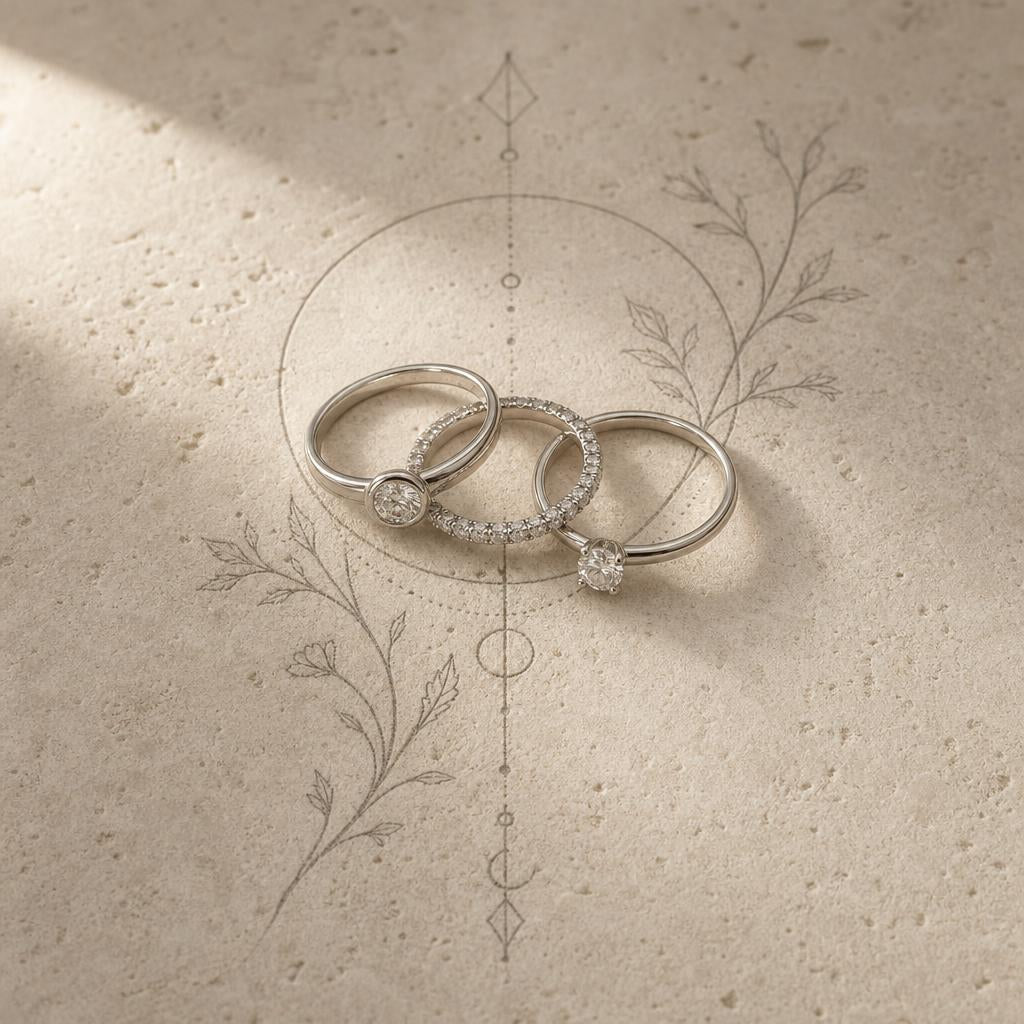
The good news is that this isn't really a mystery you have to solve from scratch. It comes down to a handful of practical choices: where your tattoo actually sits on the hand, how much visual weight a given ring style carries, and how the metal and setting interact with skin that already has something going on. Before we get into the specifics, here are a few styles worth knowing.


Why Tattoos and Rings Sometimes Fight for Attention
Here's the thing about a hand that already has tattoos on it: it's not a blank canvas anymore, and every ring you add is now in conversation with something that was there first. That's not a problem — it's just a design fact worth acknowledging. A tattoo has its own visual rhythm, made up of line weight, negative space, shading, and placement. A ring introduces a second rhythm on top of it: shape, sparkle, metal tone, height off the finger. When those two rhythms are similar in intensity, they tend to blur into visual noise. When one is quieter than the other, they read as a pairing instead of a collision.
This is really the whole principle, and almost everything else in this guide is just a variation on it. A heavily inked hand generally photographs and reads best with a ring that has a clear, simple silhouette — something the eye can register quickly before it moves back to the tattoo. A hand with one small, contained tattoo has more room to carry a ring with more presence, because there isn't already a lot competing for attention.
It's Not the Ink, It's the Layout
People sometimes assume the issue is tattoos and jewelry "clashing" stylistically, as though one is inherently more polished than the other. That's not really it. A fine line tattoo and a delicate pavé band can look stunning together. A bold traditional piece and a chunky signet can too. What actually causes visual conflict is layout — two things demanding attention from the same small area of skin with no breathing room between them. Once you think of it as a spacing problem rather than a style problem, the choices get a lot easier to make.
Read Your Tattoo's Placement First
Before you think about ring style at all, look at exactly where the ink sits, because that changes the calculus more than anything else.
Knuckle and finger-band tattoos sit closest to where a ring actually rests, so they interact with jewelry the most directly. If your tattoo wraps or sits right at the base of a finger, a ring with a smooth, low profile tends to sit against it more comfortably than one with prongs or raised claws, which can catch on the edge of the design or simply visually cut through it. This is where a bezel setting earns its reputation — the metal wraps the stone in a continuous rim rather than gripping it from four or six points, so the line stays clean whether your finger is bare or already carrying artwork.

The Cherish Ring
A continuous bezel-set band with no prongs to catch on knuckle or finger-band ink — each stone sits flush in its own smooth setting, so the line of the ring stays uninterrupted next to the line of the tattoo.
Shop The Cherish Ring →Back-of-hand and wrist-adjacent tattoos give you the most freedom, because they're not directly under or beside the ring itself — they're part of the broader hand, visible in the same glance but not in immediate contact. Here you can go bolder with the ring itself, since the two pieces are more like neighbors than roommates.
Worth knowing: Tattoo placement isn't fixed forever the way it feels in the first few months. As tattoos settle and soften slightly with age, some people find they can wear rings they avoided early on. If a piece felt like too much right after healing, it's worth revisiting a year or two later.
Choosing a Ring That Complements Rather Than Competes
Once you know where your tattoo sits, the next decision is how much visual weight your ring should carry. A few general patterns hold up well:
- Dense, heavily saturated tattoos (bold traditional work, solid black fill, dark linework) tend to pair best with rings that have a clean, contained silhouette — a solitaire or a slim stacking band rather than something wide or ornate.
- Fine line and single-needle tattoos have more visual quiet built in, which means they can actually handle a ring with a bit more sparkle or shape without things getting busy.
- Colour work introduces its own hierarchy of attention, so a ring in a cooler, quieter metal tone (like rhodium-plated silver) usually reads as more intentional than one that's fighting the same warm tones as the ink.
- Faded or older tattoos have softened enough that almost any ring style works, since the contrast between skin and ink is naturally lower than it was when the piece was fresh.
When a Statement Ring Actually Works
None of this means a tattooed hand is stuck wearing only minimalist rings forever. A statement ring can absolutely work — it just tends to work best when it has its own clear moment, rather than sitting directly on top of the busiest part of a design. Think of it the way you'd think about styling a bold print with bold jewelry: it's not impossible, it just asks for a bit more editing elsewhere. If your hand has one dramatic tattoo, let the ring either echo its energy on a different finger or go quiet where they're closest together.
Stacking Rings on a Tattooed Hand
Stacking adds another layer of decisions, because now you're managing three visual elements at once: the tattoo, and however many rings you're wearing together. The safest approach is to let the stack read as one unit rather than several competing pieces — thin, similarly-toned bands that sit close together tend to look considered next to linework, where a jumble of different widths and finishes can start to look accidental.

The Devotion Ring
A circle of baguette-cut stones with a sharp, architectural edge — the geometry pairs naturally with fine line or dotwork tattoos, echoing straight lines instead of competing with curves.
Shop The Devotion Ring →If your tattoos are geometric or linear, a stacking band with straight-edged stones — baguette cuts, for example — can pick up that same architectural quality rather than reading as a totally separate design language. If your tattoos are soft and organic (florals, script, watercolour-style shading), a rounder, pavé-set stacking band usually feels more like an extension of the same mood.
The Practical Side Nobody Talks About: Healing and Timing
Styling aside, there's a real, practical timing question that comes up constantly and deserves an honest answer: fresh tattoos and jewelry don't mix, at least not right away. A new tattoo is technically an open wound while it heals, and anything that traps bacteria, causes friction, or puts pressure on the area — including rings — needs to wait until the skin has fully closed and settled.
✦ Pro tip: Most people can comfortably return to wearing a well-fitted ring somewhere in the range of one to two weeks after a hand or finger tattoo, once the surface has fully healed, though this varies by person and by how the tattoo is healing. If a ring still feels tight, itchy, or irritated against the area, it isn't fully ready yet — give it more time rather than forcing it.
This is also a good moment to think about ring width and profile if you know a hand tattoo is coming. A narrower band puts less surface area in direct contact with fresh skin than a wide, chunky one, which can make the return to wearing jewelry a little more comfortable in those first weeks.
Quick Takeaways
- Think of tattoos and rings as two visual rhythms — the goal is spacing, not matching styles.
- Knuckle and finger-band tattoos pair most comfortably with smooth, low-profile settings like bezels.
- Dense, saturated tattoos generally want quieter rings; fine line and faded tattoos can handle more sparkle.
- When stacking, let thin, similarly-toned bands read as one unit rather than several competing pieces.
- Give a new hand tattoo time to fully heal before wearing rings over or near it again.
Frequently Asked Questions
Can I wear a ring over a tattoo?
Yes, once the tattoo has fully healed. On healed skin, a ring worn over or near a tattoo is no different from wearing it on bare skin — the main things to think about at that point are style and comfort, not healing. On a fresh tattoo, wait until the area is completely closed and no longer tender before putting jewelry back on.
How long after a hand tattoo can I wear rings again?
It depends on the person and how the tattoo heals, but most people find they can comfortably wear a well-fitted ring again somewhere between one and two weeks after a hand or finger tattoo. If the skin still looks shiny, feels tight, or is at all irritated, it's worth waiting a bit longer.
Do bezel settings really make a difference next to tattoos?
In practical terms, yes. A bezel setting encloses the stone in a smooth rim of metal rather than gripping it with prongs, so there's no raised edge to catch against skin or visually break up a tattoo's line. It's a small structural difference that ends up mattering more than people expect once you're wearing rings near ink daily.
Should tattoo placement change which finger I wear a ring on?
It can, and it's worth considering. If one finger has a knuckle or band tattoo you'd rather not layer a ring over, there's no rule saying your ring has to go on that exact finger. Moving a piece to a neighboring finger, or wearing it slightly higher or lower than you normally would, is a simple way to let both the tattoo and the ring have their own space.
At the end of the day, tattoos and rings aren't competing for the same job. One is permanent artwork; the other is something you can change with your mood, your outfit, or the season. The hand doesn't need to pick a side — it just needs a little thought about spacing, weight, and timing so both things get to do what they do best. Once you've found the styles that work with your specific ink, it stops feeling like a negotiation and starts feeling like just how your hand looks.


