

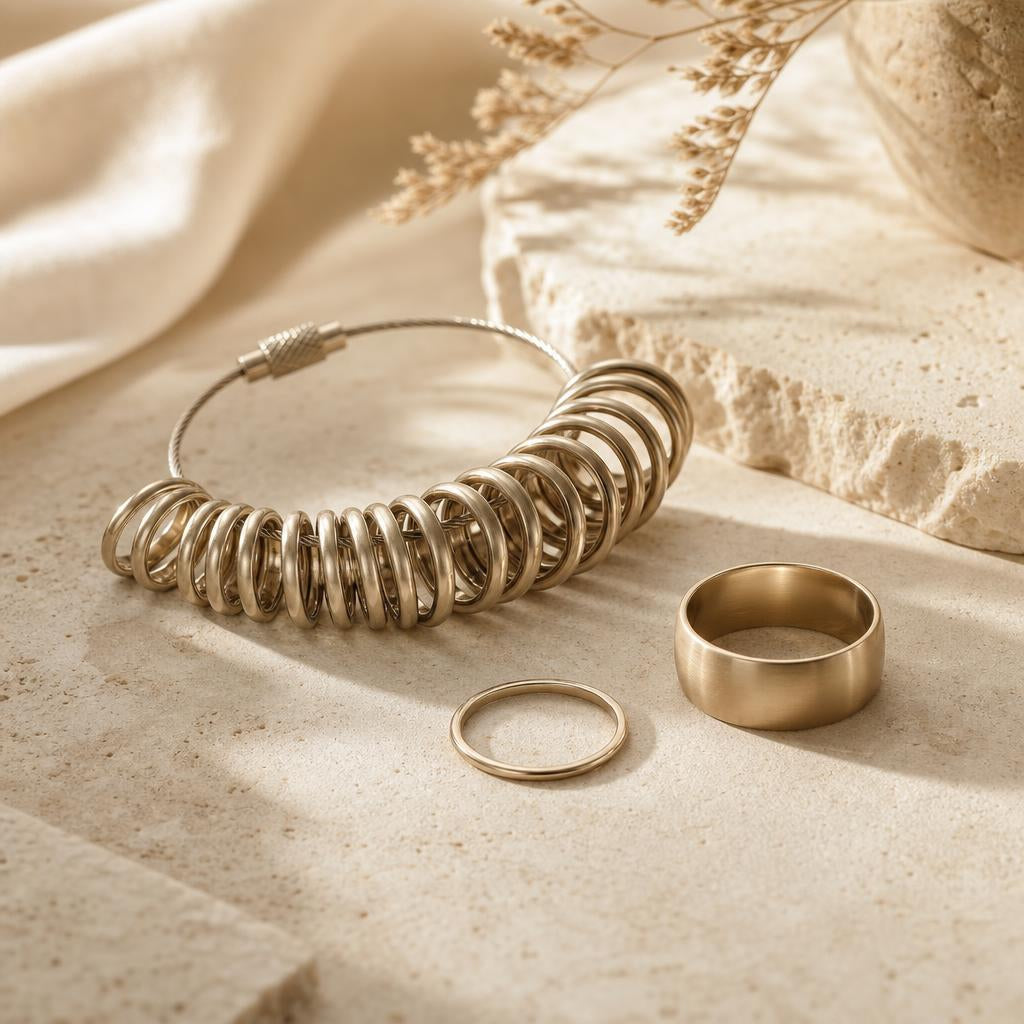
Ring Sizing for Slender and Full Fingers: What Actually Changes at Each End of the Spectrum
Two women can wear the exact same ring size and have completely different experiences putting the ring on, wearing it through a full day, and taking it off at night. One of them has slender fingers, and the ring spins toward her palm by lunchtime. The other has fuller fingers, and the same style feels snug at the knuckle but loose everywhere else. Neither of them measured wrong. The number on the sizer was never the whole story.
Ring size accounts for circumference — but it says nothing about how a band's width, profile, or setting interacts with the actual shape of your finger. That interaction is where most fit complaints actually come from, and it plays out differently depending on which end of the spectrum you're on. Here's what changes at each end, and which styles tend to handle both of them well.


Why "Size 7" Doesn't Mean the Same Thing on Every Hand
A ring size measures the circumference of a circle — the inside diameter of the band at one specific point. What it can't measure is the shape of the finger that circle is going to sit on. Two fingers can share an identical circumference at the base and still behave completely differently once a ring is actually on: one tapers gently from knuckle to base, the other has very little difference between the two, and a third might be the reverse, with a knuckle notably wider than the base beneath it.
Slender fingers tend to have less separation between joints, which sounds like it should make sizing simpler — and for getting the ring on and off, it often is. The complication shows up after that: a band with nothing to grip against can rotate freely, sliding around to face any direction it wants throughout the day. Fuller fingers face closer to the opposite problem. There's frequently more difference between the knuckle and the base, which means a ring sized to clear the knuckle can feel noticeably loose once it settles below it.
Neither of these is a flaw in your hand. They're just two different geometries, and a ring that's designed without either one in mind will always compromise somewhere.
What Actually Changes for Slender Fingers
The main challenge on slender fingers isn't getting a ring on — it's keeping it oriented once it's there. A band with a rounded, low-contact profile has less surface area gripping the finger, so lightweight, thin settings are the styles most likely to spin toward the palm during the day. The fix isn't always a tighter size. It's often a different shape of band altogether — one with slightly more surface contact or a flatter interior that resists rotation.
This is also where scale plays a bigger role than most buyers expect. A wide, heavy-topped setting on a slender finger doesn't just look proportionally larger — it changes the ring's center of gravity, making it more likely to twist toward whichever side is heaviest. Thinner, evenly weighted bands sit still more easily, and they're also the styles that stack cleanly if you're planning to build a look around more than one ring.

The Infinity Ring
A slim, evenly weighted pavé eternity band with no single heavy point to pull it off-center. It sits flat against the skin, resists rotating through the day, and layers cleanly against other thin bands if you're building a stack.
Shop The Infinity Ring →✦ Pro tip: If a ring keeps rotating on a slender finger, it's rarely a sizing problem you can fix by going tighter. A tighter fit that still spins just becomes a tighter fit that still spins — and now it's harder to remove. Look at the band shape before you touch the size.
What Actually Changes for Full Fingers
On fuller fingers, the more common issue is the reverse: the ring clears the knuckle comfortably but then has extra room once it's past it, especially toward the end of the day when fingers naturally soften. This is the mismatch between your knuckle and the base of your finger showing up in real time, and it's one of the most common reasons a ring that fit perfectly in the store starts to feel loose a few weeks in.
Wider bands and side-stone settings tend to work in your favor here, not against it. A wider silhouette distributes pressure across more of the finger rather than concentrating it at one narrow point, which reads as more secure and generally more comfortable over a full day. It also has a visual benefit: a band with a bit more presence tends to look proportionate rather than like it's trying to disappear, so you're not fighting the ring's own scale on top of everything else.

The Orabelle Ring
An oval centre stone flanked by side stones for a wider, more substantial silhouette. The extra width distributes pressure evenly across the finger and reads as proportionate rather than delicate.
Shop The Orabelle Ring →The Comfort-Fit Question That Matters More Than the Number
Comfort fit bands — the ones with a gently rounded interior instead of a flat one — matter more at this end of the spectrum than most buyers realize before they've worn one. A flat interior edge creates a defined pressure line right where it meets the finger, which becomes more noticeable the more surface area is in contact with the skin. A rounded interior spreads that same pressure out, so the ring can sit at true size without ever feeling like it's gripping.
This isn't only a fuller-finger consideration, either. Anyone who wears a ring for extended hours — through a full workday, a flight, a workout — tends to notice the difference a rounded interior makes regardless of finger width. It's a small structural detail that has an outsized effect on how a ring actually feels by hour eight.
Worth knowing: Get sized later in the day rather than first thing in the morning. Fingers are consistently at their smallest after waking and gradually settle to their "normal" size within a few hours — sizing in the morning is one of the most common reasons a ring feels tight by afternoon.
Band Width: The Detail Both Ends of the Spectrum Get Wrong
Band width is where slender and full fingers make opposite mistakes. On a slender finger, a wide band can look disproportionate — like the setting is wearing the hand rather than the other way around — and it exaggerates rather than balances the width difference between the ring and the finger beneath it. On a full finger, the reverse happens: a very thin band can look underscaled, almost lost against the width of the finger, even when the stone itself is a reasonable size.
As a rough guide, bands in the 1.5–2mm range tend to suit slender fingers best, keeping the proportions in balance without adding visual bulk. Bands from around 2.5mm up read as more substantial and tend to suit fuller fingers, distributing weight and pressure more evenly across the finger's width. These aren't hard rules — personal style matters more than any measurement — but they're a useful starting point if you're choosing between two otherwise similar settings.
When to Size Up, When to Stay True to Size
The instinct on a full finger is often to size up "to be safe," and the instinct on a slender finger is to size down to stop a ring from spinning. Both instincts are usually the wrong move. Sizing up to accommodate a knuckle just recreates the looseness problem below it, and sizing down to stop rotation on a slender finger usually just makes the ring harder to remove without solving the spinning at all.
The better approach is to size accurately to the base of the finger — where the ring will actually rest most of the day — and then address the knuckle and rotation issues through the style of the setting rather than the number. If you're between sizes, it's worth reading up on which direction tends to serve you better before defaulting to "round up," since the right call depends on the band width and setting you've chosen, not just your measurement.
It's also worth remembering that identical sizes don't always behave identically across different settings, which is part of why some sizing advice sounds right in theory but usually isn't reliable in practice once you're shopping a specific style.
Quick Takeaways
- Ring size measures circumference, not the shape of your finger — that's why identical sizes can fit so differently.
- Slender fingers are more prone to spinning bands; look at band shape and weight distribution, not just size.
- Full fingers often show a gap between knuckle and base — wider, side-stone settings tend to sit more securely.
- Comfort fit (rounded interior) bands reduce pressure for both ends of the spectrum, especially over long wear.
- Size to the base of the finger, then solve knuckle and rotation issues through the setting style, not the number.
Frequently Asked Questions
Does a wider band actually need a bigger size?
Often, yes, by a small amount. A wider band takes up more physical space around the finger, so the same numeric size can feel slightly tighter than a thin band would in that same size. If you're moving from a slim band to a wider one, it's worth trying it on rather than assuming your existing size carries over exactly.
Can the same ring feel different on my left hand versus my right?
Yes — it's common for a dominant hand to be very slightly larger due to muscle development and daily use, and most people don't have perfectly symmetrical fingers to begin with. If you're sizing for a ring you'll wear long-term on one specific hand, measure that hand specifically rather than assuming both sides match.
Should I size based on my knuckle or the base of my finger?
The base, in almost every case — that's where the ring will actually rest for most of the day. If your knuckle is noticeably wider than your base, look for settings and band widths designed to ease over that difference rather than sizing up to accommodate it.
Do Gemiros rings run true to size?
Yes — Gemiros rings are sized to standard US ring sizing. If you're unsure where you land, sizing later in the day and measuring the base of the finger you plan to wear the ring on will give you the most accurate read before you order.
Whichever end of the spectrum you're on, the fit issues that actually bother people day to day are rarely about the number being wrong — they're about a setting that wasn't chosen with your finger's particular shape in mind. Once you know what to look for, it becomes a lot easier to tell which rings are worth trying on and which ones were always going to fight you.


