

Ring Sizing for Larger Body Types: What Changes, and What Doesn't
Most ring sizing advice is written for one kind of hand — and if yours doesn't match it, the standard tips start falling apart fast. "Just measure with a string" doesn't account for a knuckle that's noticeably wider than the base of your finger. "Go up half a size" doesn't tell you which half size, or why. If you've ever ordered a ring that slid past your knuckle and then sat loose, or one that fit at the knuckle and never made it past the joint at all, the problem usually isn't your finger. It's that most sizing guidance was never built with the full range of hand sizes in mind.
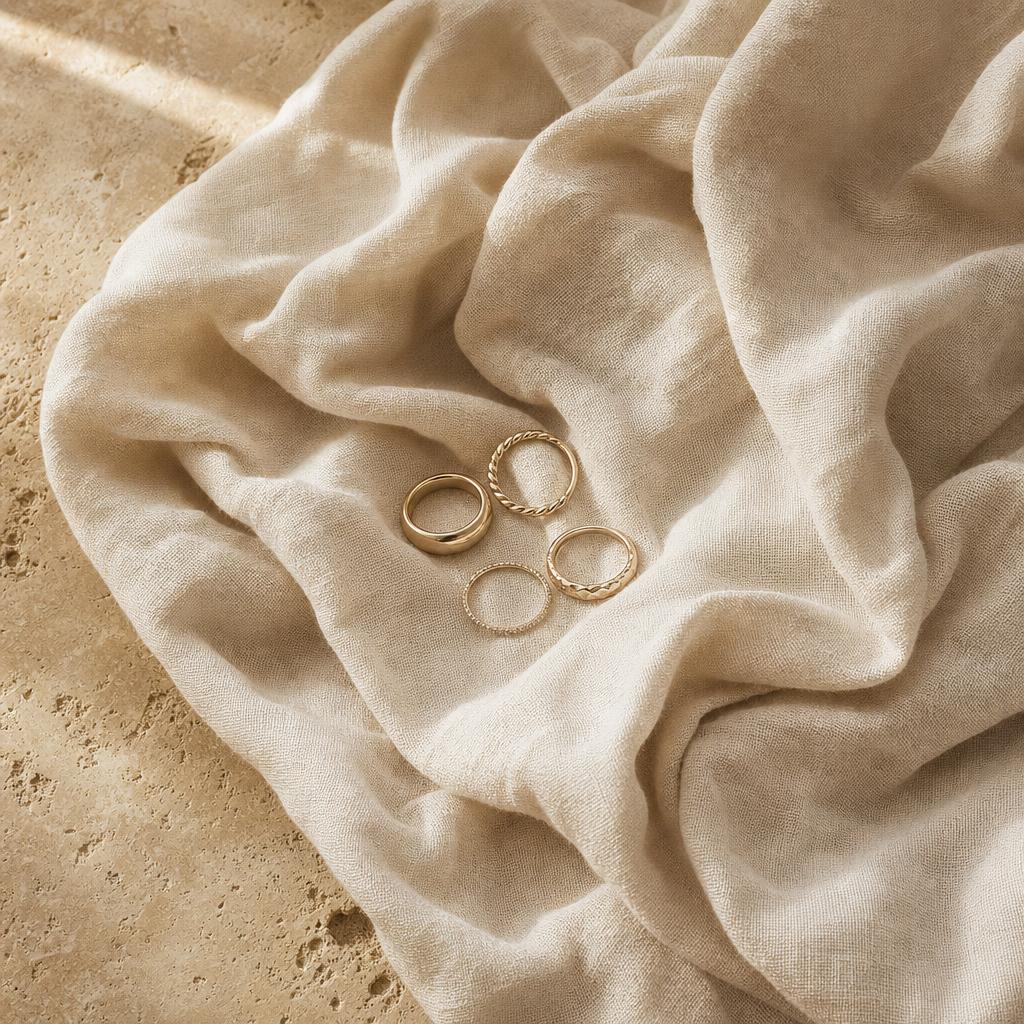
The good news is that fitting a ring properly on a fuller hand isn't guesswork — it just uses a few different reference points than the generic advice does. Before we get into the specifics, here's a spread of styles worth knowing about, each of which tends to behave a little differently once size and band width come into play.

Why the same "size" can fit two hands so differently
Ring sizing charts measure one thing: the circumference of a specific point on your finger. What they don't measure is the relationship between that point and everything around it — how much wider your knuckle is than the base of your finger, how much your finger tapers between the first and second joint, and how much padding sits just below the surface. On a fuller hand, that gap between knuckle and base is often more pronounced, which is exactly why a ring that glides on comfortably can still feel loose once it's past the joint, or why a ring sized to clear the knuckle can feel snug at the base all day. This isn't a flaw in your hand. It's a limitation of a sizing system that was designed around a single, narrow reference point. Once you understand that the knuckle-to-base relationship is the real variable — not just "size" as a single number — the whole process gets a lot less frustrating.
Worth knowing: Jewelers have a name for the gap between knuckle and base measurements — they simply call it "the difference." A difference of one full size or more is common and completely normal; it isn't a sign that anything is wrong with your hand.
Getting an accurate size when your hand is fuller
The most common mistake isn't measuring wrong — it's measuring only one point and assuming it tells the whole story. A more reliable approach takes two measurements and works with the difference between them, rather than trying to force one number to do both jobs.
- Measure at the base, not the knuckle. Wrap a strip of paper or a ring sizer snugly around the base of the finger where the ring will actually sit day to day, not around the knuckle itself.
- Measure the knuckle separately. Do the same at the widest part of the knuckle, when your hand is at a normal, unswollen temperature — not right after a workout or a hot shower.
- Note the difference between the two. If your knuckle measures noticeably larger than your base, that gap is the single most useful piece of information you can hand a jeweler, in person or online.
- Measure at the right time of day. Hands are typically smallest in the morning and can swell later in the day, after exercise, or in heat — measure a few times across different points in the day and use the middle of the range.
✦ Pro tip: If you're buying online and can't be professionally sized in person, order a printable ring sizer or a set of plastic ring sizers before you buy — they cost almost nothing and remove nearly all the guesswork from a first purchase.
Settings that actually behave better on a fuller hand
Not every setting responds to knuckle-to-base differences the same way. Some styles are genuinely easier to size confidently on a fuller hand, simply because of how they're built — not because they're marketed that way, but because of how the metal actually sits against skin.

The Cherish Ring
A bezel setting wraps each stone in a smooth rim of metal instead of raised prongs, so there's nothing to catch or dig in at the knuckle on the way past. It's one of the more forgiving styles to size confidently, especially for anyone who's dealt with a prong-set ring snagging mid-slide.
Shop The Cherish Ring →Low-profile solitaires behave well for a similar reason — a clean, close-to-the-finger setting has less surface area to catch against a wider knuckle than a tall, elevated one. A style like this asscher-cut solitaire keeps its silhouette simple enough that sizing feels straightforward rather than fussy.

The Échelon Ring
A structured 1.25 carat asscher-cut solitaire with a clean, close band profile. Its simplicity is exactly what makes it easy to size with confidence — there's no elaborate setting geometry working against the fit.
Shop The Échelon Ring →Hidden halo settings deserve a mention too — not because they change how a ring sizes, but because of what they do visually. A hidden halo tucks a ring of small stones just beneath the center stone, which adds perceived size and sparkle without adding width to the band itself, so it doesn't change how the ring behaves against a fuller knuckle.
What actually stays the same
It's worth saying plainly: a fuller hand doesn't change the fundamentals of how rings work. The metal, the settings, the resizing process, and the core sizing logic are identical regardless of hand size. What changes is which measurement matters most and how much attention that knuckle-to-base gap deserves before you order — not the ring itself, and not the guidelines that apply to it.
Resizing works exactly the same way it does for any other hand. Sterling silver rings can typically be sized up or down within a reasonable range by a jeweler, and the same comfort-fit interior options — a slightly rounded inner band that reduces friction against the skin — are available regardless of the size you're ordering. If anything, the standard advice about avoiding a too-tight fit applies with more consequence here, not less: a ring that's genuinely too snug at the knuckle is harder to remove in heat or after exercise, so it's worth erring very slightly loose rather than snug.

The Duchess Ring
A double halo of pavé stones around a cushion-cut center, designed to maximize visual size without adding band width. A striking option when you want more presence without more bulk against the hand.
Shop The Duchess Ring →Band width: the detail most sizing guides skip
Band width has an outsized effect on how a ring feels, and it's rarely discussed alongside sizing. A wider band takes up more surface area at the knuckle, which means the same numerical size can feel noticeably tighter in a wide band than in a thin one. If you're between two sizes, a wider band is generally the case for sizing up rather than down — the extra surface contact makes a snug fit more noticeable and more uncomfortable over a full day of wear.
This matters just as much when you're building a stack. Adding a second or third band around an existing ring changes the effective width sitting against your knuckle, even if each individual piece is sized correctly on its own. It's one of the reasons a stack that looked fine in isolation can suddenly feel crowded once it's all worn together — worth factoring in before adding a third or fourth ring to a wedding band for cushion cut rings or any other centerpiece you already own.
A note on swelling and day-to-day variation
Fingers change size throughout the day for everyone, but the swing can be more noticeable on a fuller hand simply because there's more soft tissue to respond to heat, salt intake, medication, and activity. This isn't something to size around perfectly — it's something to plan for. A ring that fits comfortably during a normal afternoon is doing its job; expecting it to feel identical after a long, hot day or a salty meal isn't realistic for any hand shape, and adjusting your expectations (rather than your size) is usually the right move.
Worth knowing: If a ring fits well most days but feels tight occasionally, that's normal daily fluctuation — not a sizing mistake. Reserving a properly-fitted ring for the days it feels snug rather than resizing at the first sign of tightness will usually save you an unnecessary trip to the jeweler.
Quick Takeaways
- Measure both the base of your finger and your knuckle separately — the difference between them matters more than either number alone.
- Bezel settings and low-profile solitaires tend to glide past a knuckle more comfortably than tall prong settings.
- A wider band will feel tighter than a thin band at the same numerical size — size up slightly for wide styles.
- Hidden halo settings add visual size without adding band width, so they don't change how a ring fits.
- Resizing, materials, and comfort-fit options work exactly the same regardless of hand size — only the measurement approach changes.
Frequently asked questions
Should I size for my knuckle or the base of my finger?
Size for the base of your finger, where the ring will sit day to day — but take a separate knuckle measurement too. If the gap between the two is large, a jeweler can advise on a size that balances comfortably getting the ring on with a secure fit once it's past the joint.
Is it true that wider bands need to be sized up?
Generally, yes. A wider band has more surface contact with your knuckle, which makes the same numerical size feel tighter than it would in a thin band. If you're between sizes and choosing a wider style, sizing up is usually the more comfortable call.
Does a fuller hand mean a ring will be harder to resize later?
No. Resizing works the same way regardless of hand size — a jeweler adjusts the band within a reasonable range either up or down. The process, materials, and typical limits are identical.
What if my size seems to change throughout the year?
That's common and not specific to any hand size — heat, humidity, salt intake, and activity level all affect finger size temporarily. If the change is seasonal and mild, it's usually more practical to live with slight variation than to resize every few months.
The most useful thing to take away from all of this is that fitting a ring well on a fuller hand isn't a different process — it's the same process, done with a little more attention to the gap between two measurements instead of one. Once you know your base size and your knuckle size, and you understand how band width and setting style interact with both, choosing a ring that actually feels right stops being a guessing game.


