

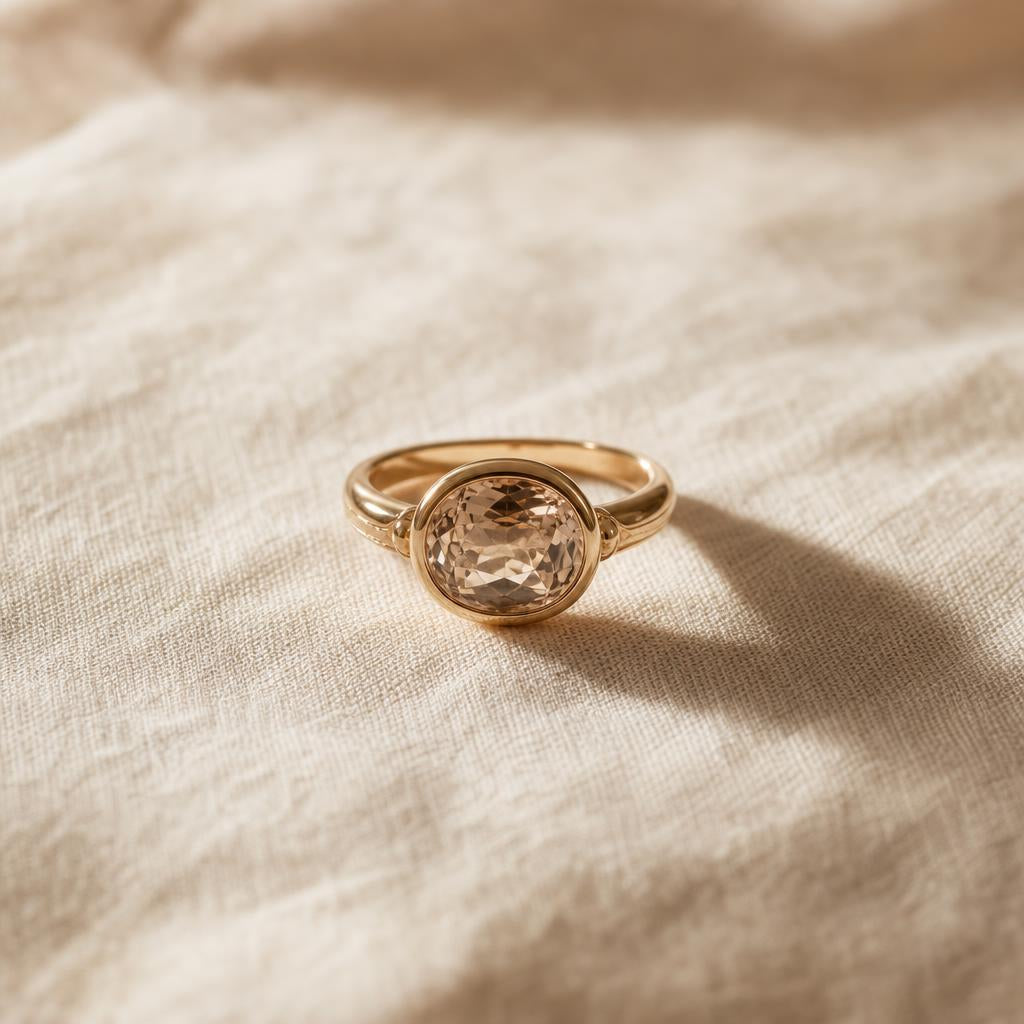
The Ring as a Boundary: What It Means to Buy One for Yourself
Nobody asks a man why he bought himself a watch. But say out loud that you bought yourself a ring, and you can watch the question form on someone's face before they've even said it: for what occasion? The honest answer — none — is the whole point.
More women are treating a ring purchase as something they don't need a reason for. Not a placeholder for a proposal that hasn't happened. Not a consolation prize. A boundary, quietly drawn: this is mine, and I decided it, and that's reason enough.


The question nobody needs to answer
There's an unspoken rule that a ring has to be earned by someone else's decision. A proposal. An anniversary. A milestone somebody else remembers on your behalf. It's a strange rule when you actually look at it — nobody applies that logic to a coat, a car, or a vacation. Yet a ring, somehow, is supposed to wait for permission.
The women skipping that rule aren't rebelling for the sake of it. They've just noticed the math doesn't hold up. If the piece is beautiful, well made, and something you'll wear for years, the person who buys it matters a lot less than the fact that it gets bought. Buying a ring for yourself isn't a workaround for a missing partner or a missing occasion. For a lot of women, it's simply the more efficient path to something they were always going to want.
What "boundary" actually means here
A boundary isn't a wall. It's a line that says: past this point, I decide. Applied to jewelry, it looks like this — you stop waiting for someone else's timeline to intersect with your own taste, and you stop treating "I bought it myself" as something to explain away at dinner. The ring on your hand doesn't need a backstory involving another person to be worth wearing.
This is where the old jewelry-store script actually falls apart. It was built entirely around a second person — his budget, his research, his surprise. A self-purchased ring removes that person from the equation and, with him, the waiting. You're not settling for less romance. You're removing a dependency that was never actually necessary for the ring to mean something.
Worth knowing: A self engagement ring isn't a smaller, sadder version of the traditional kind. It's the same object, the same craftsmanship, the same sparkle — just without a middleman deciding when you're allowed to have it.
Why the fear talk misses the point
The two questions that come up most when women consider a ring to buy for yourself are: will people assume something about my relationship status, and will it look like I'm compensating for something? Both questions assume the ring is a signal meant for other people to decode. It isn't. It's for your hand, your light, your Tuesday.
And the material fear underneath both — will it look cheap, will it hold up — deserves a straight answer, not a soft one. Gemiros rings are set in 925 sterling silver with moissanite or CZ stones that are indistinguishable from a diamond to the naked eye and pass diamond testers. No one is going to clock the difference, including your jeweler. That's not a hedge. That's the actual, defensible fact.
The old permission structure, retired
For a long time, "earning" a ring meant someone else spending three months' salary to prove something. That was never really about the ring — it was about a manufactured scarcity that made jewelry stores money. The intelligent move isn't spending more to prove you're worth it. It's recognizing the markup for what it is and buying the version that gives you the same look without funding the myth.

The Empress Ring
A 3.5-carat elongated oval center stone flanked by tapered baguette side stones, set in a polished four-prong silhouette. This is the ring for the woman who isn't asking the room's permission to take up space on her own hand.
Shop The Empress →What women are actually marking with the purchase
Talk to enough women who've bought their own ring and a pattern shows up fast. It's rarely about the ring shape or the carat look. It's about a moment — a promotion, a lease signed alone, a hard year survived, a relationship that ended and a new chapter that started without waiting for the next one to begin. The ring becomes a marker for the decision itself: I got here, and I noticed.
That's a different emotional job than a gift ring does. A gift ring commemorates something between two people. A self-purchased one commemorates something between you and yourself — and there's no reason that story needs to be smaller.
It also tends to be a more durable kind of meaning. A gift ring's story belongs partly to the person who gave it — retell it, and you're retelling their gesture too. A ring you chose and paid for is a story with a single author. Years later, the memory attached to it doesn't depend on whether that relationship lasted. It's yours regardless of what came after.
✦ Pro tip: If you're building toward the purchase rather than buying on impulse, treat it like any considered decision — try a few silhouettes on, compare how a halo versus a solitaire actually sits on your hand, and give yourself the same research window you'd want a partner to take.
Choosing a ring that's actually yours
Because there's no second person's taste to compromise with, self-purchased rings tend to be more decisive than gifted ones. Buyers reach for shapes and settings that reflect exactly what they want — not what they think will read as "appropriate" for someone else to have chosen. That's part of why this category skews toward pieces with real presence: an oval with side stones, a radiant cut with a hidden halo, a twist detail that catches the eye from an angle a plainer setting wouldn't.

The Devotion Ring
A continuous channel of baguette-cut stones with architectural precision — worn alone as a statement or stacked as the first piece in a collection you're building entirely on your own terms.
Shop The Devotion →The quiet rise of self-love rings
Search interest in self love rings for women has been climbing for a reason — the idea of wearing something that marks your own commitment to yourself, rather than someone else's, has moved from niche to mainstream. It's not a trend built on hashtags. It's a shift in who gets to decide when a piece of jewelry means something.
Part of that shift is generational. The women buying rings for themselves at 30 grew up watching an older generation treat jewelry almost entirely as something received — an engagement, an anniversary, a milestone birthday marked by somebody else's gift receipt. That model isn't wrong so much as incomplete. It assumes every meaningful moment in a woman's life involves another person handing her something. Plenty of the moments that actually matter don't.
There's also a practical layer underneath the emotional one. Waiting for a gift ring means waiting for someone else's budget, someone else's calendar, and often someone else's guess at what you'd actually choose. Buying it yourself collapses all three variables into one decision you control from start to finish — no guessing, no compromise on the setting, no ring that's technically lovely but not quite what you would have picked.
None of this requires a bigger budget than a gift ring would. Shopping for a diamond ring for myself, as more than one buyer has put it, doesn't mean settling for less than a traditional jeweler would charge to deliver the same look. The value was never really in who paid — it was in the craftsmanship, and that part hasn't changed.
Quick Takeaways
- A self-purchased ring isn't a smaller version of a gifted one — it's the same craftsmanship without the waiting
- Both core fears (looking cheap, not holding up) have direct answers: 925 sterling silver, moissanite or CZ that passes diamond testers
- Self-purchased rings tend to be more decisive in style, since there's no second person's taste to factor in
- The purchase usually marks a moment you chose for yourself, not an occasion someone else set
Frequently Asked Questions
Should I buy a ring for myself?
If you'd want the ring regardless of who paid for it, there's no reason to wait. The craftsmanship, the sparkle, and the way it sits on your hand don't change based on who was holding the card at checkout.
What does it mean when you buy yourself a ring?
For most women, it marks a decision rather than a relationship status — a milestone, a hard year closed out, or simply the recognition that beautiful things don't need to wait for someone else's timeline.
Is it bad luck to buy your own engagement-style ring?
No — that idea is a holdover from a tradition built around someone else's proposal timeline, not a rule with any real basis. A ring you choose and pay for yourself is no less meaningful than one chosen for you.
What finger do you wear a ring you bought yourself on?
There's no fixed rule. Many women wear a self-purchased ring on the right hand to visually distinguish it from engagement-ring convention, though plenty simply wear it wherever it feels most natural on their hand.
The ring doesn't need a story about someone else to be worth wearing. It needs to be well made, genuinely beautiful, and yours — and the moment you stop waiting for permission to buy it is the moment the boundary actually holds.


