

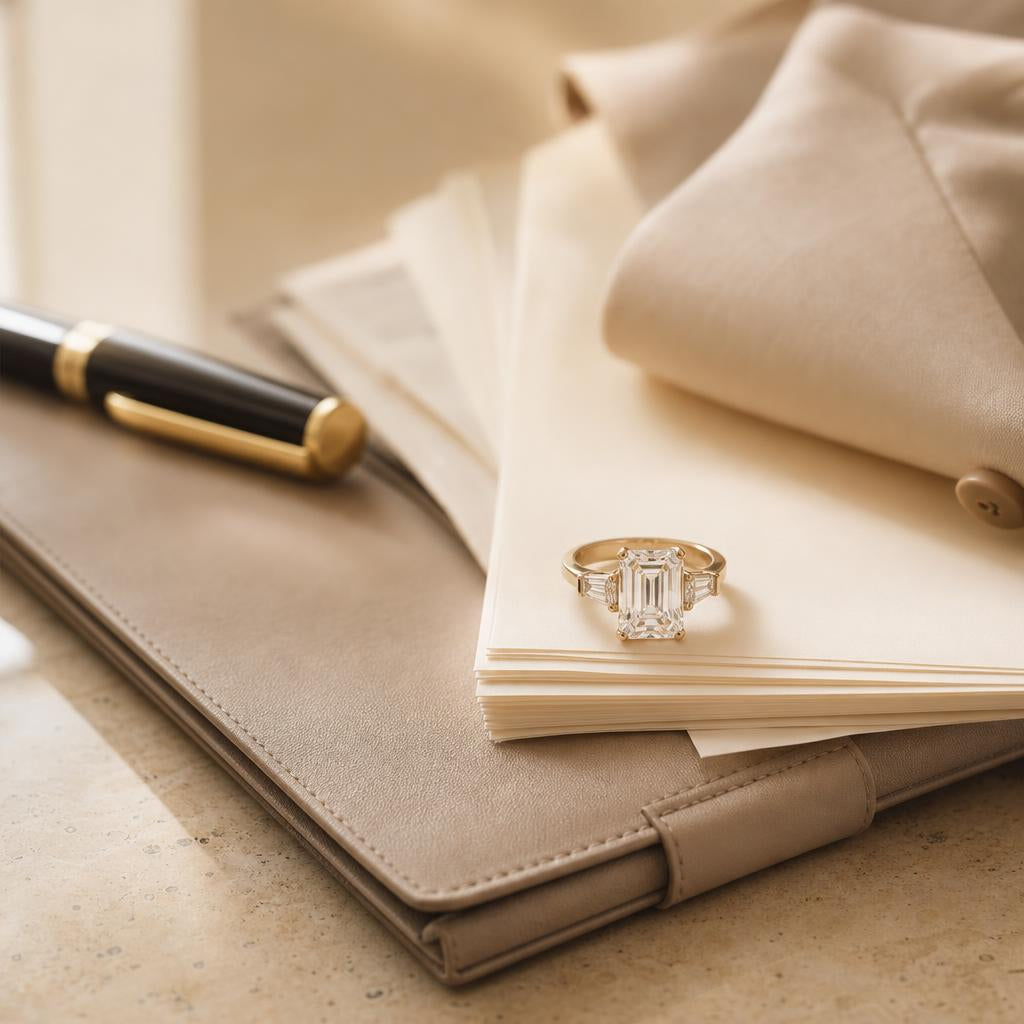
Promotion and New-Job Rings: Marking a Career Milestone You'll Wear Daily
No one throws you a party for a promotion the way they do for a wedding. There's no registry, no shower, no built-in excuse to buy something beautiful and call it tradition. So when the offer letter lands, or your manager finally says the words you've been working toward for a year, the moment tends to pass with a congratulations email and a round of drinks you pay for yourself. You did the work. You get to decide what marks it.
A ring is a strange thing to buy for a career milestone, until you actually think about it. It's the one piece of jewelry you'll see on your own hand forty times a day — typing, signing, gesturing through the exact meetings that got you here. A necklace lives under a blazer. A ring is in view the whole time.


Why a ring makes sense for a career milestone
There's an entire industry built around congratulating people at work, and it runs almost entirely on candles, mugs, and gift baskets that get used once and then live in a drawer. None of that is wrong, exactly — it's just designed for someone else to buy you, in an amount they feel comfortable spending on a coworker. It was never built for the version of this where you're the one who decided what the moment was worth.
That's the actual shift happening here. You're not waiting for someone to notice the milestone was big enough to deserve something real. You noticed. You're the one who knows what the last year actually cost you, and you're the one deciding how to close the loop on it — with something that outlasts the congratulations email by a couple of decades.
Worth knowing: Gemiros rings are set in 925 sterling silver with rhodium, 18k gold, or rose gold plating, paired with moissanite or a simulated diamond that's indistinguishable from a mined stone to the eye — and passes diamond testers. No one across the conference table is going to be able to tell the difference, including a jeweler.
What actually makes a ring work for everyday office wear
A ring you're wearing to celebrate a promotion still has to survive the job that earned it — typing for eight hours, gripping a coffee cup through back-to-back calls, going in and out of a bag or a blazer pocket a dozen times a day. A few things matter more here than they would for a piece you're only wearing on weekends.
- Low-profile settings wear better at a keyboard. A hidden halo or pavé band sits closer to the finger than a tall prong setting, so it's less likely to snag on a sleeve or catch on a laptop bag.
- Solitaires read as polished without trying too hard. A single clean stone photographs well on a video call and doesn't compete with whatever else you're wearing that day.
- Stacking bands let the moment grow with you. A thin band worn alone now can take on a second and third ring later, at the next milestone, without ever looking finished — which is, in a way, the whole point.
None of that means the ring has to be quiet. It means it has to be considered — chosen because it fits the life you're actually wearing it into, not just the moment you bought it.
The right hand isn't a compromise
If you've spent any time shopping for this, you've probably noticed most engagement ring content assumes a very specific hand and a very specific reason for buying. A right hand ring skips both of those assumptions entirely. It doesn't have to answer to anyone else's timeline, and it doesn't have to look like anything other than exactly what it is: a ring you chose, for yourself, because you earned it.
You already did the math on this
Somewhere along the way, most of us absorbed the idea that a ring worth noticing has to come with a jewelry-store price tag attached — that the sparkle and the markup are the same purchase. They aren't. The old rule that a ring has to cost thousands to mean something was never actually a rule about the ring. It was a rule about who got to decide the ring meant something, and it usually wasn't you.
Buying your own milestone ring is a quiet rejection of that math. You know exactly what the promotion took out of you and exactly what it's worth marking. You don't need a jewelry store's price to validate the decision, and you don't need anyone else's permission to make it — you just need a ring that looks like it belongs to the moment, which is a different problem entirely from finding one that's expensive.

The Ophelia Ring
An oval hidden-halo solitaire built for the promotion that actually changes things — the kind of raise or title shift you'll still be talking about in five years. It reads like a ring that costs $15,000 or higher, without a single number attached to that comparison being true.
Shop The Ophelia Ring →Not every milestone needs a hero ring
The offer letter that finally gets you out of a job you hated deserves something. So does the smaller win — the raise that wasn't a title change, the project that actually landed, the review that confirmed what you already knew about your own work. Those moments don't need a showstopper. They need something you'll notice on your hand at your desk on an ordinary Tuesday, which is arguably the harder job for a piece of jewelry to do.
This is where a stacking band earns its place. It's quiet enough to wear starting the day you sign the offer, and it's built to be added to — one thin band for this milestone, another for the next one, until your hand tells a version of the story that a resume never could.

The Eternity Ring - Gold
A pavé stacking band in 18k gold plating over 925 sterling silver — thin enough to wear alone starting now, built to take on a second band the next time you've got something worth marking.
Shop The Eternity Ring - Gold →How to actually choose one
Start with how you'll wear it more than how it photographs. If your job has you typing all day, skip anything with prongs tall enough to catch on a keyboard tray. If you're on camera constantly, a solitaire or a low, even pavé band reads clean at a distance in a way a busier setting doesn't. And if you're not sure yet whether this is a one-ring moment or the start of a stack, a single thin band is the one choice that keeps every future option open.
Sizing matters more here than it does for a ring you'll wear occasionally. Gemiros rings come in whole sizes only, so if you're between sizes, size up rather than down — a ring that's slightly loose is a quick, inexpensive fix with a local jeweler; one that's too tight isn't something you can wear through a full workday.
✦ Pro tip: If you're buying this for yourself quietly — no announcement, no story required — a solitaire or a single stacking band is the easiest to wear without inviting questions you're not in the mood to answer at your desk.
Quick Takeaways
- A ring is one of the only pieces of jewelry you'll see on your own hand all day, which makes it a genuinely fitting way to mark a career milestone.
- Low-profile settings — hidden halos, pavé bands, clean solitaires — hold up better against a keyboard and a full workday than tall prong settings do.
- A stacking band lets a smaller win be marked now, with room to add to it at the next one.
- Gemiros rings run in whole sizes only with no resizing service, so size up rather than down if you're between sizes.
Frequently Asked Questions
Is it strange to buy yourself a ring for a promotion?
No — it's simply recognizing a milestone the same way you would if someone else were marking it for you. Plenty of women buy their own rings for exactly this reason, and a ring bought for a career win reads no differently than one bought for any other occasion.
Which hand should a self-purchased ring go on?
There's no rule. Many women wear a self-gifted ring on the right hand simply to keep it visually distinct from an engagement or wedding ring, but a left-hand ring worn alone reads exactly as intentional.
What ring style holds up best for daily office wear?
Low-profile settings — hidden halos, pavé bands, and clean solitaires — sit closer to the finger and are less likely to catch on a keyboard, a laptop bag, or a sleeve than a tall prong setting.
Should I start with one ring or a stack?
If this is your first milestone ring, a single thin stacking band or solitaire keeps every future option open — you can always add to it at the next milestone without it ever looking unfinished.
The work already happened. The recognition doesn't have to wait for someone else to decide you've earned it — and it definitely doesn't have to arrive in a gift basket you'll forget by next quarter. Choose the ring, wear it to your desk on Monday, and let it do the one thing a candle never could: still be there at the next milestone, ready to be added to.


