

Nurses Engagement Rings at Work: What the 'No Jewelry' Dress Code Really Means
Somewhere between the offer letter and your first shift, someone hands you an employee handbook with a line in it that stops you cold: minimal jewelry only, rings subject to removal, no exceptions during patient care or food prep. If you've built a ring collection around one beautiful, meaningful piece, that line doesn't feel like a formality. It feels like a decision you didn't get to make.
Here's the part most dress-code policies never explain: "no jewelry" rarely means no jewelry, ever, full stop. It usually means no jewelry that catches, snags, harbors bacteria, or gets in the way of the actual job — which leaves more room than the handbook lets on, once you know which rings actually clear the bar.


Where the Ban Is Real (and Why)
Most "no jewelry" policies exist for one of three reasons: infection control, machine safety, or food hygiene. None of them are about your taste. Understanding which one applies to your job tells you exactly how much room you actually have.
Nurses Engagement Rings at Work
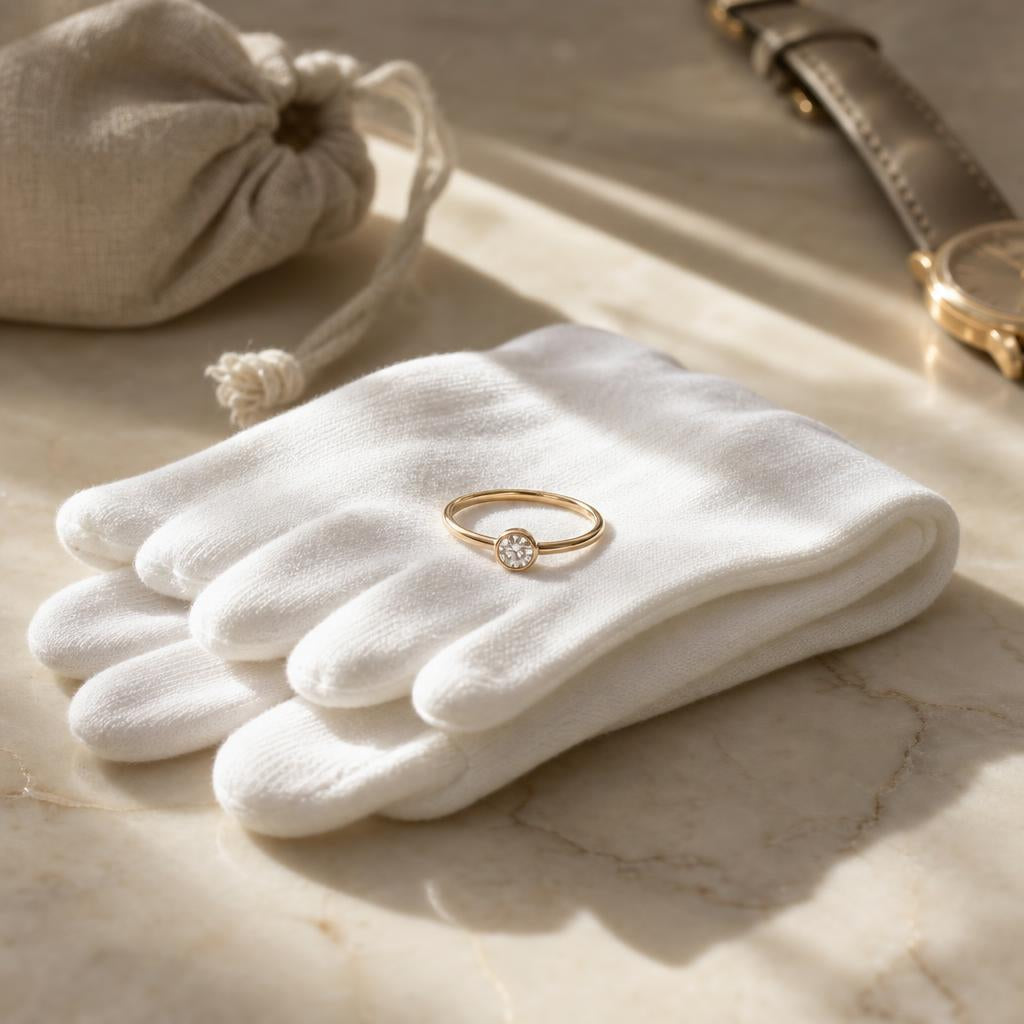
Healthcare is the strictest case, and for good reason. Rings with raised settings can tear exam gloves, trap bacteria in the tiny gaps between stone and band, and catch on bedrails, IV lines, or equipment during a twelve-hour shift. This is why nurses engagement rings at work have become their own quiet subcategory of ring shopping — the question isn't whether to own a ring worth loving, it's which one survives a shift without becoming a liability. A smooth bezel setting, where metal fully encircles the stone, solves most of this: nothing raised to snag, nothing exposed to harbor anything, no gap for a glove to catch on.
Kitchens, Food Service, and Retail Counters
Health codes in food service tend to mirror healthcare logic for a simpler reason: nobody wants to find a loose stone in a plated dish. Prong-set rings are usually the first thing asked to come off, while a flush, low-profile band often passes without comment. Retail and hospitality roles are typically less regulated but follow the same instinct — a ring that doesn't announce itself tends to clear even a vague, unwritten dress code.
Manual Labor, Trades, and Machinery
This is where the stakes stop being about hygiene and start being about the hand itself. Around moving machinery, exposed wiring, or heavy equipment, any metal ring is a real risk — the reason so many trade employers enforce a genuine, hard ban rather than a soft suggestion. If your job puts your hands near anything with moving parts, this is the one category where the honest answer is: take it off, no substitute required.
Worth knowing: A policy that says "no rings" during specific tasks — surgery, machine operation, food handling — isn't optional styling advice. It reflects a documented, real safety risk in those specific roles. Read your specific handbook before assuming any ring, however low-profile, gets you an exception.
What "Technically Banned" Actually Means in Practice
Between the hard bans above and a fully open dress code sits the largest category: jobs where jewelry is discouraged, restricted during certain tasks, or left to a supervisor's judgment rather than spelled out in writing. Office environments, client-facing roles, and most desk jobs fall here. The dress code might say "minimal jewelry" or "nothing distracting" without ever mentioning rings by name — which means the real filter isn't a rulebook, it's whether your ring gets in the way of typing, handshakes, or the day-to-day motion of the job.
This is also where the real risk gets quietly overstated. A round brilliant solitaire on a smooth band poses none of the catch-and-snag risk of, say, an ornate vintage setting with exposed prongs. The industries above ban rings outright because the risk is structural. Everywhere else, it's really a question of setting, not sentiment.
The Settings That Actually Clear a Restricted Dress Code
If your workplace falls anywhere short of a hard ban, the setting you choose does most of the work. A few structural facts worth knowing before you shop:
✦ Pro tip: Run your finger over the front of the ring with your eyes closed. If you can feel a raised edge, a gap, or a sharp prong tip, that's exactly what catches on gloves, fabric, and hair. A setting that feels smooth passes the same test a dress code does.
Bezel settings are the clearest winner — the metal rim that wraps the stone protects it from impact and leaves nothing proud of the band to snag. The Cherish Ring uses exactly this approach, setting each round stone into its own low, sealed bezel along a slim stacking band, so the sparkle reads close and contained rather than raised and exposed.

The Cherish Ring
Each round stone sits inside its own sealed bezel along a slim silver band — smooth enough for gloves, close enough to the hand to layer under a watch or work sleeve without catching.
Shop The Cherish Ring →A simple 4-prong solitaire, kept slim, is the next best option — The Stella Ring is the case in point, a round center stone set high enough to catch light but on a band narrow enough that it doesn't add bulk under a glove or a work sleeve. And if you want the visual size of a bigger stone without the raised profile, a hidden halo does that work quietly: the accent stones sit beneath the center stone rather than around it, so the ring reads bigger from across a room but stays flat and unobtrusive up close, exactly like The Duchess Ring.

The Duchess Ring
A cushion-cut center with a halo tucked beneath it, not around it — the extra sparkle stays out of the way of gloves and fabric while still reading larger than its actual profile.
Shop The Duchess Ring →The Smarter Workaround: A Second Ring for Shift Days
The women who've actually solved this problem long ago stopped treating it as an either-or choice between "wear my ring" and "leave it in a drawer for eight hours." They bought a second ring — one built for the job, not the photo — and saved their original for the hours a strict no jewelry policy doesn't reach. It's the same logic behind a travel ring, just applied to a shift instead of a suitcase: the meaningful piece stays safe at home, and a ring that looks every bit as considered takes the daily wear.
This isn't a downgrade. A well-chosen bezel or slim solitaire under $200 holds up to twelve-hour shifts, hand sanitizer, and glove changes in a way that a piece with raised prongs and exposed edges never will — and it means you're never standing in front of a mirror deciding whether today is a "leave it at home" day. Once you own one, the dress code stops being a daily negotiation and becomes a non-issue.
Quick Takeaways
- Hard bans (healthcare, food handling, machinery) exist for documented safety reasons — no ring substitutes for removing it entirely during those tasks.
- Everywhere else, the setting matters more than the policy: bezel, low-profile solitaire, and hidden halo styles clear most "minimal jewelry" dress codes without a second look.
- A dedicated shift ring — separate from your main piece — solves the problem permanently instead of daily.
- Run the smooth-edge test: if you can't feel a raised prong or gap with your eyes closed, it's not what's catching on your gloves.
Frequently Asked Questions
Are nurses allowed to wear rings at work?
It depends on the unit and facility. Many hospitals permit a smooth, low-profile band outside of direct patient care or sterile procedures, while operating rooms and intensive care units typically require removing all rings entirely. Always check your specific unit's policy rather than assuming a general hospital rule applies.
Is it appropriate to wear an engagement ring to work?
In a standard office setting, yes — a ring is one of the least remarked-on pieces of jewelry there is. The consideration shifts once your day involves a lot of hands-on work, frequent glove changes, or machinery, where a raised setting becomes a practical problem rather than a style one.
Is it unprofessional to wear rings at work?
Not in most office or client-facing roles — a simple ring reads as polished, not distracting. It becomes a genuine concern only in hands-on jobs where a raised setting can catch, tear, or trap bacteria, which is a safety question dressed up as a professionalism one.
What jobs typically restrict wearing rings?
Healthcare, food preparation, and any role involving machinery or heavy equipment are the three categories with the most consistent restrictions. Office, retail, and hospitality roles are far more likely to leave the decision to you, guided by a general "minimal jewelry" standard rather than a hard rule.
When should you not wear a ring at all, regardless of setting?
During any task involving machinery, exposed wiring, or heavy lifting, no setting is safe enough to justify keeping a ring on — bezel-set or not. That's the one category where the right move is removing it entirely, not finding a lower-profile substitute.
Do nurses wear engagement rings to work at all?
Plenty do, just not always the same ring they wear off shift. It's common practice to keep a primary piece safely at home and wear a simpler, bezel-set or plain band version during working hours — the ring changes, the reason for wearing one doesn't.
A dress code that restricts jewelry isn't actually asking you to choose between your job and your ring collection. It's asking you to be a little more intentional about which piece meets which moment — and once you've made that call, wearing rings at work stops being a daily source of friction and becomes exactly as automatic as putting on your shoes.


