

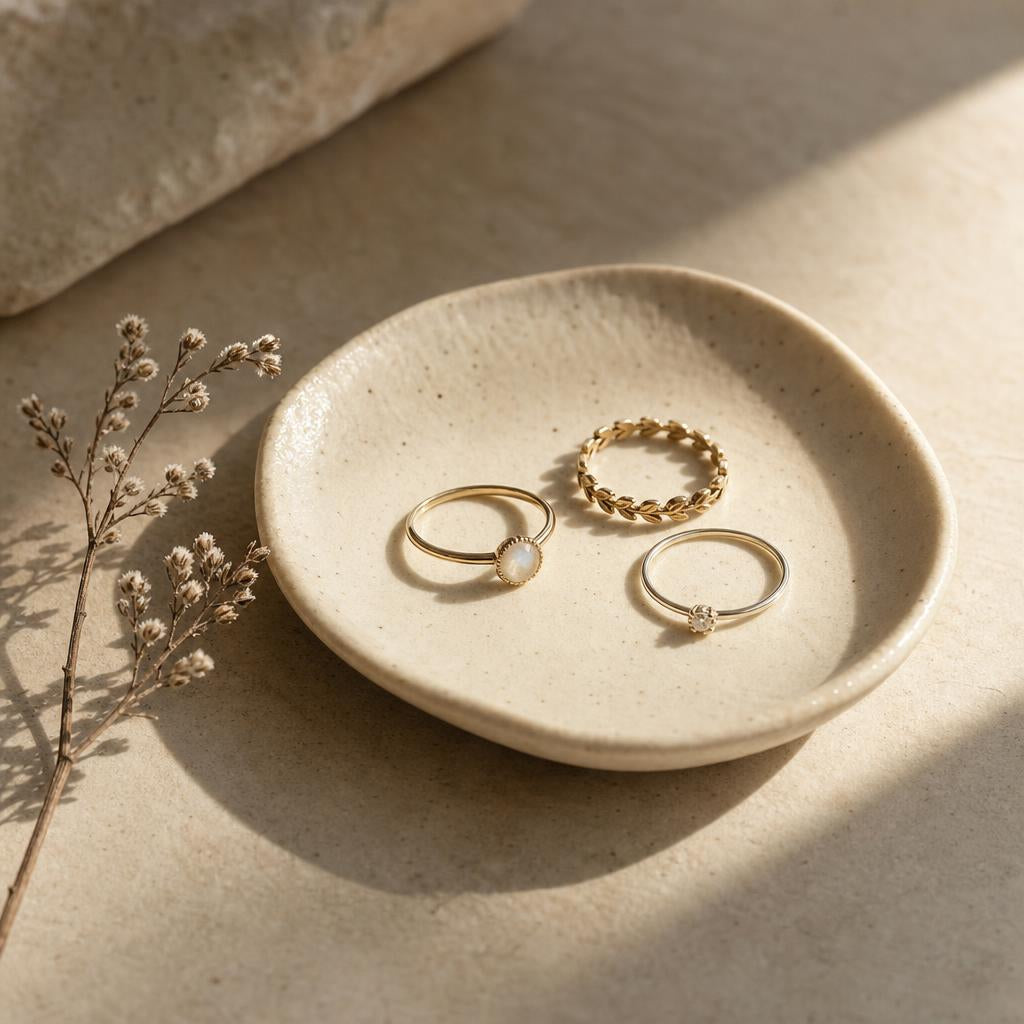
The New Year Ring Reset: How to Declutter Your Ring Collection in January
January arrives, and the internet is very sure about what you should throw away. Most of that noise doesn't apply to you. But somewhere in your jewelry box is a genuine signal worth listening to — the three rings you reach for on repeat, and the eleven you haven't touched since a birthday two Januarys ago. That's the actual case for a new year ring reset, and it has nothing to do with guilt.
A ring collection built with intention doesn't need constant additions. It needs one honest look a year at what's actually earning its place on your hand, and what's just taking up drawer space out of habit.


Why January Is the Right Time for a Ring Reset
Every other January routine gets aimed at your closet, your pantry, your inbox. Your jewelry box rarely gets the same treatment, which is strange, because it's one of the few collections you touch with your hands every single day. A ring you don't wear isn't neutral — it's a small, recurring decision you keep half-making. You open the drawer, see it, feel a flicker of "I should wear that more," and close the drawer again.
A proper reset isn't about owning less for its own sake. It's about knowing exactly why each ring earned a place in the rotation, so that when you do reach for something new, you're adding to a collection that already makes sense — not padding a pile you've stopped seeing clearly.
A Simple Jewelry Declutter, Built for Rings Specifically
Generic decluttering advice tends to treat jewelry as one undifferentiated category — bracelets, earrings, and rings all sorted the same way. Rings deserve their own pass, because the stakes are different. A ring gets knocked against doorframes, worn through dish soap and hand sanitizer, and sized to a very specific finger. Here's a jewelry declutter method that actually accounts for that.
Ask what you've reached for in the last thirty days
Not what you love in theory. What you actually put on. Set a small dish on your dresser for a month and drop in every ring the moment you take it off. At the end of thirty days, you'll have an honest map of your real rotation — usually two or three pieces, worn in nearly every combination.
Ask what still fits your actual life
The ring you bought for a desk job doesn't necessarily survive a career change into something more hands-on. A hidden halo that used to feel exactly right might now feel like more than the life you're currently living calls for. Fit isn't just about size — it's about whether a ring still matches the days you're actually spending.
Ask what deserves a repair, not a goodbye
Before anything leaves the rotation for good, separate "I don't reach for this" from "this needs five minutes of care." A loose stone, a bent band, or a claw that's caught one too many sweaters isn't a reason to retire a ring — it's a reason to fix it and put it back in the drawer where you'll actually see it.
Worth knowing: If you're not sure where a ring even came from — a gift, an estate piece, something inherited — that uncertainty is exactly why it keeps getting skipped over. Give it a real evaluation on its own merits, not on the strength of its backstory.
What to Keep Without Apologizing For It
Somewhere in most collections is one ring that does more work than the rest combined — the piece you'd grab first in an emergency, the one people compliment without fail. For a lot of Gemiros customers, that's a ring like the Ophelia: an oval center stone under a hidden halo, built to read like the kind of ring that costs $15,000 or higher. It isn't. It's 925 sterling silver and a stone that's indistinguishable from a diamond, passes diamond testers, and doesn't ask you to explain yourself at a dinner party.
That's the standard worth applying to every ring you decide to keep. Not "is this expensive enough to justify," but "does this still make me feel like I made the smart choice when I bought it." A ring that clears that bar earns its spot every year, no re-litigating required.
The Stacking Pieces Worth Keeping in Rotation
Stacking bands are where most collections quietly overgrow themselves — it's easy to keep adding thin bands until the stack says nothing in particular. The ones worth keeping are the ones doing a specific job: adding width, adding texture, or filling a visual gap the hero ring leaves open.

The Everlasting Ring
A channel-set band built to sit flush against a solitaire or halo without competing for attention — the kind of stacking piece that earns a permanent place rather than a seasonal one.
Shop The Everlasting Ring →If a band has been sitting in a stack purely out of momentum — you bought it, so you wear it — ask whether it's still doing that job. A stack of three deliberate pieces reads as considered. A stack of six unrelated ones just reads as busy.
What to Actually Do With the Rings You're Letting Go
Deciding a ring is done with your rotation doesn't mean it has to disappear entirely. A few honest options, in order of how often they're worth it:
- Move it, don't lose it. A ring that no longer works on your right hand might be exactly right restyled on a pinky or worn on a chain instead.
- Regift with intention. A piece you never connected with might be precisely what a sister, a friend, or a daughter has been circling on her own wish list.
- Store it properly, out of the daily rotation. Sentimental pieces don't need to earn a spot in your everyday dish to be worth keeping — they just need a dedicated place that isn't a junk drawer.
- Actually let it go. Donation, consignment, or simply passing it along all count. A ring sitting unworn in the dark isn't doing anyone any good, including you.
✦ Pro tip: Do the physical sort before you shop for anything new. It's much easier to see an honest gap in your collection — no everyday solitaire, no third stacking band — once the noise is cleared out of the way.
Building Back With Fewer, Better Choices
Once the reset is done, resist the urge to immediately refill the space you just made. The point isn't an empty jewelry box — it's a collection where every piece has a reason. If the sort revealed you're missing an everyday piece you can wear without thinking, something like the Solis Ring, a round solitaire built for daily wear, fills that gap on purpose rather than by accident.
The same logic applies to a hero piece. If your reset confirmed you don't currently own a ring that feels like a genuine statement, a cushion-cut halo like the Maxima Ring is the kind of addition that replaces several smaller, less-loved pieces at once — one ring doing the work three used to.
Quick Takeaways
- Track what you actually wear for thirty days before deciding what stays
- Separate "needs repair" from "needs to go" before you decide anything is done
- Keep hero pieces on merit, not on how much they cost to replace
- Let go of stacking bands that are there out of habit, not purpose
- Rehome, restyle, or store sentimental pieces instead of defaulting to storage limbo
- Shop the gap the reset revealed, not a vague sense that you need "more"
Common Questions About Decluttering Your Ring Collection
What's the best way to organize a ring collection once you've edited it down?
Keep your daily rotation somewhere visible — a small tray or dish on your dresser works better than a closed box, because you'll actually see and choose from what's there. Reserve a separate, closed container for sentimental or occasion-only pieces so they don't compete for space with what you wear every day.
Is there a rule of thumb for how many rings to actually keep in rotation?
There's no fixed number, but a useful gut check is whether you could name each ring's job — an everyday piece, a hero piece, one or two stacking bands. If you can't say what a ring is for, that's usually your answer about whether it belongs in the active rotation.
What should you do with an inherited or sentimental ring that doesn't match your style?
You don't have to wear it to justify keeping it. Store it properly and separately from your everyday rotation, or consider having a jeweler reset a meaningful stone into a style you'd actually wear. Either way, it doesn't need to sit in the same drawer, competing with rings you put on every morning.
How often should you actually repeat a ring collection reset?
Once a year is enough for most people — your habits, your job, and your style shift gradually enough that an annual check-in catches what's changed without becoming a chore. January simply gives the reset a natural, recurring anchor.
None of this is about owning less for the sake of a tidier drawer. It's about knowing, with total confidence, why every ring you own is still there. That's a much better use of January than another resolution you'll quietly abandon by February.


