

Decluttering Your Jewelry Box: What to Keep, Sell, or Finally Let Go Of
Every jewelry box eventually reaches a tipping point — the drawer that won't close, the tangle you dig through every morning to find the one ring you actually wear. Clearing it out isn't about owning less for its own sake. It's about finally being able to see what you have.
Most jewelry boxes don't get cluttered because you bought too much. They get cluttered because nothing was ever chosen to work together, and nothing was ever taken back out. A little honest sorting fixes both problems at once — and often makes room for the pieces you'll actually reach for.


Why jewelry boxes get cluttered in the first place
It rarely happens all at once. A gift here, an impulse buy there, a ring that fit at 22 and doesn't quite anymore, a pair of earrings you loved for exactly one summer. None of those individual decisions were wrong — the problem is that a collection built entirely from one-off decisions has no shape. Nothing was ever chosen against anything else, so nothing was ever ruled out either.
The fix isn't a ruthless purge. It's a slower, more honest sort — one that separates what's actually earning its place from what's just been sitting there out of habit or guilt.
The three-question test
For every piece, three questions do most of the work. You don't need a spreadsheet or a system — just an honest answer to each one, piece by piece.
1. Have you actually worn it in the last year?
Not "would you wear it" — have you. A ring you keep meaning to wear but never quite reach for usually has a reason: it doesn't fit right, it doesn't match how you actually dress now, or it was bought for a version of your style that's since moved on. Twelve months is long enough to catch every season and every occasion that would reasonably call for it.
2. Does it still fit, comfortably?
Rings especially get kept out of momentum long after they stop fitting well. A ring that spins, pinches, or has to be pushed past a knuckle isn't going to get worn regardless of how much you like it. If sizing is the only issue, it's worth checking whether the piece can be resized before deciding to let it go.
3. Is it in condition you'd be proud to wear today?
Tarnished plating, a stone that's gone cloudy, a clasp that no longer closes properly — these are fixable in some cases and not worth fixing in others. Sterling silver and rhodium-plated pieces in particular can often be restored with proper cleaning rather than replaced outright, so this question is worth answering carefully before anything gets sold or discarded.
Worth knowing: If a piece fails all three questions, it's very rarely a difficult decision once you actually ask them. Most of the hesitation in decluttering jewelry comes from not asking the questions at all, not from the answers being unclear.
What's usually worth keeping
A few categories consistently earn their place, even when they don't get worn constantly:
- Versatile, low-maintenance pieces. Bezel settings, simple solitaires, and anything that doesn't snag or need constant fussing tend to survive every round of sorting because they simply get worn more.
- Pieces tied to a real memory, not a vague one. There's a difference between "I think someone gave me this" and a piece connected to a specific, meaningful moment. The second kind is worth keeping even if it's rarely worn.
- One or two statement pieces you save for occasions. Not everything needs to be in weekly rotation. A ring that only comes out a few times a year can still be worth its space if those occasions genuinely call for it.

The Kensington Ring
An emerald-cut solitaire with quiet, old-world presence — the kind of piece that earns a permanent spot rather than getting sorted out in the next round of decluttering.
Shop The Kensington Ring →What's usually worth selling or letting go
The harder category, but usually the more obvious one once you're honest about it:
- Duplicates that do the same job. If you own three thin gold bands that all serve the exact same purpose in a stack, you likely only wear one of them regularly. Keep the best, let the rest go.
- Pieces bought for a style you've outgrown. Taste genuinely shifts over a decade, and holding onto pieces that no longer match how you actually dress just crowds out the ones that do.
- Anything damaged beyond a reasonable fix. If restoring a piece would cost close to what a new one costs, it's rarely sentimental guilt worth acting on — it's just inertia.
- Gifts you never actually liked. This one carries real guilt, but keeping something purely out of obligation to the giver doesn't serve either of you. A piece sitting unworn in a drawer isn't honoring the gesture any more than passing it on would.
How to actually sell or repurpose what you're letting go of
Once you've sorted the "let go" pile, there are a few realistic paths, depending on the piece:
| Piece type | Best option | Why |
|---|---|---|
| Fine jewelry, gold or precious metal | Resale platform or local buyer | Metal value alone often makes this worthwhile |
| Simulated stones, costume pieces | Gift or donate | Resale value is usually minimal; someone else may still love it |
| Sentimental but unworn | Repurpose or restyle | A stone or setting can sometimes be reworked into something you'll actually wear |
| Damaged beyond repair | Responsible disposal | Not everything needs to become someone else's problem |

The Everlasting Ring
A continuous line of pavé that works as a stacking layer or a stand-alone band — exactly the kind of neutral, do-everything piece worth keeping room for once the clutter is cleared.
Shop The Everlasting Ring →Building forward, not just clearing out
Decluttering only feels worthwhile if it leaves you with something better than a smaller pile — it should leave you with a collection you can actually see and use. Once the box is sorted, look at what's left and ask what's genuinely missing, rather than immediately refilling the space with more of the same. If everything left is a stacking band and nothing is an anchor piece you'd wear alone, that's the gap worth filling next, not another band.
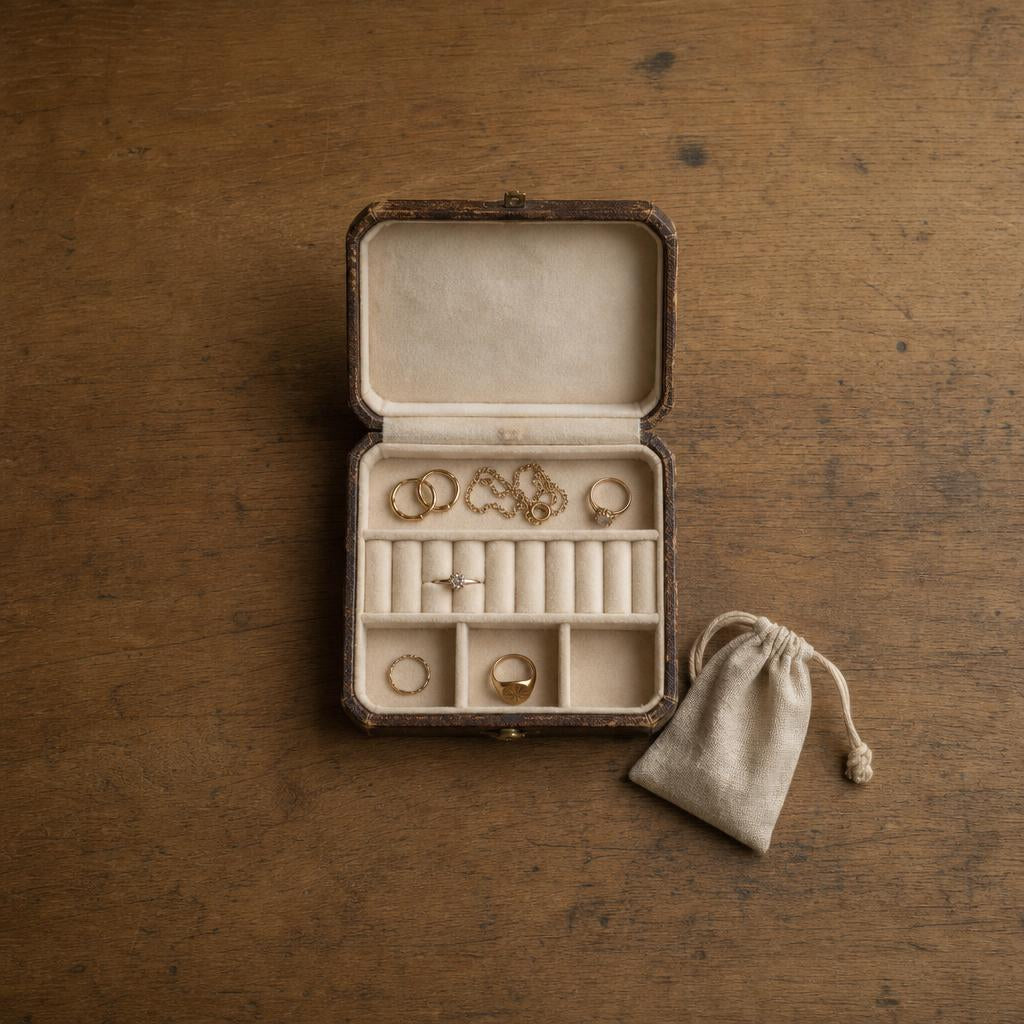
This is also a good moment to reconsider how you organize what you keep. A jewelry box where every piece is visible and easy to reach stays decluttered far longer than one where things get buried again within a month.
✦ Pro tip: Sort in one sitting, not over several weeks. Decluttering jewelry in small stages tends to stall out, because the pieces you're most unsure about get set aside "for later" and later never comes.
Quick Takeaways
- Ask three questions per piece: worn in the last year, still fits comfortably, still in wearable condition.
- Keep versatile low-maintenance pieces, genuinely sentimental ones, and a small number of statement pieces.
- Let go of duplicates, outgrown styles, damaged-beyond-repair pieces, and gifts you never actually liked.
- Match the exit path to the piece — resale, gifting, repurposing, or responsible disposal.
- Use the cleared space to identify real gaps in your collection, not to immediately refill it.
Frequently asked questions
How often should I actually declutter my jewelry box?
Once a year is usually enough for most people — often around a birthday or the start of a new season, when it's natural to take stock of what's changed. More frequent sorting rarely turns up much new.
What if I'm not sure whether to keep something?
Set it aside in a separate "maybe" pile rather than forcing an immediate decision, but give yourself a deadline — a month, not a year — to revisit it. If you haven't thought about it again by then, that's usually your answer.
Is it wasteful to get rid of jewelry I paid for?
The money is already spent either way. A piece sitting unworn in a drawer isn't recovering that cost — passing it on, selling it, or repurposing it at least lets it be useful to someone, including you, in a different form.
Should sentimental pieces get a pass from all of this?
Genuinely sentimental pieces are worth keeping regardless of how often they're worn. The distinction worth making is between real sentimental value and simple guilt about getting rid of something — those two feelings are easy to confuse.
A decluttered jewelry box isn't really about having less. It's about being able to open the drawer and actually see what you have — and reach for the piece that's right for the day, instead of digging past a dozen you never wear to find it.


