

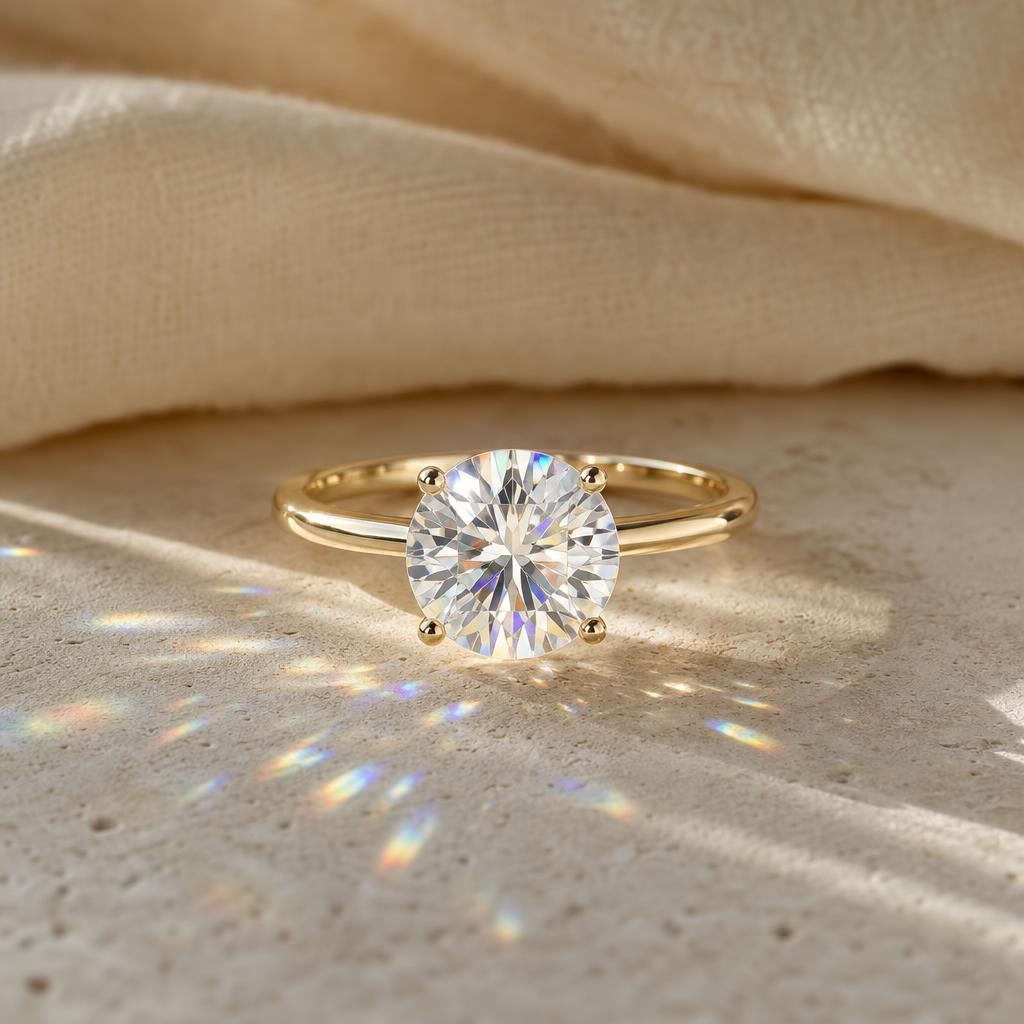
Moissanite vs Diamond Sparkle: Why Moissanite Rings Photograph Differently
Take a moissanite ring outside, tilt it toward the sun, and point your phone at it. What comes back is usually more than you saw with your eyes: more flash, more color, more life in every facet. That isn't a camera trick. It's the stone doing exactly what it was made to do.
The six rings below are the ones we'd put in front of a camera first. Each one shows a different side of what moissanite does with light, and the rest of this guide explains why.


Why the camera sees more in a moissanite ring
Light does two different things inside a gemstone. It bounces back as white light, which we call brilliance. It also splits into spectral color, which we call fire. Moissanite leads on both measures. Its refractive index sits between 2.65 and 2.69, against 2.42 for a diamond, and its dispersion is about 0.104, against roughly 0.044. That is more than twice the fire.
Your eye smooths that out. Standing across a table, a moissanite ring reads as a bright, lively stone. A camera has no such filter. It freezes a single frame, catches a flash of orange or blue at one facet and holds it there, so the photo can look more colorful than the moment felt. If you want the full comparison, we put the two stones side by side.
Worth knowing: Moissanite is also doubly refractive, meaning light splits in two as it travels through the stone. That is a large part of why it looks so layered and busy in close-up photos. It is a property of the material, not a flaw in the cut.
Moissanite vs diamond sparkle: what each one actually records
A diamond tends to return crisp white flashes with smaller bursts of color. Moissanite throws a broader, more colorful pattern, and it does so across the whole face of the stone. In a photo that difference shows up in three ways:
- More color flash. Rainbow highlights appear at the edges of facets, especially in bright, direct light.
- A busier face. Because of double refraction, the pattern inside the stone looks denser, with more layered reflections.
- A brighter overall glow. The higher refractive index sends more light back toward the lens, so the stone often photographs lighter and livelier than the setting around it.
None of this makes the stone look less like a diamond to the people you're standing next to. Gemiros moissanite is lab-created, set in 925 sterling silver, and indistinguishable from a diamond to the naked eye. The difference is something a macro lens can find. Someone across a dinner table cannot.
How lighting changes everything
Most disappointment with ring photos comes down to the light source, not the ring. The same stone can look flat in one room and electric in the next. Here is what to expect.
| Light source | What you'll see | Best for |
|---|---|---|
| Direct sunlight | Maximum fire, with vivid rainbow flashes across the face | Showing off the stone's full personality |
| Window light (indirect) | Balanced brilliance with softer color | Clean, editorial photos |
| Overhead LED or spotlight | Sharp, high-contrast sparkle with strong flashes | Close-ups and short videos |
| Warm lamplight | Softer glow, less color separation | Evening, candlelit looks |
| Overcast daylight | Gentle, even brightness with little flash | A calm, understated look |
The gap between the two stones is widest outdoors. Compare a diamond vs moissanite in sunlight and moissanite pulls ahead, because direct sun gives dispersion the most to work with. Move indoors to soft, diffuse light and the two converge, which is why a ring that looked dramatic on your balcony can look quietly elegant at dinner.
✦ Pro tip: If a photo looks too busy, move the ring out of direct sun and into bright shade or window light. You keep the brilliance and soften the color flashes without touching the stone.
Six ways to photograph it well
You don't need studio gear. You need to control three things: where the light comes from, what is behind the ring, and how close you get. Our guide on how to photograph your ring goes deeper, and these are the essentials for moissanite specifically.
- Clean the stone first. A thumbprint dulls every facet. A soft cloth and a minute of care changes the whole picture.
- Use a plain, neutral background. Cream, stone, or soft gray lets the color flashes read as sparkle instead of clutter.
- Angle the ring slowly. Tilt it a few degrees at a time and watch the face change. The best frame is rarely the first one.
- Shoot in short bursts or video. Fire is about movement. A two-second clip often captures what a still can't.
- Turn the flash off. Direct flash washes out the depth. Natural light does far more.
- Take both a close and a wearing shot. The close-up shows the fire. The hand shot shows how it looks to everyone else, which is calmer and more elegant.
How shape and setting change what shows up
Stone shape matters as much as the stone itself. A round cut has the most facets and returns the most scattered light, so it tends to photograph with the liveliest pattern. Ovals and pears stretch that pattern across a longer face. Radiant and princess cuts give you bold, geometric flashes.

The Vivienne Moissanite Ring
A plain four-claw radiant-cut solitaire with no halo and no pavé, so the stone is the only thing in frame. Available in three carat sizes, in both Platinum and Gold colorways.
Shop The Vivienne Ring →Setting plays its part too. A plain solitaire gives the stone nothing to compete with, which is why it photographs as pure flash. A pavé band or a halo adds a second layer of sparkle around it, so the whole ring catches light, not just the center. If you want to know how the metal tone changes the picture, look at how the stone reads against silver versus gold.

The Verona Moissanite Ring
A pear-cut center with a hidden halo and a pavé band. The tapered shape draws the eye along the finger, and the halo underneath adds a glint you only catch when the ring moves.
Shop The Verona Ring →What stays the same in every light
A photo can exaggerate fire, but it can't change what the stone is. Moissanite rates 9.25 on the Mohs scale, so it resists daily wear, and it holds its sparkle without clouding. Because it is so strong at returning light, the fire and brilliance you see on day one is the same on day one thousand.
That consistency is part of why a stone-forward design works so well on camera. Moissanite is lab-created, conflict-free, and ethically sourced, and the 925 sterling silver setting is hypoallergenic and nickel-free. You get the light show without having to think about the details.

The Eternelle Moissanite Ring
A scallop-set row of round moissanite with pavé along both shoulders. Every angle of the band catches the light, so it photographs beautifully from almost any direction.
Shop The Eternelle Ring →The smarter way to think about the camera
You've probably seen the debate about whether moissanite looks "too sparkly." That framing assumes a diamond is the ceiling. It isn't. A stone that returns more light than a diamond is simply a stone with more to give, and you control how much of it shows by choosing your light and your angle.
That is the quiet advantage of knowing your material. A buyer who understands dispersion picks the light that flatters her ring, sizes her expectations to the room, and wears it with complete confidence. And if a jeweler runs it across a tester, it will pass a diamond tester, so there is nothing to explain.
Quick Takeaways
- Moissanite has a higher refractive index and more than twice the dispersion of a diamond, so it returns more light and more color.
- Cameras freeze single flashes, so photos can show more rainbow fire than your eye does in person.
- Direct sunlight gives the most fire. Window light and shade give a softer, more balanced look.
- Clean the stone, use a plain background, tilt slowly, and skip the flash.
- Shape and setting change the photo: solitaires show pure flash, while pavé and halos add a second layer of sparkle.
Frequently asked questions
What shines brighter, moissanite or diamond?
Moissanite. Its higher refractive index returns more light, and its dispersion is more than twice a diamond's, so it throws more rainbow fire. A diamond's flashes are whiter and more restrained. Which one you prefer is a matter of taste, not quality.
Can you visually tell the difference between moissanite and diamond?
Not from across a table. Up close, in direct light or through a macro lens, moissanite shows more color flash and a denser pattern. In everyday wear, the two are indistinguishable to the naked eye.
Does moissanite look different in photos than in person?
Often, yes. A camera captures one frozen flash, so the color can look stronger than it does in motion. Softer, indirect light and a few degrees of tilt will give you a photo that matches what you see on your hand.
How can you tell if a stone is moissanite or a diamond?
Under magnification, moissanite shows doubled facet edges and more color flash. A standard diamond tester reads moissanite as a diamond, which is exactly why a jeweler needs more than a quick test to separate them.
Is moissanite durable enough to wear every day?
Yes. It rates 9.25 on the Mohs scale, second only to diamond among commonly used gemstones, and it keeps its sparkle with simple cleaning.
Light is the whole point of this stone. Choose the setting that suits you, find the light that flatters it, and let it do what it was made for.


