

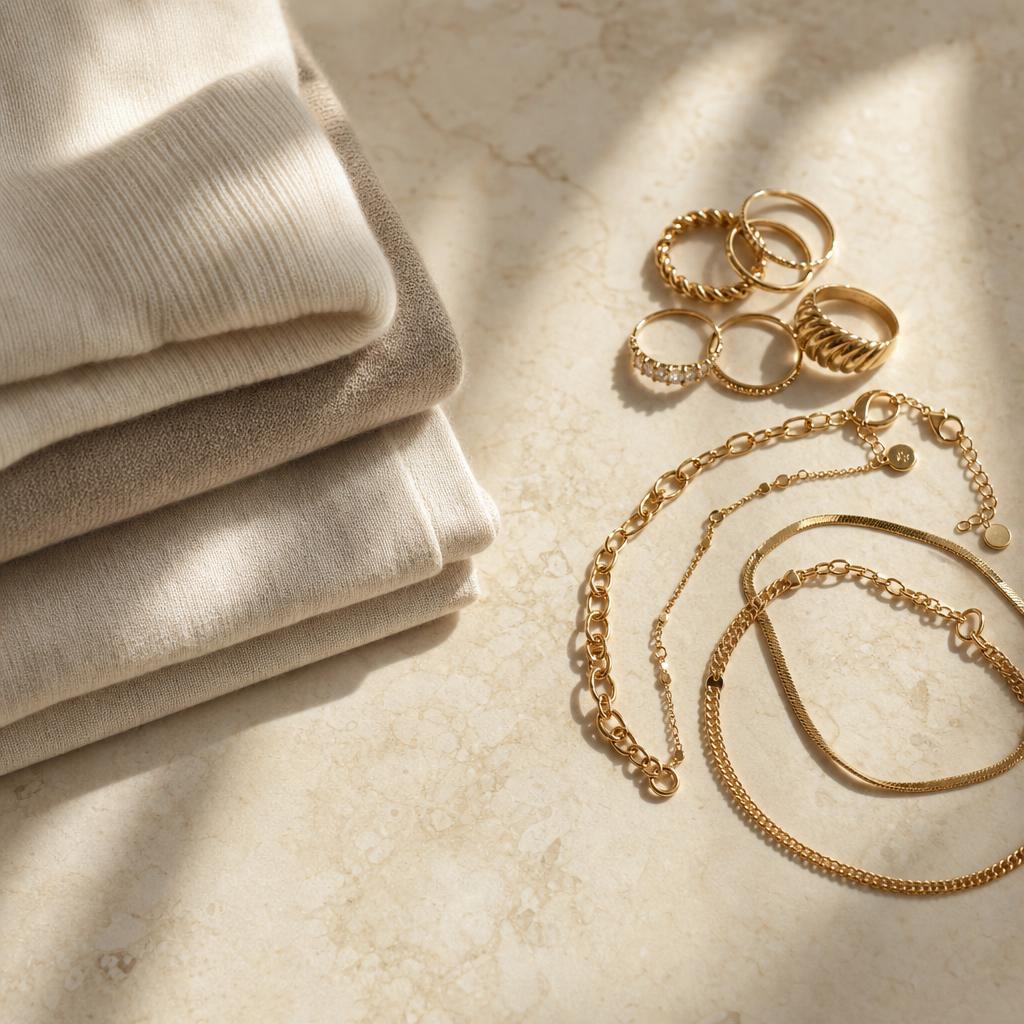
Minimalist Wardrobe, Maximalist Jewelry: Why It's Not a Contradiction
You've spent the last few years editing your closet down to pieces that actually work — a handful of good trousers, one perfect white shirt, nothing that needs explaining. And then you get to your jewelry box and reach for three rings, a stack of bracelets, and a necklace with more presence than your entire outfit. That's not a contradiction. That's the whole point.
Minimalism, as a wardrobe philosophy, was never about disappearing — it was about clearing the noise so the things you actually chose could be seen clearly. Jewelry, especially the kind you buy for your own hands and your own reasons, is exactly the place where that clarity is supposed to show up loud.


The Myth of "Matching" Your Jewelry to Your Style
Somewhere along the way, "minimalist" got treated like a full personality package — quiet clothes, quiet accessories, quiet everything. But a closet edited down to its essentials isn't a mood, it's a decision. It's the decision to stop spending attention on things that don't earn it. Once you've made that decision about your clothes, you have more attention left over, not less — and jewelry is where a lot of women choose to spend it.
There's nothing inconsistent about wearing the same five well-cut basics all week and still reaching for a ring stack that takes up the whole hand. If anything, the plain backdrop is what lets the rings do their job. A bold piece against a busy outfit competes for attention. A bold piece against a clean sweater and dark denim simply is the outfit.
Worth knowing: Stylists have a shorthand for this — the 2:1:1 rule, where one statement piece is balanced by two supporting ones and nothing else competes for the eye. It's less a hard rule than a reminder that bold jewelry still needs a quiet stage to actually read as intentional rather than cluttered.
What Maximalist Jewelry Actually Means (Not What You Think)
The maximalist label isn't about wearing everything you own at once. It's a specific aesthetic decision — more color, more texture, more visible craftsmanship, pieces that ask to be looked at instead of quietly assumed. A single dramatic ring can be maximalist. So can five thin bands stacked so the hand reads as one continuous line of sparkle. What makes it maximalist isn't quantity; it's intention. Nothing about it is accidental, and nothing about it apologizes for taking up space.
That's precisely why it pairs so naturally with a pared-back wardrobe. A woman who has already decided not to waste her morning deciding between six near-identical sweaters has more bandwidth, not less, to think about what a radiant cut framed in a floral halo does for her hand. The Fleur Ring's marquise-and-round halo is a good example of exactly that kind of considered drama — nothing about the setting is subtle, and none of it needs to be, because the rest of the look is already doing the quiet work.

The Lumière Ring
A 4-carat round brilliant solitaire in a slim, polished 4-prong setting — one uncomplicated shape, sized to command a room without a single extra detail on the band.
Shop The Lumière Ring →The Lumière is the clearest proof that minimalist and maximalist were never opposites in the first place. The setting is as restrained as it gets — one stone, one band, no side detail. The presence is enormous. That's minimalist design doing maximalist work, and it's the exact instinct this whole approach is built on.
Why a Quiet Wardrobe Makes Room for Loud Rings
Every outfit has a limited amount of visual attention to spend, and a minimalist wardrobe simply spends almost none of it on the clothes. That leftover attention has to go somewhere, and hands are one of the few places left that haven't been simplified into oblivion. A woman in a plain black turtleneck and unbroken trousers isn't hiding — she's arranged things so the one part of her outfit built to catch light actually catches it.
This is also, not incidentally, the more intelligent version of the old dressing rule that told women to take one thing off before they left the house. That rule assumed the goal was restraint for its own sake. The actual goal is legibility — making sure the one thing you chose to be loud is the thing people actually notice. A stack of rings does that better than almost any other accessory, because hands move, gesture, and hold things, which means the sparkle is never static.
Building Your First Maximalist Ring Stack
If the idea of a full maximalist ring stack feels like a big jump from wearing one ring at a time, it doesn't have to happen all at once. Start with a single anchor — something with real presence, like a three-stone setting or a wide halo — and build outward from there over months, not days. The Statement Ring's radiant cut and heart-cut side stones work well as that anchor piece precisely because it doesn't need company to look finished; anything added afterward is a deliberate choice, not a rescue.
From there, the stacking logic holds regardless of scale: vary the height and width of each band so they don't fight for the same visual lane, and let at least one piece sit lower-key so the eye has somewhere to rest between sparkle. A round solitaire on a pavé band, like the Solis Ring, makes an excellent quiet second note next to a louder anchor.

The Everlasting Ring
A continuous line of round brilliant stones designed specifically to stack — the piece that turns a single ring into the beginning of a proper collection.
Shop The Everlasting Ring →A full eternity band like the Everlasting works as connective tissue between louder pieces — it reads as continuous sparkle rather than a separate ring competing for its own attention, which is exactly what a stack needs once it grows past two or three pieces.
✦ Pro tip: Build a stack in the order you'll actually wear it, not the order you buy it in. An anchor piece plus one supporting band is already a complete, considered look — you're never mid-project.
The Wardrobe Side of the Equation
None of this works if the clothes are also fighting for attention. A quiet wardrobe isn't a strict uniform — it just means the pieces are chosen for fit, fabric, and color consistency rather than pattern or logo. Sterling silver, moissanite, and gold-toned settings all read cleanly against neutral fabrics precisely because there's nothing else competing with them for the same visual space. This is less a rule about jewelry and more a rule about attention: spend it once, spend it well, and let the rest of the outfit get out of the way.
Sourcing your own version of this look, rather than borrowing someone else's stack wholesale, matters here too. What reads as intentional on one hand can read as overdone on another if the scale doesn't suit your fingers or the metal tone fights your skin undertone. Building slowly — one considered piece at a time — is what keeps a stack looking like a decision instead of an impulse purchase.
Quick Takeaways
- A minimalist wardrobe and bold jewelry aren't opposites — the clean backdrop is what lets statement rings actually read as intentional.
- Bold jewelry is about intention and presence, not quantity — one dramatic ring can qualify.
- Build a ring stack slowly, starting with one anchor piece before adding supporting bands.
- Vary height, width, and visual weight across a stack so no two pieces compete for the same attention.
Frequently Asked Questions
What does "maximalist" actually mean when it comes to jewelry?
Maximalist jewelry is jewelry designed to be noticed rather than blended in — bold settings, visible craftsmanship, and pieces layered with intention rather than restraint. It's defined by confidence and deliberate design, not by how many pieces you're wearing at once.
What is the 2:1:1 rule in jewelry?
It's a simple styling ratio: one statement piece, balanced by two smaller supporting pieces, with everything else left alone. It keeps a maximalist look from tipping into visual clutter by making sure only one piece is doing the loudest work at a time.
Are ring stacks still in style?
Yes — ring stacking has moved from a passing trend to a standard way of wearing jewelry, precisely because it lets one collection do double duty as both an everyday look and an evolving personal statement. A well-built ring stack ages better than a single trend-driven piece because it's built from pieces chosen individually over time.
What actually counts as minimalist jewelry?
Minimalist jewelry typically means single-stone settings, slim bands, and an absence of extra detail — think solitaires over halos, and one clean shape over layered embellishment. It's a setting philosophy, not a rule about carat size, which is exactly why a large stone in a simple setting can still read as minimalist.
The real takeaway isn't that you have to choose a lane. It's that a wardrobe built on restraint is the smartest possible setup for jewelry built on presence — one makes room for the other, and neither one is a compromise. Wear the plain sweater. Wear all the rings.


