

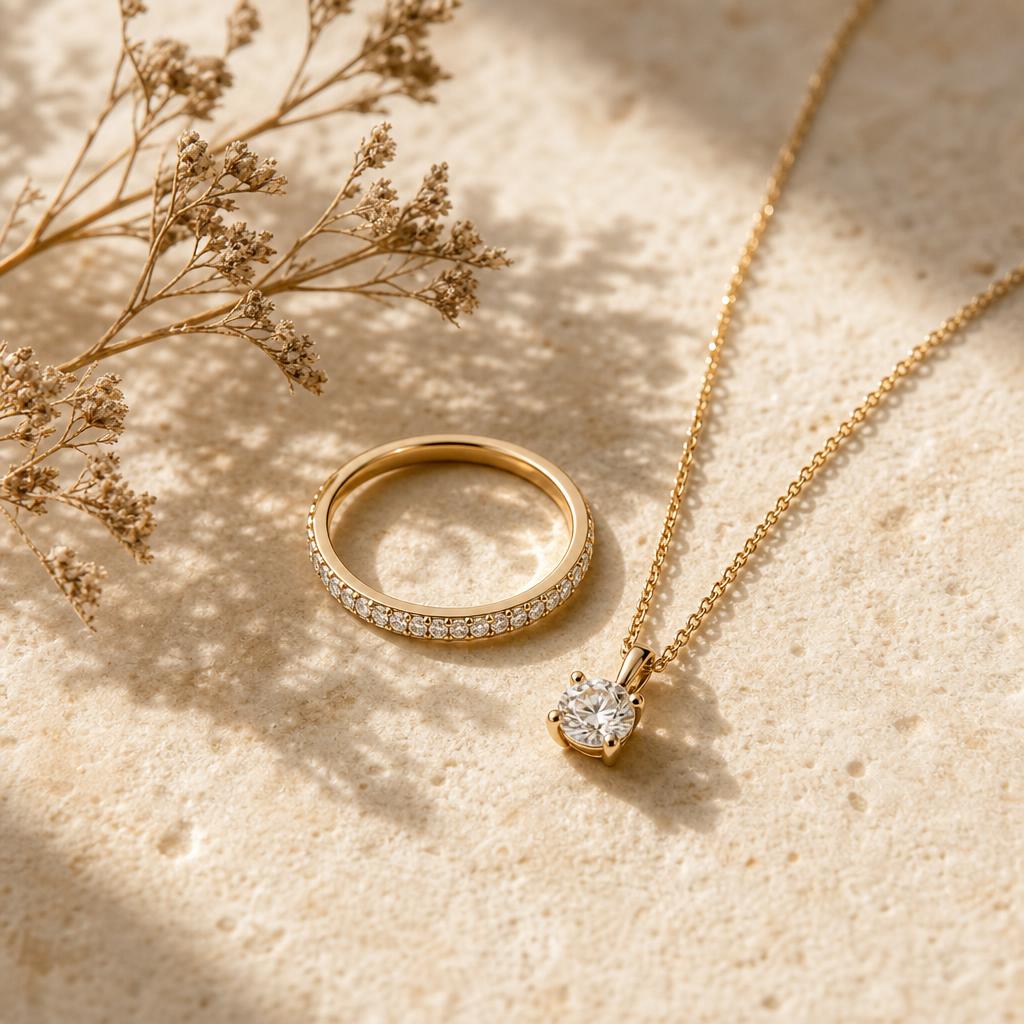
Matching Jewelry for Couples: What Actually Works (Without Matching)
The matchy-matchy version of couples jewelry is easy to spot from across a room, and it usually reads as a costume rather than a relationship. The version that actually works is quieter than that — it's about two people whose jewelry clearly belongs to the same story, without either piece being a carbon copy of the other.
That distinction is the whole game. Matching jewelry for couples has gotten a lot more interesting than the identical-band, his-and-hers sets of a decade ago, and the smartest approach right now is coordination rather than duplication — same metal tone, same era, same level of restraint, but two pieces that were clearly chosen for the person wearing them.


Why "Coordinated" Beats "Identical"
Identical jewelry works for exactly one context: a photo you're staging on purpose. In daily life, two people wearing the literal same ring or the literal same pendant tends to read as a themed couple rather than two individuals who happen to be together — and that's not usually the vibe either of you is going for at brunch or at work.
Coordinated jewelry solves this by matching on the things that actually register visually — metal tone, general silhouette, level of sparkle — while letting the specific piece flex to the person. A rhodium-plated silver band on one hand and a rhodium-plated silver pendant on the other neck read as a set even though neither is a copy of the other. That's the difference between jewelry that looks like two people coordinated on purpose and jewelry that looks like a matched Halloween costume.
Start With Metal, Not With the Piece
Before you shop for a specific ring or necklace, agree on one thing: are you both silver, both gold, or is one of you warm-toned and one of you cool-toned by design? Metal consistency is doing 80% of the "we clearly coordinated this" work, and it's the one variable that's genuinely worth locking down before anything else. Everything downstream — warm-toned yellow gold versus cool rhodium-plated silver versus rose gold — is a style choice you can make once you've settled that.
Worth knowing: Sterling silver with rhodium plating reads as "white metal" — the same family as platinum or white gold — so a silver ring and a silver necklace coordinate visually even though the pieces are entirely different designs.
Matching Rings for Couples, Without the Wedding-Band Energy
Plain stacking bands are the most underrated option for two people who aren't engaged, aren't married, and don't want their jewelry to read as either. A simple pavé or bezel band worn on the right hand, or stacked casually with existing rings, carries none of the engagement-ring signaling that a solitaire does — it's just a good ring that happens to pair well with a partner's.
The Eternity Ring and The Beloved Ring were built for exactly this kind of pairing. Both are full stacking bands in the same silver tone, but the settings are different enough — a continuous pavé row on one, a bezel-set row with a slightly more vintage feel on the other — that they read as two people's individual taste rather than a matched set bought off a single display case.

The Cherish Ring
A bezel-set take on the eternity band, with each stone held in its own individual spotlight rather than a continuous pavé line — a slightly bolder pairing option for the partner who wants more presence on the hand.
Shop The Cherish Ring →None of this requires spending anything close to what a jewelry counter implies it should. A pair of simulated diamond bands, one for each of you, still lands well under what a single mined-diamond ring costs — and 925 sterling silver with rhodium plating is nickel-free and hypoallergenic, so neither of you is trading comfort for the coordinated look.
Matching Necklaces for Couples: The Easiest Entry Point
If rings feel like too much commitment-adjacent symbolism for where you are, necklaces are the lower-stakes way in. They don't carry the same cultural weight that rings do — nobody assumes a pendant means anything beyond "this person has good taste and so do I" — which makes them the easiest starting point for anyone who wants coordinated jewelry without a conversation about what it symbolizes.
The trick with pendants specifically is picking silhouettes that share a language without being the same shape. A round bezel solitaire and a starburst pendant are both minimal, both catch light the same way, and both sit at roughly the same size on the chest — but they're clearly two different pieces, chosen by two different people with two different instincts.

The Éclat Moissanite Necklace
A round-cut moissanite in a timeless 6-prong solitaire setting — the most classic silhouette in the lineup, and an easy anchor piece if one of you wants something simpler while the other goes with a shaped pendant.
Shop The Éclat Moissanite Necklace →This is also where a lot of couple-necklace searches tend to land on the wrong thing — puzzle-piece pendants and split hearts that only make sense as a matched pair and look strange worn alone. A solitaire pendant or a clean geometric shape does the opposite: it works as a coordinated piece when you're together, and it works as a perfectly good necklace on its own the other 95% of the time you're not standing next to each other for anyone to notice the match at all.
Chains Deserve the Same Logic
For chains specifically, it's really a question of link style and weight rather than design. A finer curb or rope chain on one person and a slightly heavier version of the same chain style on the other reads as coordinated without anyone needing to buy the literal same product in two sizes. If you're building toward a full look rather than a single piece, pairing a necklace with earrings in the same metal tone extends the same coordination logic beyond just the two of you.
What "Matching" Should Actually Mean Long-Term
The honest answer to how much coordinated jewelry should cost is: not as much as the phrase implies. This isn't heirloom territory, and it isn't meant to be — it's two pieces of well-made, demi-fine jewelry that happen to look good together, not a joint investment either of you needs to justify. That's the whole appeal of doing this in simulated diamonds and moissanite rather than mined stones: the coordinated look works exactly the same, the sparkle reads identically to the naked eye and passes diamond testers, and neither of you is locked into a piece you'll feel strange wearing if things change.
That's also why coordinating on taste rather than identical products holds up better over time. If you buy the exact same ring as a set, replacing or upgrading one piece later feels loaded in a way it shouldn't. If you both bought the piece that actually suited you — in the same metal, at the same general price point — either of you can add, swap, or wear something else entirely without the coordinated look collapsing.
Quick Takeaways
- Match on metal tone and general style first — never on the identical product.
- Stacking bands make better couples' rings than engagement-style solitaires, since they carry none of the same signaling.
- Solitaire and geometric pendants work better than novelty split-pendant necklaces, because they hold up as standalone pieces too.
- Coordinated jewelry costs less and ages better than identical sets, since either person can change their piece without breaking the pair.
Frequently Asked Questions
What's a good way to do matching jewelry for couples without it looking matchy-matchy?
Coordinate on metal tone and overall style rather than buying the identical piece twice. A silver stacking band and a silver pendant in a related silhouette read as a set without either person's jewelry looking like a costume.
Do couples actually wear matching rings?
Plenty do, and it doesn't have to mean engagement or marriage. Simple stacking bands in the same metal, worn on the right hand or layered into an existing stack, are a common way couples coordinate without the ring reading as a proposal statement.
What's a good matching necklace to get for a boyfriend or girlfriend?
Skip anything designed to only make sense as half of a pair, like split hearts or puzzle pieces. A solitaire pendant or clean geometric shape in a shared metal tone works as a couple's piece and as a standalone necklace, which makes it a safer, more versatile gift.
Do you have to buy both pieces at the same time?
No — coordinated pieces don't need to be purchased together the way an identical set does. As long as the metal tone and general style line up, a ring bought in the spring and a necklace bought around the holidays will still read as a matched pair.
Matching jewelry for couples works best as a shared decision about taste, not a shared purchase of the same product. Pick your lane on metal, choose the piece that actually suits each of you, and let the coordination happen in the details rather than in duplication — that's the version that still looks intentional five years from now, not just on the day you bought it.


