

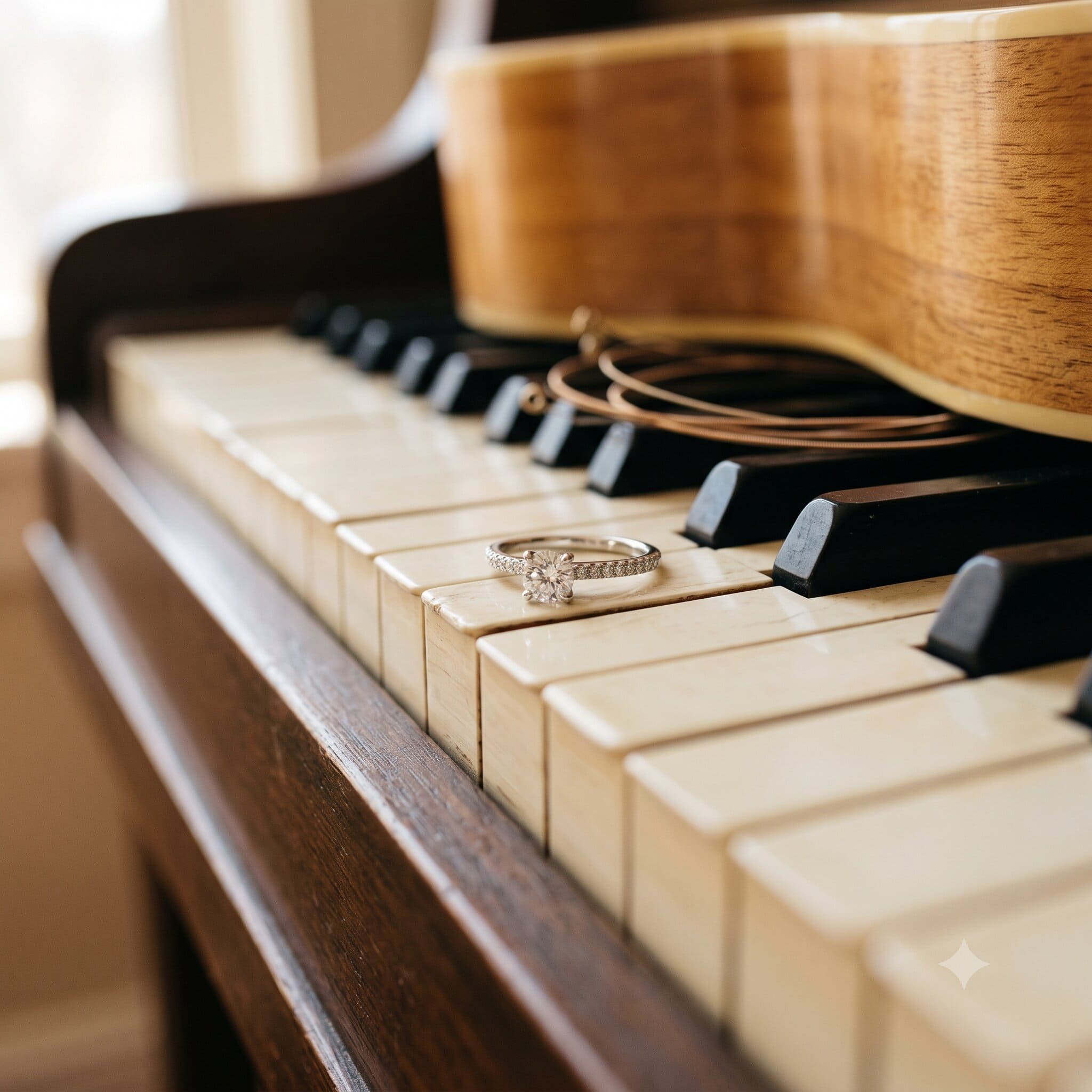
Low Profile Engagement Rings for Piano and Guitar Players: What Actually Works
Somewhere between the fourth measure of a Chopin nocturne and the barre chord you've played a thousand times, a ring shifts half a millimeter and you feel it — a click against the key, a drag against the string, a half-second of hesitation that has nothing to do with your technique and everything to do with what's sitting on your finger. If that's ever made you take your ring off before you sit down to play, the problem was never the ring itself. It was the setting.
Some settings genuinely do get in the way of fretting hands and playing hands. Others sit so close to the finger you forget they're there by the second bar. The difference is entirely in how the stone is set — and once you know what to look for, you never have to choose between wearing your ring and playing the way you actually play.


What Actually Gets in the Way (and What Doesn't)
It helps to be specific about the mechanics, because "rings get in the way" is too vague to actually solve. On a guitar, the issue is almost always height: a prong-set stone or a raised claw setting sits proud of the band, and when your fretting fingers roll or press against the strings, that raised metal catches, drags, or dulls the string's tone. On a piano, the issue is contact — a tall setting changes the angle at which your fingertip meets the key, which throws off the tiny, practiced adjustments your hand makes without you thinking about it.
What doesn't get in the way is anything that sits flush or close to the finger. A setting with no raised claws, no exposed prongs, and no significant height above the band lets your fingers do exactly what they'd do bare-handed. This is the same logic behind choosing rings for people who type all day — the hands doing repetitive, precise work are the same hands that benefit most from a low-snag setting, whether the task is a keyboard shortcut or a scale run.
The Settings That Actually Solve It
There are three setting types worth knowing if you play regularly, and each solves a slightly different version of the problem. Understanding the difference matters more than picking a single "best" ring, because guitar and piano actually stress your hands in different ways.
Bezel settings wrap a thin rim of metal fully around the stone's edge, so there's no raised prong to catch on anything — strings, sleeves, or the felt underside of a key. It's the most protective setting that still reads as a real engagement or everyday ring, not a plain band. It's one of the most durable, low-snag styles in the entire catalog, which is exactly why more buyers are choosing it even outside a musical context.
Hidden halo settings tuck a ring of small accent stones beneath the center stone instead of around the top, so the widest, showiest part of the ring stays low and close to the finger. From above, it looks like a clean solitaire. From the side, it's doing quiet work to make the center stone look larger without adding height. That combination — visual impact without vertical bulk — is exactly what a low profile engagement ring is built to deliver, and it's why hidden halo settings show up so often in this conversation.

Forever
A half-eternity pavé band that sits slim and flush against the finger — no raised centerpiece, no claws to catch a string or a key. It's the ring a lot of our customers reach for on practice days specifically because it disappears into the hand.
Shop Forever →Flush and pavé eternity bands take the logic a step further by never lifting a single stone above the metal at all — each one is set directly into the band, so the entire ring reads as smooth from every angle. There's genuinely nothing to catch, which is why full-eternity styles are one of the most reliable low profile rings you can wear through a long practice session or a set list without a second thought.
Guitar Players: What Your Fretting Hand Actually Needs
If you play, you already know your fretting hand takes the real abuse — pressing strings against frets, rolling across the fingerboard, occasionally sliding hard enough to feel it the next day. A tall or heavily pronged setting on that hand doesn't just risk catching a string; it changes how precisely you can place a finger, which matters more than it sounds like it should once you're playing anything technical.
The fix isn't to stop wearing a ring on that hand. It's to choose a setting that behaves like it isn't there. A bezel setting or a flush eternity band on the fretting hand means your fingers roll across the strings the same way they would bare — no snag, no altered angle, no need to think about it mid-song. Save anything with a raised center stone or exposed prongs for your other hand, or for the days you're not playing.
Worth knowing: Sterling silver doesn't just look right against a fretboard — 925 sterling silver is genuinely durable enough for daily practice, and every Gemiros ring is nickel-free and hypoallergenic, so hours of contact with your hands won't irritate skin the way lower-grade metals can.
Piano Players: Why Height Matters More Than Width
Pianists tend to assume the problem is a wide band, but width is rarely the actual issue — height is. A ring that sits high off the finger changes the angle of contact between your fingertip and the key, and that tiny shift is enough to throw off the touch you've built through years of practice. It's a different problem than a guitarist's, which is why the solution looks slightly different too.
A hidden halo ring solves this cleanly because the accent stones sit beneath the center stone rather than around it, keeping the ring's overall profile low even when the center stone itself is a meaningful size. You get the visual weight of the ring without the vertical height working against your hands.

Evermore
A row of baguette-cut stones set directly into a sleek channel band, with nothing raised above the metal. It's about as flush as a ring gets — a genuinely low-maintenance option for anyone who spends real hours at a keyboard, musical or otherwise.
Shop Evermore →If you're already building out a collection, the same low-profile logic should guide how you stack. A slim, low-profile band next to your main ring keeps the entire stack close to your hand instead of adding height you'll notice mid-piece. And if you're deciding between prong counts on a solitaire-style ring, it's worth understanding how prong count affects security and profile before you commit to a style.
What This Isn't About
None of this means your everyday rings need to look plain, or that a statement setting is off the table forever. It means being deliberate about which ring goes on which hand, on which days. A dramatic hidden-halo cushion cut like Duchess still reads as a low profile ring in daily wear — the drama is in the stone, not the height. Save your tallest, boldest settings for the nights you're not the one playing, and let a flush or bezel setting carry the hand that actually does the work.
Quick Takeaways
- The real issue is height and exposed prongs, not width — a tall or heavily clawed setting is what catches on strings and interrupts key contact.
- Bezel settings are the most protective option for a fretting hand — no raised edge, nothing to snag.
- Hidden halo settings keep visual size without adding height, which matters most for pianists.
- Flush and full-eternity pavé bands have nothing raised at all, making them safe for either hand on any instrument.
- 925 sterling silver holds up to daily practice and is nickel-free, so extended hand contact won't irritate skin.
Frequently Asked Questions
What is a low profile engagement ring, exactly?
It's a ring where the center stone sits close to the finger instead of raised up on tall prongs. The setting height stays low — usually achieved through a bezel, hidden halo, or flush-set style — which makes the ring more resistant to catching on anything, from strings to sleeves to gloves.
What's the difference between a flush setting and a bezel setting?
A flush setting embeds the stone directly into the band itself, so the metal and the stone sit at the same level with nothing raised at all. A bezel setting surrounds the stone with a thin rim of metal that sits slightly above the band, fully enclosing the edge. Both resist snagging; a flush setting is marginally lower profile, while a bezel setting shows a touch more of the stone's face.
Should I just take my ring off to play instead?
You can, but you shouldn't have to. The right setting means you don't lose or misplace a ring between rehearsals, and you don't have to build "remove ring" into your routine every time you sit down to practice. Choosing a low-snag setting solves the problem permanently instead of managing it daily.
Are hidden halo rings actually more secure, or just more subtle?
Both. Because the accent stones sit beneath the center stone rather than around the top, there's less exposed metal edge overall, which means less surface area to catch on something. The subtlety is a side effect of a setting that was built to protect the stone first.
Whatever instrument you play, the rule holds: a ring that gets in the way isn't a reason to stop wearing one — it's a sign you're wearing the wrong setting. Choose low, choose flush, and let your hands do what they've always done.


