

How to Tell If a Ring Is Good Quality: The Quiet Signs Most Buyers Miss
Two rings can look absolutely identical in a product photo — same shape, same sparkle, same confident angle under the same studio light. Then one arrives, and within about four seconds of turning it in your hand, you know. The prongs catch the light differently. The band feels thinner than it looked. The stone either throws color across the table or just sits there, flat and glassy. Nothing about the listing lied to you, exactly. You just didn't know what to look for.
Here's the good news: knowing how to tell if a ring is good quality isn't a skill jewelers keep secret. It's a short list of specific, checkable things — most of which you can actually spot in a photo once you know where to look, and all of which you can confirm the second a ring is on your hand.


The Metal: What's Actually Under the Shine
Every ring photographs well in the right light. Metal is reflective by nature — a ring shot under a softbox will throw a convincing shine whether it's solid, plated, or barely plated at all. What the photo can't tell you is what's underneath that shine, and that's where quality actually starts.
Look for the metal content stated plainly, not implied. "925" on a hallmark or in a listing means 925 sterling silver — 92.5% pure silver, alloyed for strength — and it's the same base metal standard used across fine jewelry, not a lesser substitute for it. A well-made ring will also tell you what's plating that base: rhodium for a bright white finish, 18k gold, or rose gold. If a listing is vague about metal content, that's usually not an oversight. It's a listing with nothing specific to say.
Weight is a smaller but real signal. A ring that feels suspiciously light for its size often has thin-walled construction — enough metal to hold a shape, not enough to hold a shape for years. It won't necessarily fail on day one. It'll fail on day four hundred, right when you've stopped thinking to be careful with it.
Worth knowing: Sterling silver doesn't inherently look or wear cheaper than gold — it's simply a different metal with different upkeep. The quality question isn't silver versus gold. It's whether the piece was built to the standard it claims.
The Stone: What Actually Separates Brilliant From Flat
This is where most buyers assume they're powerless without a jeweler's loupe, and it's actually the opposite — stone quality is one of the easiest things to check, because light doesn't lie the way marketing copy can.
A well-cut simulated diamond or moissanite throws fire — flashes of color across the stone as it moves — not just a single dull glint. Cut precision, not size, is what produces that. A large stone cut poorly will look duller than a smaller stone cut well, every time. Gemiros® Signature Simulated Diamonds and moissanite are indistinguishable from a diamond to the naked eye and pass diamond testers — not "close enough," not "almost." That's a fact you can confirm the moment a ring is in front of you, not a claim you have to take on faith from a listing.

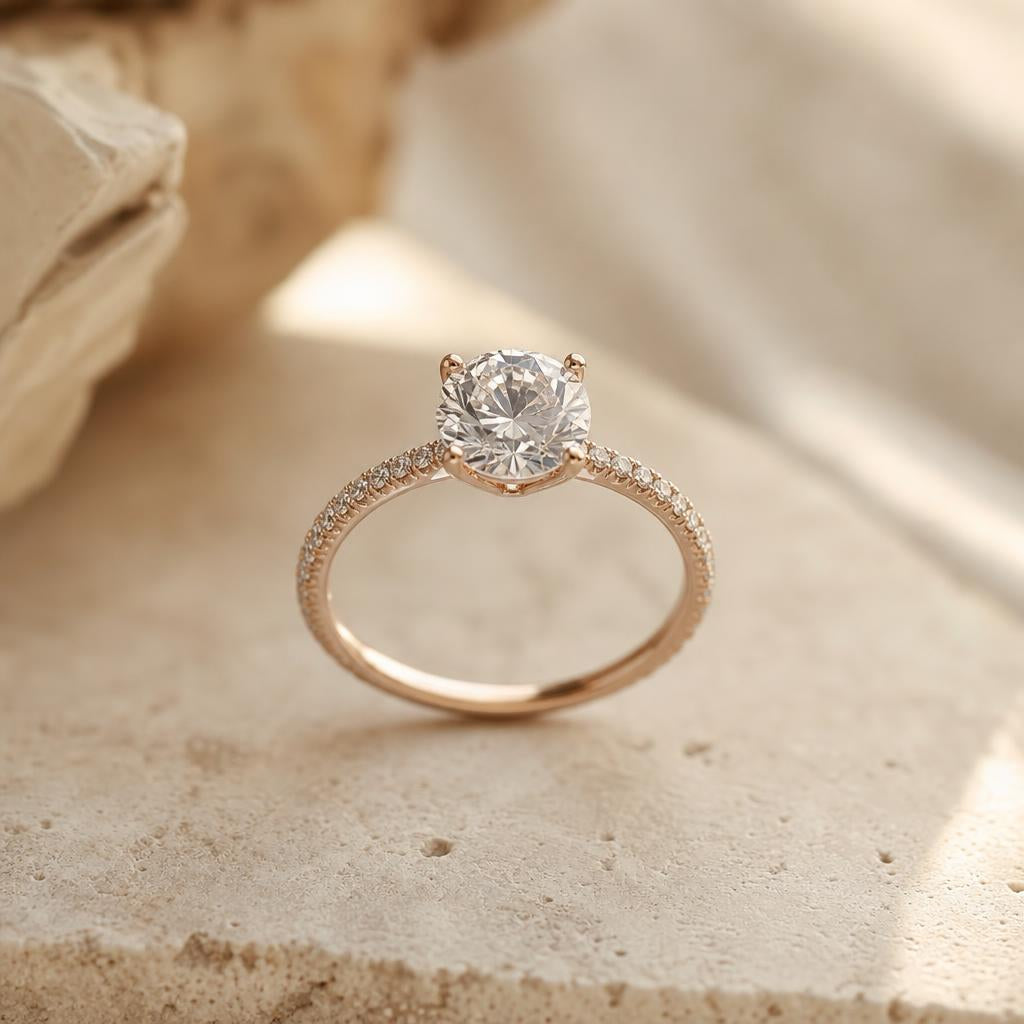
The Leighton Ring
A round center stone framed in a halo of pavé, built to catch light from every angle rather than just the top-down shot a listing photo usually shows.
Shop The Leighton Ring →Facet count matters here too — more facets, cut at the right angles, mean more surfaces bending light back at you. That's the actual mechanism behind a stone that looks "alive" versus one that looks like a paperweight, and it has nothing to do with whether the stone is mined, lab-grown, or simulated. A poorly cut mined diamond will look flatter than a precisely cut moissanite every time.
The Setting: Where Craftsmanship Either Shows Up or Doesn't
If the metal and the stone are the ingredients, the setting is the part that actually has to work — the prongs, the pavé, the band construction that holds everything in place through years of ordinary wear. This is also the part cheap manufacturing cuts corners on first, because it's the least visible in a flat product photo.
Run your finger across a pavé band before you trust it. The small stones should sit flush, evenly spaced, with no visible gaps or wobble. Prongs should be tight against the stone with no daylight showing underneath — a loose prong is the single most common reason a "good enough" ring loses its center stone within the first year. More prongs generally means more security for a larger stone, which is one reason a heavier stone often sits in a 6-prong setting rather than a delicate 4-prong one.

The Camilla Ring
A twisted pavé band that has to be evenly set on both the outer and inner curve — a construction detail that separates a ring built with intention from one that only looks good from directly above.
Shop The Camilla Ring →Hidden halo construction is worth a closer look too. Done well, it tucks a ring of smaller stones just beneath the center stone, invisible from above but visible in profile — adding real size and sparkle without changing the ring's face-up footprint. Done poorly, it's just a gap. If a listing only ever shows the top-down angle, that's often the reason.
✦ Pro tip: Check every listing photo for at least one angled or profile shot, not just the straight-on hero image. A seller confident in the setting will show it. One that only shows the flattest possible angle usually has a reason.
Reading a Listing Like Someone Who Already Knows
Once you know what you're looking for, a product page tells you almost as much as holding the ring would. Specificity is the tell. "925 sterling silver with rhodium plating" is a fact you can verify. "Premium metal" is a phrase designed to sound like one. The same goes for the stone — "moissanite" or "simulated diamond" is specific; "diamond alternative" dressed up in vague language usually means the seller would rather you not ask which one.
Multiple photos from multiple angles, at least one macro shot of the setting, and a listing that states carat weight, cut, and metal content plainly are the three fastest signals that what you're looking at was actually built with care — not just photographed with it. A ring that's genuinely well made rarely needs to hide behind a single flattering angle.
Quick Takeaways
- Metal quality is a stated fact, not a visual one — look for "925 sterling silver" and a named plating, not vague phrases like "premium metal."
- A well-cut stone throws fire — flashes of color as it moves — regardless of whether it's mined, lab-grown, or simulated.
- Check prong tightness and pavé spacing first. Loose prongs are the most common reason a ring loses its center stone.
- Weight matters, but only as one signal among several — a heavy ring with sloppy pavé still isn't a well-made ring.
- A listing with angled and macro photos, plus specific metal and stone details, is usually a listing with nothing to hide.
Frequently Asked Questions
Can you actually tell if a ring is good quality just from photos?
More than you'd think. You can't feel the weight or run a finger across the pavé, but you can check for specific metal content, multiple angles including a profile or macro shot, and stones that show genuine facet-driven sparkle rather than a single flat glare. Vague language and a single hero angle are the two biggest red flags in a listing photo.
Does a heavier ring always mean better quality?
Not on its own. Weight is a useful signal for wall thickness and durability, but a heavy ring with loose prongs or uneven pavé still isn't well made. Treat weight as one data point alongside the setting and the metal content, not the whole answer.
Is there a quick way to check if a stone is set well?
Run a finger across the stone and its prongs. There shouldn't be any catch, wobble, or visible gap between the prong and the stone. For pavé, the small stones should sit flush and evenly spaced with no daylight showing between them and the band.
Is sterling silver lower quality than gold?
No — it's a different metal, not a lesser one. 925 sterling silver is a defined purity standard used across fine jewelry. The quality question isn't which metal a ring uses, it's whether the piece is built to the standard it claims, with the plating, thickness, and setting to back it up.
Once you know what you're actually looking for, "does this look expensive" stops being a guessing game. The metal is either what it says it is or it isn't. The stone either throws light or it doesn't. The setting is either tight or it's a matter of time. Every ring in the Gemiros collection is built to hold up to exactly this kind of scrutiny — because a ring that only looks good in one photo, from one angle, was never actually the point.


