

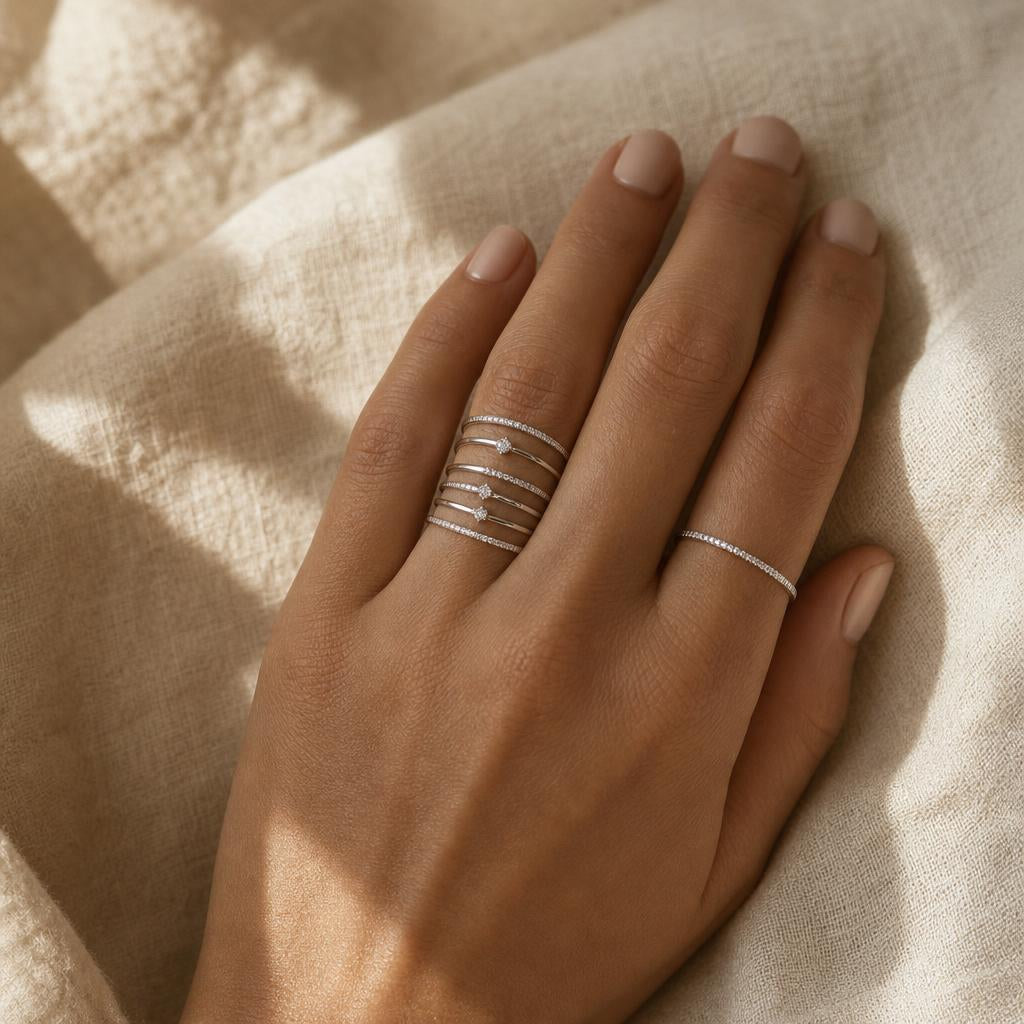
How to Stack Rings With Your Engagement Ring: Vertical vs. Horizontal
There are two completely different ways to wear more than one ring at once, and most women stumble into one of them by accident — usually the one that doesn't actually suit their hand.
Vertical stacking piles rings on top of each other, one finger doing all the work. Horizontal stacking spreads them out, one ring per finger, across the whole hand. They photograph differently, they wear differently, and — this is the part most guides skip — they solve completely different problems. Here's how to tell which one your ring collection actually wants.


Vertical stacking: building upward on one finger
Vertical stacking is the classic. It's what happens when a wedding band, an engagement ring, and maybe an anniversary band all end up on the same finger, sitting flush against each other in a single column. It's also the most forgiving way to wear multiple simulated diamond bands, because the rings support each other visually — a slim eternity band reads as delicate on its own, but stacked underneath a wider ring, it becomes part of one continuous, deliberate line of sparkle instead of a lonely accent.
Vertical stacks tend to grow over time rather than arrive all at once. A woman might start with a single band, add a second for an anniversary, and let a third find its way in a few years later — which is part of why vertical stacking reads as a story rather than a purchase. Each piece marks something, even when the something is simply "I wanted more sparkle that week."
The traditional wedding ring stack order
If you're building a vertical stack around an engagement ring, there's a sequence worth knowing — not a rule, exactly, but a starting point most women adapt rather than follow to the letter. The wedding band goes on first, closest to the base of the finger — symbolically closest to the heart. The engagement ring sits above it. Any anniversary or eternity band added later goes on the outside, furthest from the hand. It's a nice bit of tradition, but it's also just practical: the wedding band tends to be the plainer, sturdier piece, so putting it against the skin protects it from the wear a statement ring takes on daily.
Worth knowing: some women flip the order deliberately — engagement ring first, wedding band on top — because it lets a curved or contoured band sit flush against an oversized center stone without gapping. There's no wrong answer here; it comes down to which pieces actually touch cleanly.
Horizontal stacking: one ring, every finger
Horizontal stacking skips the column entirely. Instead of building height on one finger, you spread rings across the hand — a band on the index, a stone on the middle, something quieter on the pinky. It reads as a jewelry wardrobe rather than a bridal set, and it's the stacking style most self-purchasing women actually reach for day to day, because it doesn't ask any single ring to share space with three others.
This is where a mixed-metal approach genuinely works in a way it doesn't on a single finger. Wearing rose gold on one hand and a cool-toned band on another doesn't compete for attention the way two clashing metals would if they were touching. If you've been hesitant about combining pieces, horizontal is the lower-risk way to try it — nothing has to match, because nothing is actually next to anything else.
How to actually decide between them
If you've been searching for how to stack rings with engagement ring pieces you already own, the honest answer is that most hands do both, just not on the same finger. A vertical stack around an engagement ring on the left hand, and a horizontal scatter of one or two quieter rings across the right, is by far the most common real-world combination — and it looks intentional rather than accidental because each hand has its own clear logic.
If you're starting from nothing, ask what you're actually trying to say. A tall vertical stack reads as a story — this ring, then this one, then this one, each added at a different point. A horizontal spread reads as a collection — pieces gathered because you liked them, not because they mark anything in particular. Neither is more "correct." One just happens to be built around a single centerpiece, and the other isn't.
Where mismatched stacking earns its reputation
Mismatched stacked wedding bands get a bad reputation they don't deserve. The failure mode isn't mixing textures or metals — it's mixing widths that don't sit flush, so the stack looks unfinished rather than deliberate. A wide band under a delicate pavé line will almost always look like an accident. A wide band paired with another substantial piece, texture and all, looks composed. Match the weight before you worry about matching the metal.

The Everlasting Ring
A continuous line of 3mm round simulated diamonds on a substantial 3mm band — built to anchor a stack rather than disappear inside one.
Shop The Everlasting Ring →Building a vertical stack that actually stays flush
Band width is the first thing that matters more than most stacking guides let on: three slim 2mm bands sit differently than one wide statement piece plus a slim companion, and mixing the two without a plan is the most common reason a stack looks cluttered instead of curated. Second is profile — a low, flat band will always sit closer to a flush fit than anything with a raised setting, so put the pieces with prongs or halos on the outside of the stack, not buried in the middle where they'll catch on everything else. And third, simply: comfort. Three or more rings on one finger genuinely change how the stack fits, so if you're building toward a permanent vertical stack, it's worth trying the full combination before committing to it as your everyday wear.
Sterling silver stackable rings make this experimentation low-stakes in a way fine jewelry doesn't. Because The Eternity, The Infinity, and The Wishbone are all built on the same 925 sterling silver base with the same simulated diamond sparkle, you can build a stack, live with it for a season, and swap a piece out without the financial second-guessing that comes with resizing or reselling solid gold.

The Eternity Ring
A full circle of pavé simulated diamonds in a classic 2.0mm profile — low enough to sit flush under almost anything you stack above it.
Shop The Eternity Ring →Wedding ring stack ideas that actually hold up daily
Some combinations earn their keep more than others. A wishbone-shaped band paired with a straight eternity line creates a chevron effect that flatters almost any center stone shape. Two matched bands worn symmetrically — one above, one below a solitaire — reads as classic and comfortable, since neither piece competes with the other for attention. And a single wider band worn alone, no stack at all, is still one of the most requested "ring stack" looks — proof that the category includes restraint, not just accumulation.
For horizontal wear, the logic is simpler: pick one finger as your "sparkle" finger and let the rest stay quiet, or commit to a single delicate band on three fingers for a look that reads as deliberate rather than scattered. Either approach photographs well, which matters more than it should — a lot of stacking decisions get made based on what looks good in a mirror selfie before they get worn anywhere else.
Quick Takeaways
- Vertical stacking builds upward on one finger — best for engagement ring stacks and telling a story over time.
- Horizontal stacking spreads one ring per finger — best for everyday variety and mixing metals without conflict.
- Traditional stack order: wedding band closest to the hand, engagement ring above it, extras added on the outside.
- Match band widths before you worry about matching metals — that's what separates deliberate mismatching from a cluttered stack.
- Sterling silver stacking bands make it low-risk to experiment before committing to a permanent combination.
Frequently asked questions
What is the correct order to stack a wedding ring set?
Traditionally, the wedding band goes on first, closest to the base of the finger, with the engagement ring stacked above it. Any anniversary or eternity band added later sits on the outside. It's a starting point, not a rule — plenty of women flip the order so a contoured band sits flush against an oversized stone.
Are mismatched wedding bands a good idea?
Yes, as long as the widths are matched even when the metals or textures aren't. A slim band under a wide statement piece tends to look unfinished; two substantial pieces styled together, even in different tones, read as intentional.
How many rings is too many for one stack?
There's no fixed number, but three to four rings is where most hands stop feeling comfortable bending. Beyond that, the stack tends to shift from curated to cluttered — and it starts to affect how the finger actually moves.
Is horizontal ring stacking still in style?
Very much so — it's arguably the more everyday version of the trend. Spreading single rings across multiple fingers lets you wear more jewelry without asking any one finger to carry the whole look, which is part of why it's become the default for women building a ring collection for themselves rather than around a single engagement ring.
Is there a rule for how many rings to wear at once?
Some stylists use a loose 2:1:1 guide — two rings on one finger, one on another, one somewhere quieter — as a way to keep a multi-ring look balanced instead of overwhelming. Treat it as a proportion check, not a limit: the point is variation, not a fixed count.
However you build it, the goal is the same: a stack that looks like it was chosen, not accumulated. Start with one piece you'd wear alone and happily, then add from there — vertically, horizontally, or, more often than not, a little of both.


