

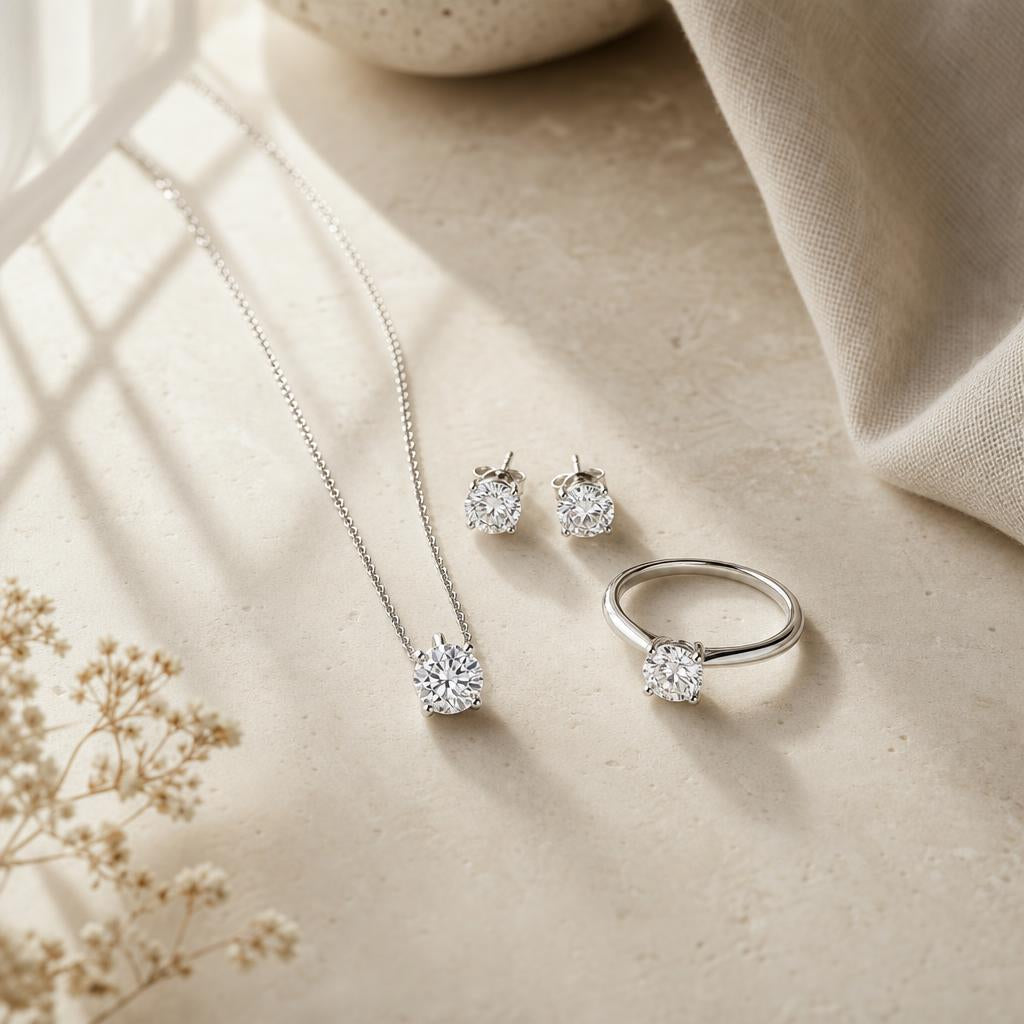
How to Build a Jewelry Collection Across Rings, Necklaces and Earrings Without It Feeling Random
Most jewelry collections don't fail because of bad taste. They fail because every piece was bought for a different version of you: a ring for one mood, earrings for a sale, a necklace that seemed like a good idea at 11 p.m. Six months later, you own a lot and wear very little.
The fix isn't buying less. It's buying in an order, and with a test, so each new piece makes the rest of the collection work harder. Here's how to build a jewelry collection across rings, necklaces and earrings so it reads as one considered wardrobe, never a random pile.


The Random-Collection Problem Is a Sequencing Problem
A collection feels random when its pieces don't share anything: not a metal, not a stone shape, not a level of drama. Each piece is fine alone. Together they argue.
The women who look effortlessly put together aren't buying more carefully because they have more taste. They've picked one or two constants and let everything else vary around them. That's the whole secret, and it costs nothing.
If you're starting from zero, our guide to what to buy first, second and third covers the opening moves. This post picks up where that one ends: you already own a few pieces, and you're deciding what comes next.
Step One: Find Your Two Constants
Look at what you reach for without thinking. Then name two things it has in common. Usually it's a metal tone (cool silver-white, warm gold, or soft rose) and a stone shape or setting style (round and classic, oval and elongated, minimal and bezel-set).
Those are your constants. Every new piece should honor at least one of them. A cool-toned collection can hold an oval ring, a round pendant and huggie hoops, because the metal ties them together. A round-stone collection can move between gold and silver, because the shape does.
The two-constant test: before buying, ask whether the new piece shares at least one constant with two things you already own. If it shares none, it's the start of a different collection, not an addition to this one.
Step Two: Know Your Gaps by Category
Rings, necklaces and earrings do different jobs. Earrings frame your face and get seen in every video call. Necklaces set the neckline and carry the most personality. Rings are the piece you see all day, because they're on your own hands.
A quick wardrobe audit of what you actually wear will show you which category is thin. If you own four rings and one pair of earrings, the next purchase is obvious. The smartest piece to add is almost always in the category you currently ignore.
Step Three: Add Pieces That Bridge Categories
Some pieces do double duty because they echo another category. A round-cut stud and a round-cut pendant look related without looking matched. That's the difference between coordinated and matchy, and it's what keeps a growing collection feeling intentional.

The Ophelia Ring
Your anchor piece. A 4ct-plus oval center with a hidden halo and pavé band, built to look like it costs $15,000 or higher. When one piece does that much talking, everything you add around it can stay quiet.
Shop Ophelia Ring →An anchor ring like this sets the ceiling. Then the question becomes what supports it: a necklace that doesn't compete with the center stone, and earrings small enough to let it lead.
Step Four: Let the Quiet Pieces Do the Daily Work
Most of what you wear should be quiet. A floating solitaire pendant and a pair of studs will end up in rotation five days out of seven. They're not the exciting purchases, but they're the ones that make the collection function.

The Lume Necklace
A round moissanite in a minimal 4-prong setting, designed to let the stone float. It reads as a single point of light, which is exactly what a daily necklace should do. 925 sterling silver, nickel-free.
Shop Lume Necklace →If you'd rather keep the collection pared back, our piece on owning less and wearing more makes the case for a smaller, harder-working set.
Step Five: Add One Piece With a Different Shape
Once your core is set, introduce one piece that breaks the pattern on purpose. A marquise pendant in a round-stone collection. An oval ring among round studs. One deliberate outlier gives the collection a point of view; two starts to look like indecision.

The Meridian Necklace
A 1.0 carat marquise-cut moissanite set vertically, so its elongated silhouette draws the eye downward. The kind of single outlier that makes a round-stone collection look curated.
Shop Meridian Necklace →On Metals: Mix by Rule, Not by Accident
Mixed metals are fine when they look chosen. The easiest rule: pick a dominant tone for roughly two-thirds of what you wear and let the accent tone appear in one piece per category at most. Our guide to mixing metals without it looking like an accident goes deeper on this.
Worth knowing: Gemiros pieces are 925 sterling silver with rhodium, 18k gold or rose gold plating, so the same stone shapes are available across tones. That makes it easy to keep a shape constant while you vary the metal.
Telling a Real Gap From an Impulse
Every collection hits the same moment: something sparkly appears in your feed and you feel certain you need it. Before it reaches your cart, answer three questions. Would I wear it this week? Does it share a metal tone or stone shape with two pieces I own? Which outfit does it finish that nothing else does?
If you can answer all three, buy it with zero guilt. If you can only answer the first, it's a want, and wants are allowed, but give them a seven-day wait. The pieces that survive the wait are almost always the ones that earn their place.
A Worked Example: Six Pieces That Look Like One Decision
Say you wear cool tones and love round stones. Start with the Éclat studs for daily wear. Add the Aria bezel pendant for a secure, simple daily necklace. Bring in the Stella solitaire ring as your everyday ring. That's three categories, one stone shape, one metal tone, and a collection that already reads as cohesive.
Next, widen it without breaking it. Huggie hoops in the same round stones give you a dressier earring. A second ring, in a different silhouette, gives you range. Notice that nothing here required matching sets or identical pieces. The constants did the coordinating for you.
What to Do With Pieces That Don't Fit
Everyone owns a few. Don't force them into the collection, and don't feel guilty about them. Sort them into three piles: wears often, wears for one specific occasion, and never reaches for. The first pile is your core. The second is a legitimate part of the collection if the occasion is real. The third is information about what to stop buying.
That third pile is one of the most useful things you own. It tells you, more honestly than any style quiz, where your taste actually lives. If every unworn piece is in a color you never wear, or a scale you find fussy, you've just found the rule for your next purchase.
Scale and Proportion Across the Whole Look
One last variable most people overlook is visual weight. A collection feels random when one piece is delicate and the next is heavy for no reason. Aim for a consistent range, and let one category carry the weight on any given day. A bold ring means quieter earrings. A statement necklace means a simpler hand. When everything is dialed to the same volume, nothing stands out; when one thing leads, the whole look has a point.
This is also why a bigger center stone is easier to wear than people expect. Once you stop asking every piece to be the star, the one you choose can simply be itself.
A Realistic Order of Purchase
- Months one to two: your daily earrings and one everyday necklace.
- Months three to four: an anchor ring that sets the collection's personality.
- Months five to six: a second pair of earrings in a different silhouette, such as huggies if you started with studs.
- After that: one deliberate outlier, then stop and wear what you have for a season.
That last step matters. A collection reads as intentional when you can see it, which means giving it time before the next purchase.
The Short Version
- Choose two constants, usually a metal tone and a stone shape, and let new pieces honor at least one.
- Fill the thinnest category first, not the one you enjoy shopping most.
- Echo shapes across categories so pieces feel related, not matched.
- Add one deliberate outlier, then pause.
Questions Women Ask About Growing a Collection
What should I buy first when building a jewelry collection?
Start with the piece you'd wear daily: earrings or a simple pendant. They get the most wear, so they teach you your taste fastest, and everything else can be built around them.
How many pieces of jewelry should you own?
There's no magic number. A minimal jewelry collection of six to eight pieces that all get worn beats thirty pieces that don't. If you can't name the last time you wore something, it's not working for you.
Can I mix metals across rings, necklaces and earrings?
Yes. Keep one dominant tone and use the second as an accent in a single piece per category. The mix looks deliberate when one metal is clearly in charge.
How do I make sure a new piece fits what I already own?
Run the two-constant test: it should share a metal tone or a stone shape with at least two pieces you already wear. If it shares neither, hold off.
Is sterling silver a smart base for a collection?
It's a very smart one. 925 sterling silver with moissanite is hypoallergenic, nickel-free, and passes diamond testers, so you build a collection that looks like fine jewelry and spend the difference on more pieces.
A collection isn't a shopping list. It's a point of view that gets clearer with each piece. Choose your constants, fill your gaps, and let the rest follow. Our five-piece capsule guide is a good next read if you want a tighter edit.


