

How Many Stacking Bands Is Too Many? Wedding Ring Stack Ideas That Work
There's a specific moment every stacker knows: you glance down mid-conversation, catch the light hitting your hand, and think — wait, is that too many rings? Somewhere between "elegant layered look" and "I forgot to take some of these off," there's a line. Most women cross it without noticing, then spend months quietly wondering why a stack that looked so good in photos feels cluttered on the actual hand.
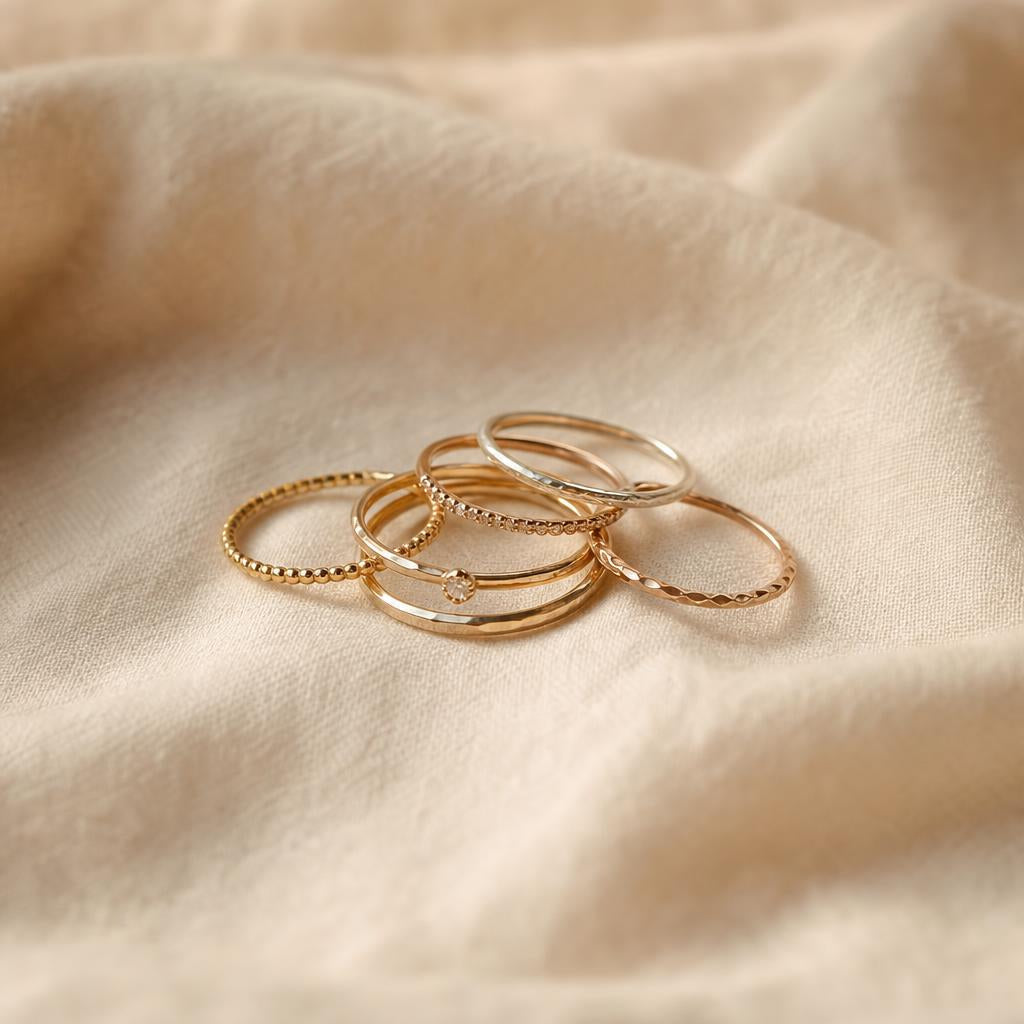
The good news: the answer isn't a number. It's math you can actually see — width, spacing, and how much visual weight each band is carrying. Before we get into how to read your own stack, here are four thin bands worth knowing, each solving a different piece of the puzzle.


So, How Many Rings Is Actually Too Many?
There's no universal number, and anyone who tells you it's exactly three or exactly five is guessing. What actually determines whether a stack reads as intentional or chaotic is total visual weight — how much sparkle, width, and texture is competing for attention at once. A hand wearing five whisper-thin bands can look quieter than a hand wearing two wide, heavily set rings. Count matters less than you'd think.
That's the real question behind most wedding ring stack ideas you'll find while scrolling for inspiration: not how to arrange rings for a flat-lay photo, but how many you can actually wear on a moving hand before it stops looking deliberate.
That said, most stacks start to tip into "too much" territory around the same point: when there's no longer a clear focal ring. If someone glancing at your hand can't tell what they're supposed to look at first, the stack has lost its shape. The fix usually isn't removing a ring — it's re-establishing which one is doing the talking.
Worth knowing: A stack of four thin bands often reads as more restrained than a stack of two chunky ones, because thin profiles leave visible skin between them. That negative space is doing more work than the ring count.
The Focal Ring, Then Everything Else
Every stack that works has a hierarchy, even an accidental one. Usually it's the ring with the most presence — the widest band, the boldest cut, or simply the one worn closest to the knuckle. Everything else should sit slightly behind it in visual volume. This is where a piece like the Devotion Ring earns its place: it has enough architecture to anchor a stack on its own, so you don't need three other rings competing for the same job.

Devotion Ring
A continuous circle of baguette-cut stones in a channel setting — enough presence to anchor a stack without needing three thinner rings to back it up.
Shop Devotion Ring →Once you've picked the anchor, the rest of the stack should be quieter by comparison — not necessarily plainer, just smaller in scale. A curved band tucked beside a bold ring reads as a supporting detail. The same curved band worn alone reads as the main event. Context changes what a ring is doing on your hand.
Reading Your Own Hand Before You Add Another Ring
Finger length and knuckle size change this math more than most stacking guides admit. On a shorter finger, three bands can visually shorten it further, especially if they're evenly spaced and similar in width — the eye reads it as one solid block rather than three distinct pieces. On a longer finger, the same three bands have room to breathe and can look deliberate rather than crowded.
A useful gut check: hold your hand at arm's length, the distance someone else would actually see it from across a table. If you can't immediately identify which ring you'd point to first, that's usually the sign to simplify rather than add. Photos taken close-up are the worst judge of this — they flatten distance and make every stack look denser than it reads in person.
Most advice about stacking rings for women assumes a full, five-ring hand as the goal, but the same width-and-hierarchy logic applies just as well to a stack of two. The number changes. The math doesn't.
✦ Pro tip: Try removing one ring before buying another. Most stacks that feel cluttered aren't missing a piece — they're carrying one too many.
Matching Metals vs. Mixing It Up
Mismatched stacked wedding bands have earned their popularity honestly — a slightly different tone or texture between bands keeps a stack from reading as a single flat block, and it photographs with more depth than an all-matching set. The trick is limiting the variation to one axis at a time. Mix metal tones or mix stone settings, but doing both at once is usually what pushes a stack from "intentionally varied" into "randomly assembled."
If you're building toward a fuller hand over time rather than all at once, it's worth deciding early whether you're building a matched set or a collected one. Both work. What doesn't work is starting matched and drifting mismatched piece by piece without ever deciding — that's the version that ends up looking unplanned instead of curated.
Width Does More Work Than People Expect
Two rings of identical width, worn side by side, tend to blur into each other — the eye can't find the seam. Vary the widths even slightly (a 1.5mm band next to a 3mm band, for example) and the same two rings suddenly read as separate, deliberate choices. This is why a stack built entirely from similar bands often looks busier than a stack with more rings but greater width variation.
Delicate, low-profile pieces are especially good at filling out a stack without adding bulk — they contribute sparkle and rhythm without competing for the anchor position. A ring like the Infinity, with its narrow lines of pavé, is built for exactly that role.
Most stackable wedding bands are cut thin for this reason — a narrow profile lets you add or remove a piece without throwing off the balance of everything already on your hand.

Infinity Ring
Delicate lines of pavé simulated diamonds in 925 sterling silver — built to add sparkle to a stack without ever competing with the anchor ring.
Shop Infinity Ring →A Quick Width Reference
| Band width | Reads as | Best used |
|---|---|---|
| 1–1.5mm | A whisper, near-invisible alone | Filling gaps between bolder pieces |
| 2–3mm | A clear, standalone statement | Anchor or secondary focal ring |
| 4mm+ | A dominant piece | Alone or with one thin band only |
Building It Slowly Instead of All at Once
Nobody actually needs to buy an entire stack in a single order — most women who wear a full hand built it over months, not one afternoon, adding a piece for a birthday here or a good week there. This slower approach solves the "too many rings" problem before it starts, because you're testing each addition against what's already on your hand instead of guessing from a flat-lay photo. If a new ring doesn't earn its spot after a week of actually wearing it, that's useful information.
When you are building deliberately, sterling silver stackable rings are a low-risk way to experiment — the base metal is consistent across pieces, nickel-free, and won't discolor skin, so you can focus purely on shape, width, and setting without worrying about metal quality varying piece to piece.
That patience pays off more than people expect. A stack built one considered piece at a time almost always looks more cohesive a year later than one bought all at once, simply because each addition was tested against real life instead of a wishlist.
If you'd rather not assemble a stack one purchase at a time, starting from a stackable rings set solves the width-variation problem automatically, since the pieces are designed to sit together from the start rather than being matched up after the fact.
Quick Takeaways
- There's no fixed ring count — visual weight (width, sparkle, spacing) determines whether a stack looks intentional or cluttered
- Every working stack has one clear focal ring; everything else should sit slightly behind it in scale
- Vary width, not just metal tone — two identical widths blur together even when the rings themselves are different
- Mixing metals or settings works best along one axis at a time, not several at once
- Build gradually and test each new ring against what you already wear before adding another
Frequently Asked Questions
What are the actual rules for stacking rings?
There isn't a rulebook, but there are patterns that consistently work: keep one ring as the clear focal point, vary width rather than repeating the same size, and limit metal or texture mixing to one variable at a time. Beyond that, it comes down to how the stack reads on your specific hand.
Are stacking rings still in style, or is the trend fading?
Stacking has held steady for years because it isn't really a trend — it's a styling method, not a single look. What shifts is the ratio: right now, thinner bands and more restrained stacks are favored over the maximalist, five-ring hand that peaked a few seasons back.
What goes into a good wedding ring stack?
Most working stacks include one anchor piece with real presence, plus one or two supporting bands that add width variation or texture without competing for attention. It rarely needs more than three pieces to look finished — quality of contrast matters more than quantity.
Is mixing and mismatching stacked bands actually a good idea?
Yes, within limits. A slight difference in tone or setting between bands adds depth and keeps a stack from reading as one flat unit. The version that doesn't work is mixing multiple metals and multiple settings and multiple widths all at once — pick one dimension to vary and keep the rest consistent.
The honest answer to "how many is too many" is the one nobody wants: it depends on what each ring is doing. A hand carrying five thoughtfully varied bands can look more put-together than a hand carrying two competing ones. Before adding the next ring, ask what job it's doing in the stack — and if you can't answer that, it might be the one to leave in the box a little longer.


