

Sterling Silver Wedding Bands in Gold Vermeil: What to Know Before You Buy
There's a fair question underneath most wedding band research: is that gold finish actually gold, or is it something you'll be replacing in a year? Sterling silver wedding bands answer that question better than most people expect — genuine gold, layered thick over real silver, built to be worn every day rather than saved for occasions.
Every Gemiros stacking band starts with a 925 sterling silver base, finished in rhodium, 18k gold, or rose gold. Here's what that construction actually means for how a band wears, stacks, and holds up over years, not months.


What Gold Vermeil Actually Means on a Sterling Silver Base
Vermeil isn't a marketing word — it's a defined standard. To legally carry the name, a piece has to start with solid sterling silver and carry a gold layer of at least 2.5 microns, roughly five times thicker than the flash-plating found on cheap costume pieces. That thickness is the entire difference between a band that holds its color for years and one that goes patchy after a few wears.
Gemiros builds its stacking collection this way on purpose: a 925 silver base underneath, then a genuine 18k gold or rose gold layer on top. The silver base is precious metal in its own right, not a filler — it's what gives the piece real weight on the hand and lets the gold read warm and rich instead of brassy.
Worth knowing: Not every gold-toned ring on the market meets the vermeil standard. A lot of budget pieces are plated over brass or steel with a coating so thin it wears through in weeks. The base metal and the micron thickness are what actually determine how long a ring looks new.
How It Wears — Daily, Not Delicate
The question underneath most of this research is really about durability: will it hold up if she wears it every day? A properly made gold vermeil band does. Indistinguishable from solid gold to the eye, resistant to everyday knocks, and built for continuous wear rather than special occasions only — that's the standard it's held to before it ever ships.
The habits that extend a plated piece's life are simple: take it off before swimming or the shower, apply lotion and perfume before you put the ring on rather than after, and store it somewhere it isn't rattling against other metal. None of that is a downside unique to this construction — it's the same basic care that keeps any fine jewelry looking its best.

The Beloved Ring
A bezel-set band built for exactly this kind of daily wear — smooth edges, no prongs to snag, and a warm 18k gold finish over a solid silver base.
Shop The Beloved Ring →Building a Stack With Stackable Gold Wedding Bands
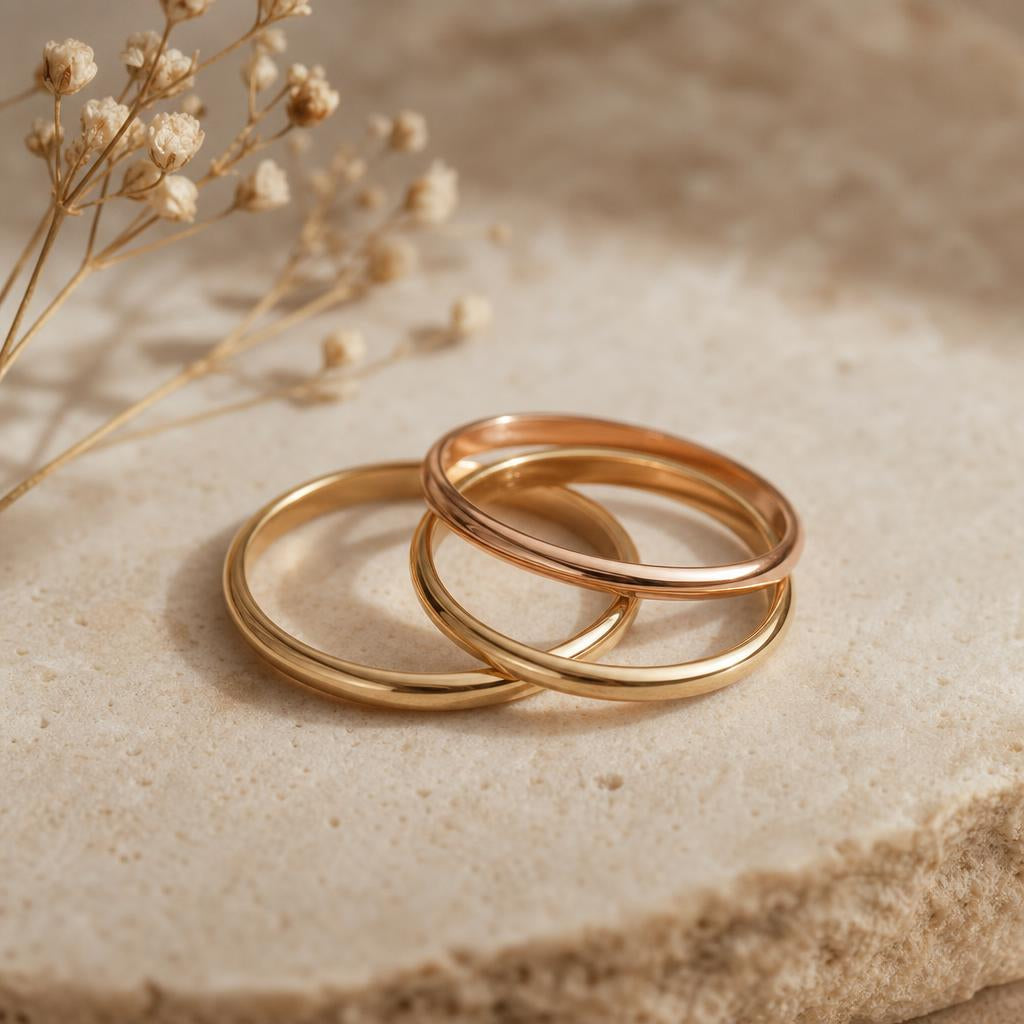
This finish earns its keep in a stack. Because the tone reads warm rather than sharp-bright, it sits comfortably next to almost anything — a solitaire, a halo, another plated band, even a mixed-metal piece from an earlier era of your collection. These pieces work best when you treat width as the organizing principle: put your slimmest band closest to the knuckle, let a slightly wider piece anchor the base, and resist buying three identical widths just because they matched at checkout.
A stack doesn't have to be finished on day one. Most women build theirs a piece at a time — a first band worn alone for a while, a second added when it feels right, a third when the stack finally looks like it's actually hers rather than assembled from a set. There's no rule that says a rose gold piece can only pair with other rose gold — a warmer tone next to a cooler one usually reads intentional far more often than mismatched.

The Petal Ring
A rose-gold-finished band with a soft, sculptural profile — made to sit flush against a solitaire or slot into an existing stack without competing for attention.
Shop The Petal Ring →Thin Gold Wedding Band or Wider Silhouette?
Width changes the entire personality of a ring, and it's worth deciding on purpose rather than by accident. A slim band — anything close to 1.5–2mm — reads quiet and layered, the kind of piece that disappears into a stack or works as a single, understated line on its own. Move up toward 3mm and a band starts to read as a statement in its own right, something that can anchor a stack instead of just filling space in it.
| Band Width | How It Reads | Best Use |
|---|---|---|
| Under 2mm | Delicate, quiet | Layering, worn alone as a minimal piece |
| 2–3mm | Balanced, versatile | Everyday stacking base or standalone band |
| 3mm+ | Confident, anchoring | Sits at the base of a stack, holds its own |
Neither is more correct. A woman who wears one ring at a time might prefer the presence of a wider band, while someone building a five-piece stack usually reaches for slimmer widths that let every piece breathe. Try both on before deciding — width is one of those things that looks completely different on the hand than it does in a product photo.
Caring for 925 Sterling Silver Wedding Bands
The silver base is the reason a plated piece feels substantial rather than hollow, and it comes with its own small set of habits worth knowing. It won't discolor skin — it's hypoallergenic and nickel-free — and a light polish with a soft cloth is usually all it takes to keep both the silver and the gold layer looking sharp. Store pieces separately rather than tangled together in a dish, since metal-on-metal contact is what actually causes surface wear over time.
None of this is unusual or fragile — it's simply how a well-built band is meant to be treated, whether the finish on top is 18k gold, rose gold, or rhodium. Give it the same casual care you'd give any piece you actually plan to wear, and the finish holds.
Quick Takeaways
- Vermeil means genuine gold — at least 2.5 microns — over a solid 925 silver base, not a thin coating over cheap metal.
- Take it off before swimming or showering, and apply lotion and perfume before you put the ring on, not after.
- Width sets the personality of a band — thin for layering, wider for a piece that anchors a stack.
- Sterling silver is hypoallergenic and nickel-free, and stores best kept away from other metal pieces.
- Mixing gold tones within a stack reads intentional far more often than it reads mismatched.
Frequently Asked Questions
Is gold vermeil real gold?
Yes. To legally carry the name, a piece must have a genuine gold layer — at least 10k purity and 2.5 microns thick — over a solid sterling silver base. It's real gold, just not gold all the way through.
How long does a plated band actually last?
With basic care — removed before water and lotion, stored away from other metal — a well-made plated band holds its finish for years of regular wear. The thickness of the gold layer is what determines longevity, which is why the micron standard matters more than the price tag.
Does sterling silver make a good wedding band?
Yes. Sterling silver is a genuine precious metal, hypoallergenic and nickel-free, and it's the same base that gold and rose gold finishes are built on. It's durable enough for daily wear and gives a plated piece its weight and warmth.
What does 925 mean on a ring?
The number refers to the silver purity underneath — 92.5% pure silver, the standard for sterling silver. When that base is layered with a sufficiently thick gold coating, the finished piece meets the vermeil standard.
Can a gold-finished ring turn skin green?
A properly made piece, plated over nickel-free sterling silver, shouldn't turn skin green. That reaction usually comes from lower-quality base metals reacting with moisture and oils — not from a genuine silver-and-gold construction.
Whichever width or tone you land on, the point of a well-built band is the same: it should look and feel like it belongs in daily rotation, not a jewelry box you open twice a year. Start with one piece, wear it until you know exactly what you want next to it, and let the stack build itself from there.


