

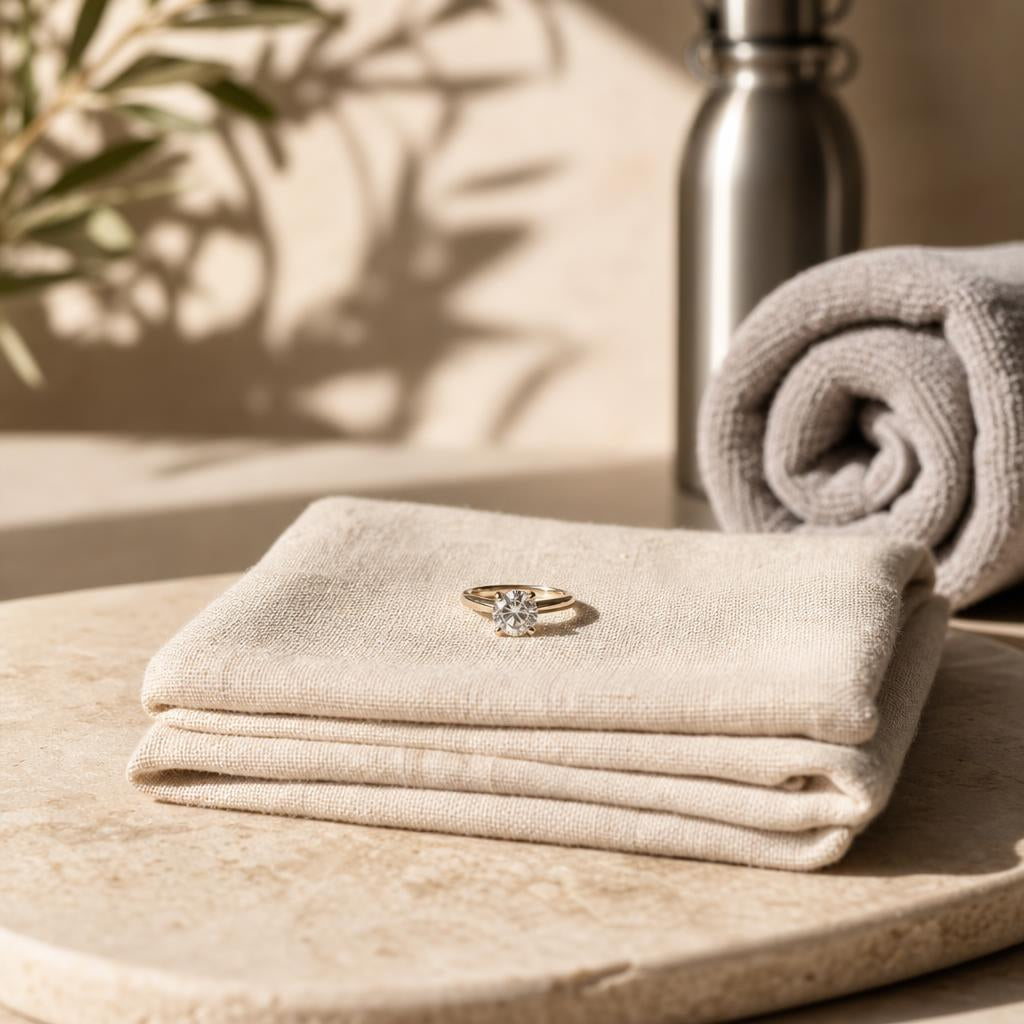
Do You Wear Your Engagement Ring to the Gym? A Real Answer
Somewhere between your third set of deadlifts and the front desk check-in, you've probably wondered whether your ring should even be on your hand right now. It's not a small question. Your ring is 925 sterling silver and a moissanite or simulated diamond that passes diamond testers — it's not going anywhere near "cheap" or "fragile" territory. But strength training puts real, repeated force through a small metal band, and that's true no matter what a ring is made of or what it costs.
Here's the short version: some of your rings are built for this, and some aren't — and knowing the difference matters more than blanket rules like "never wear jewelry at the gym." Before we get into what actually happens under load, here are a few Gemiros styles built with exactly this in mind: low profiles, flush settings, nothing raised for a barbell to catch on.


Do You Wear Your Engagement Ring to the Gym?
The honest answer is: it depends what you're doing, not what your ring is made of. A ring resting on your finger during a yoga class or a treadmill run is under almost no stress. The same ring gripping a barbell, a pull-up bar, or a set of dumbbells is under real, repeated compression — and that's just physics. It has nothing to do with whether the stone is a mined diamond or a Gemiros simulated diamond. A raised setting is a raised setting.
What changes the risk isn't the material quality, it's the shape of the setting. A tall prong setting has more surface area to catch on a bar or a machine handle. A flush, bezel-set, or low-profile band has almost nothing to snag. That's the entire logic behind this guide: match the ring to the activity, not the activity to the ring.
What Actually Happens to a Ring Under Load
When you grip something heavy, your hand tightens around the ring and pushes it against whatever you're holding. Over enough reps, that pressure can bend a soft band out of round, loosen a prong, or scratch a stone against metal equipment. None of this is a sign of poor craftsmanship — it's the same physics that makes jewelers tell brides not to wear any fine ring, mined or simulated, through a heavy lifting session.
Worth knowing: The bigger safety concern isn't scratching — it's a ring catching on equipment mid-movement. Jewelers call the resulting injury "ring avulsion," and it's the real reason most trainers recommend going ringless or wearing a flush, low-profile band for anything grip-intensive, like pull-ups, kettlebell work, or heavy compound lifts.
The Low-Profile Advantage
This is where setting choice does the actual work. A bezel setting, like the one on The Cherish Ring, wraps a rim of metal fully around the stone, so there's nothing raised for a bar to grab. A flush eternity band, like The Everlasting Ring, sits nearly level with your finger from every angle. Both are the kind of rings you can wear through a full workout without spending your whole set thinking about your hand.
A halo or a tall solitaire is a different story — not because it's less well made, but because geometry works against it under load. That's not a reason to avoid halo styles entirely. It's a reason to save them for the days you're not under the bar.

The Duchess Ring
A cushion-cut center wrapped in a double halo of pavé — dramatic, dimensional, and built for the days you're not gripping a barbell. Save this one for date night, not deadlift day.
Shop The Duchess Ring →Taking It Off at the Gym: What Other People Actually Do
Ask around a locker room and you'll hear three answers, roughly in this order of popularity: take it off and stash it, swap to a low-profile everyday piece, or just wear it and accept the small risk for low-intensity sessions. All three are reasonable. What's not reasonable is leaving a ring loose on a bench, a windowsill, or the edge of a sink — more rings are lost to a forgotten locker shelf than to any workout itself.
✦ Pro tip: If you're going ringless, use the same zippered pocket in your gym bag every single time. Consistency, not memory, is what actually prevents a lost ring.
Lifting Weights With an Engagement Ring — When It's Actually Fine
Not every gym session carries the same risk, so it's worth breaking it down by activity instead of treating "the gym" as one category. Walking, cycling, most cardio machines, and light dumbbell work put almost no pressure on a ring — this is where a low-profile everyday piece does its job with zero drama. Barbell work, pull-up bars, kettlebells, and anything involving a tight, repeated grip are the categories where taking a ring off, or switching to a flush band, actually earns its keep.
If you split your workouts this way — light days in a low-profile ring, heavy grip days ring-free or in something flush — you get to keep wearing jewelry you love without gambling with it every single session.

The Belle Ring
A 1.3-carat round center circled in pavé, with a slim 2mm band that flows straight into the halo. Beautiful for the daily grind — just not the literal grind of a barbell.
Shop The Belle Ring →Running, Cardio, and the Rings You Don't Have to Think About
Cardio deserves its own category, because it's genuinely lower-risk than almost anyone assumes. Running, cycling, the elliptical, a spin class — none of it puts meaningful compression on a ring the way gripping a bar does. The main issue with cardio is swelling: fingers expand slightly with heat and increased blood flow, so a ring that fits perfectly at 7am can feel snug by the end of a hot class. That's a sizing conversation, not a durability one, and it's worth checking your fit if you notice it regularly during workouts.
Swimming is the one cardio exception worth flagging. Chlorine and saltwater are harder on plated metals over time than a single sweaty spin class ever will be, which is really a travel and pool-day issue more than a gym one. If you're the type to swap rings before a pool day or a beach trip, the same flush, low-profile pieces that work for lifting tend to be the easiest to travel with, too.
Why Sterling Silver and Moissanite Actually Make This Easier
None of this is a durability problem unique to simulated diamonds. Every Gemiros ring is 925 sterling silver with rhodium or gold plating, set with moissanite or a Gemiros™ signature simulated diamond — nickel-free, hypoallergenic, and indistinguishable from a mined diamond to the eye or a diamond tester. That's not a caveat; it's the actual spec. The reason a flush or bezel setting is smarter for the gym isn't that your ring is somehow less durable than a mined-diamond piece costing many times more — it's that geometry, not material, decides what can catch on a barbell.
That distinction matters, because a lot of women quietly assume their ring is the fragile link in this equation. It isn't. A tarnish-resistant sterling silver base and a lab-created stone built to pass professional diamond testing are not the weak point of your gym bag. The weak point is wearing a tall setting through a grip-heavy set — which is exactly as true for a ring costing thousands more as it is for yours.
Quick Takeaways
- The setting shape — not the material — determines gym risk. Flush and bezel settings are the safest choice for grip-heavy training.
- Low-intensity movement (cardio, walking, light dumbbells) puts almost no stress on a ring worn correctly.
- Heavy grip work — barbells, pull-up bars, kettlebells — is where you take it off or switch to a low-profile piece.
- Store a removed ring in the same spot every time. Loss, not damage, is the more common gym-jewelry mistake.
- Sterling silver and moissanite aren't the fragile part of this equation — geometry under load is.
FAQ: Rings, Workouts, and What Actually Holds Up
Can you wear a wedding ring at the gym?
Yes, for most low-to-moderate activity — walking, cycling, cardio machines, light weights. The setting matters more than the occasion: a flush or bezel band handles a gym session easily, while a tall prong setting is better saved for grip-light days.
How do I protect my engagement ring at the gym?
Match the ring to the workout. Wear a low-profile, flush-set piece for lighter sessions, and remove any ring for barbell work, pull-ups, or kettlebells. If you're taking it off, store it in the same designated spot — a zippered gym bag pocket — every single time.
Should I take my ring off when I lift weights?
For heavy or grip-intensive lifting, yes — that's where the repeated pressure and snag risk are highest. For lighter dumbbell work or machines with padded grips, a flush or bezel-set ring can usually stay on without issue.
When shouldn't you wear your engagement ring?
Skip it for anything involving a tight, repeated grip on hard equipment — barbells, pull-up bars, climbing holds — and for swimming in chlorinated or salt water, which is harder on plating over time than a single workout ever is. Everyday wear, including most of the gym, is exactly what a well-made ring is built for.
The real takeaway isn't "never wear your ring to the gym" — it's that a smart ring wardrobe makes the question disappear entirely. Keep a flush or bezel piece in rotation for training days, save the halos and solitaires for everything else, and you'll never have to choose between showing up for your workout and showing up for your ring.


