

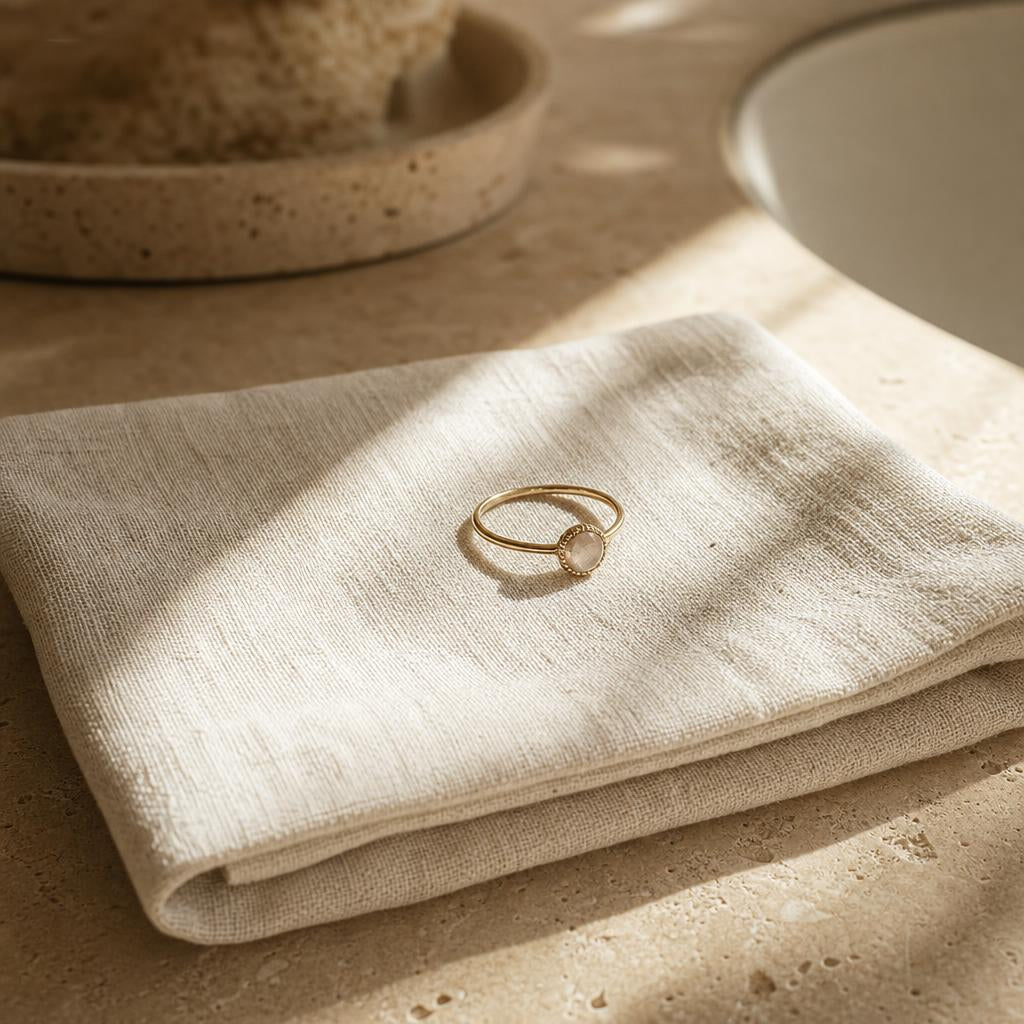
The "No Jewelry Left Behind" Habit: A Simple System for Never Losing a Ring at the Gym, Pool or Sink
It usually happens the same way. You slide your ring off before the gym, or before you get in the pool, or before you wash your hands at a restaurant sink — and you set it down somewhere that feels safe in the moment. Ten minutes later, you can't remember where "somewhere" was.
Losing a ring is rarely dramatic. It's almost always this quiet, forgettable moment repeated enough times that eventually, one of them goes wrong. The fix isn't more caution — it's a system that doesn't depend on remembering anything at all, built around a ring you're not afraid to take on and off a dozen times a day.


Why rings actually go missing
Almost nobody loses a ring by having it slip off their finger unnoticed. That happens, but it's rare. The far more common story is that you took it off on purpose — for a workout, a swim, a shower, a round of dishes — set it down somewhere that made sense at the time, and then the day moved on without you. A gym bag gets packed differently than usual. Someone wipes down the pool deck. A guest towel gets tossed in the wash with a ring still folded inside it.
None of this is carelessness in the way it feels afterward. It's just what happens when a valuable object depends entirely on a single person remembering a single detail in the middle of a distracted day. The system that actually works removes that dependency instead of trying to will it away with more attention.
The three danger zones: gym, pool, sink
Almost every lost-ring story traces back to one of three settings, and each one fails you a slightly different way.
The gym. Rings come off for lifting because metal against a barbell is uncomfortable and because a snagged setting during a set is a genuine injury risk. They get tucked into a shoe, a jacket pocket, or the little zip pouch in a gym bag — all places that feel secure until the bag gets emptied in a hurry later that night.
The pool. Chlorine and salt water are hard on plating and can loosen prongs over time, so rings come off before anyone gets in. The problem is where they land next: a beach bag, a pool ledge, the outside pocket of a towel. Wet hands and a crowded pool deck are not a great combination for remembering exactly where you set something down twenty minutes ago.
The sink. This is the quiet one. Hand soap and lotion make rings slide, so people slip them off before washing up — at home, at work, in a public restroom — and set them on the edge of the basin. A restroom sink edge is one of the single most common places a ring is later found by someone who isn't its owner, if it's found at all.
Worth knowing: Insurance data and lost-and-found reports from gyms and hotels consistently point to the same pattern — rings go missing at the moment they're removed, not the moment they're worn. The fix has almost nothing to do with the ring itself and everything to do with what happens in the sixty seconds after it comes off.
Build a two-ring system
The simplest fix isn't a habit you have to remember to perform — it's a setup that makes the risky moments low-stakes by default. Keep your meaningful ring, the one with real sentimental or financial weight, reserved for situations where you're not removing it under pressure: dinner out, an event, a regular day at a desk. For anything that involves taking a ring off and on repeatedly — the gym, the pool, a hotel bathroom, a day of errands — wear a ring you'd be genuinely fine losing.
This is the entire logic behind a travel ring, and it's worth taking seriously even if you've never thought of yourself as a "travel ring person." A simulated diamond ring in sterling silver looks convincingly like the real thing from across a room, costs a fraction of what your primary ring is worth, and comes off your finger with zero emotional stakes attached. If it ends up left behind at a hotel or a gym, it's an inconvenience, not a loss that keeps you up at night.

The Odette Ring
A clean oval solitaire that reads as effortlessly elegant without demanding constant attention — the kind of ring you can wear through a workout, a pool day, or a full sink of dishes without a second thought.
Shop The Odette Ring →This approach also solves a problem people rarely mention out loud: the anxiety of constantly checking that your ring is still on. When the ring on your hand during a chaotic day isn't the one you'd be devastated to lose, the whole day gets quieter.
The five-second habit that actually prevents most losses
If you do want to keep wearing a ring you care about through active moments, the fix isn't vigilance — it's a fixed location. Pick one specific spot that is always, without exception, where a ring goes the second it comes off. Not "somewhere in my bag." Not "wherever's closest." One spot.
✦ Pro tip: A small zip pocket inside your gym bag or a labeled interior pocket in your everyday bag works better than a ring dish at home, because the danger zones are almost never at home. The fixed spot needs to travel with you into the exact situations where rings actually go missing.
The habit only works if the spot is boring and consistent. A ring dish on your dresser is a lovely idea for the five minutes a week you're actually standing in front of it, but it does nothing for the moment you're rinsing conditioner out of your hair at a gym shower or drying your hands at a restaurant sink two states from home. Build the habit around the situations where the ring actually leaves your hand, not the situations where it's convenient to imagine putting it away.
What to do the moment you realize a ring might be gone
Even with a good system, rings occasionally get left behind. What separates a five-minute inconvenience from a permanent loss is almost always speed. The moment you notice — not an hour later, not "I'll deal with it after dinner" — retrace the exact sequence: where you took it off, what you touched right after, and whether anyone else was in that space within the last few minutes.
Gyms, pools, and hotels all field lost-jewelry questions constantly, and most have a genuine system for it — a front desk log, a lost-and-found bin, a lifeguard station. Ask immediately, describe the ring specifically, and leave a phone number. A surprising number of rings get returned within the same day simply because someone asked before the shift changed and the bin got emptied.

The Duchess Ring
A cushion-cut hidden halo with pavé detailing that gives you real presence on the hand — a good pick if your everyday ring needs to feel a little more special without becoming precious about it.
Shop The Duchess Ring →A ring dish is not enough
Ring dishes are genuinely useful, but only for one narrow situation: the ring that comes off at home and stays at home. They do nothing for the version of you that's mid-workout, mid-swim, or drying her hands in an unfamiliar bathroom. Building a full system means covering all three zones separately, with a plan that doesn't rely on the dish being anywhere nearby.
- At the gym: a small zippered pocket inside your gym bag, used every single time, no exceptions.
- At the pool: a ring holder clipped to a beach bag, or — better — simply not wearing a ring you'd mourn losing to a pool deck in the first place.
- At the sink: this is the hardest one to systematize because sinks are everywhere and unfamiliar. The most reliable fix is wearing a ring you're not removing for hand soap at all, which is exactly where a lower-stakes everyday piece earns its keep.
Notice that two of the three zones are solved more easily by changing which ring you're wearing than by building a more elaborate storage system. That's the actual insight here: the habit that scales is the one that doesn't require a system everywhere you go.
Quick Takeaways
- Most lost rings aren't lost while being worn — they're set down somewhere and forgotten.
- Gyms, pools, and sinks account for the overwhelming majority of lost-ring situations.
- A two-ring system — a meaningful ring for low-risk moments, a low-stakes ring for active ones — removes the stakes entirely.
- A fixed, boring, repeatable spot beats a ring dish, because the danger zones are rarely at home.
- Speed matters most if a ring does go missing — ask the front desk or lifeguard immediately.
Frequently asked questions
Is it actually safe to wear a ring at the gym at all?
For most lifting and cardio, yes — but a low-profile, snag-resistant setting is worth choosing over anything with tall prongs or delicate detailing. Many women prefer to remove rings for heavy lifting specifically because of grip and snag risk, which is exactly the moment a fixed-spot habit matters most.
Does chlorine actually damage a ring, or is that overstated?
Chlorine can dull plating and, over time, weaken certain metal alloys and settings. It's not usually dramatic after one swim, but repeated exposure adds up — which is another reason a lower-stakes ring makes sense for regular pool days rather than a piece you'd want to protect long-term.
What's the single most effective habit if I only adopt one thing from this?
Pick one fixed, portable spot — a specific zip pocket, not a general area — for a ring the second it comes off, and use it every time without exception. Consistency matters more than the container itself.
Should I really buy a separate ring just for the gym and pool?
You don't have to, but it solves the problem at the source rather than managing around it. A ring you're not emotionally or financially attached to changes the entire calculation — a missed pocket or a forgotten sink edge becomes a minor annoyance instead of a genuine loss.
None of this requires becoming a more careful person, which is good, because willpower isn't a reliable long-term strategy for anything involving a distracted Tuesday morning. What actually works is designing the risky moments out of the equation — a fixed spot that travels with you, and a ring on your hand during the messiest parts of your day that you're not afraid to set down.


