

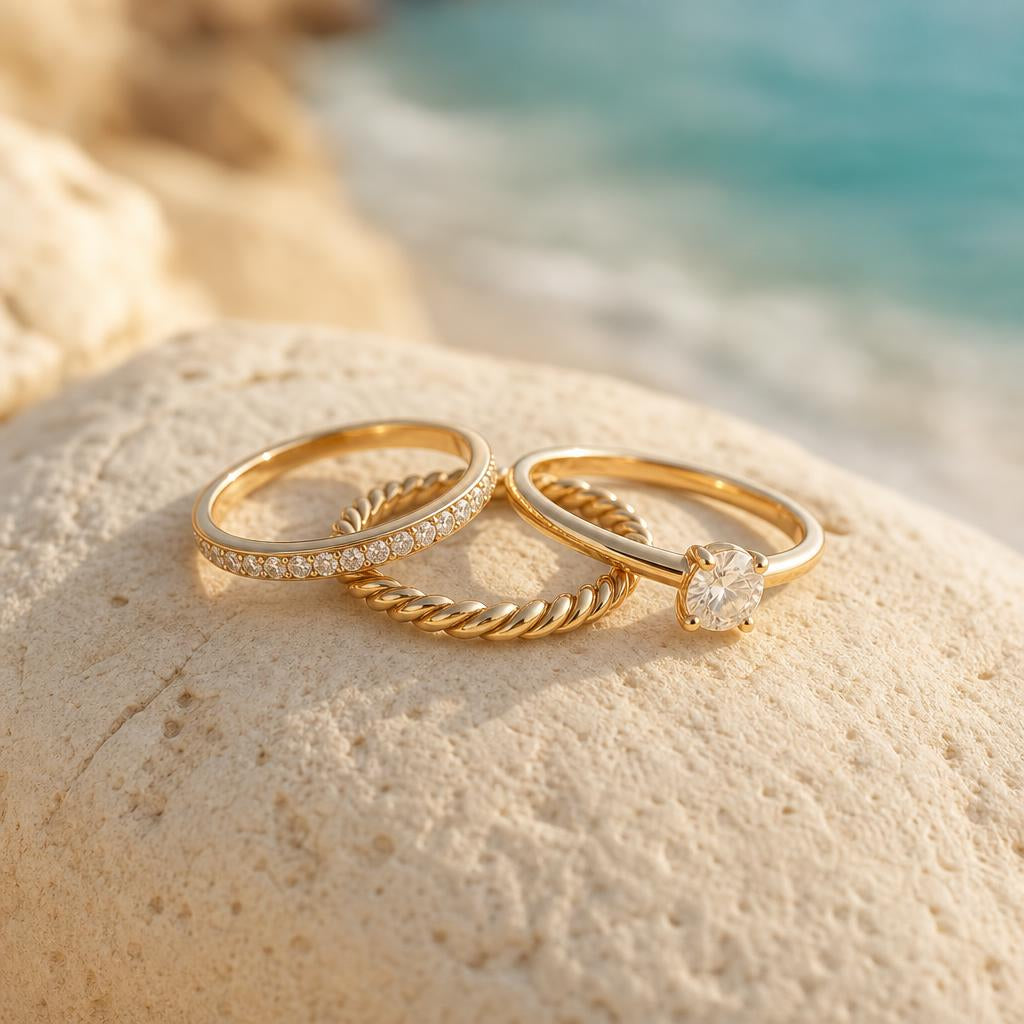
Beach, Pool, Saltwater, Sunscreen: Which Jewelry Actually Survives a Holiday
Somewhere around the third day of your holiday, the question arrives: you're heading to the beach, already in your swimsuit, and your engagement ring is sitting on the bathroom counter looking at you. Leave it? Wear it? Wrap it in a flannel and hope for the best?
For most women, the answer — reluctantly, cautiously — is to leave it behind. And that decision, while sensible, has a way of nagging at you all day. The good news is that this is a solvable problem. Here's an honest breakdown of what holiday environments actually do to jewelry, which pieces survive them, and what to pack so you never have to make that call again.


What the beach actually does to your jewelry
The hazards aren't always obvious, which is why so many women find out the hard way. Sand, salt, chlorine, heat, and sunscreen each interact with jewelry in different ways, and the combination of them — which describes most beach holidays fairly accurately — is more damaging than any single element on its own.
Saltwater and the sea
Saltwater is corrosive. Over time, exposure to ocean water accelerates oxidation in sterling silver — that familiar tarnish you've seen on older pieces — and can weaken gold plating by stripping the surface layer. The salt itself acts as a mild abrasive on softer metals, and the mechanical action of waves introduces physical stress to settings, especially prong settings where thin claws can bend or shift if the ring catches on something in the current.
For the stone itself, simulated diamonds are essentially impervious to saltwater — they're glass-hard and chemically stable. A real diamond is technically fine too, but the setting and metal around it are the vulnerable points. Organic stones like pearl or coral are a different matter: saltwater can dissolve the surface of a pearl and permanently damage its lustre.
Chlorine: the less obvious threat
Pool water is, if anything, worse than the ocean. Chlorine is a powerful oxidising agent — it reacts with metal at a molecular level. For sterling silver, repeated exposure to chlorinated water causes accelerated tarnishing and surface pitting. For solid gold, chlorine has minimal effect. But for gold-plated silver — which covers most accessible-price-point "gold" jewelry — chlorine can strip the plating and reveal the silver beneath far more quickly than ordinary wear would.
Worth knowing: It only takes a few pool sessions for chlorine to visibly dull gold-plated jewelry. The damage isn't catastrophic, but it is cumulative and irreversible once the plating is gone.
Sunscreen and the build-up problem
Sunscreen doesn't destroy jewelry, but it clogs it. The oils, waxes, and UV-filter chemicals in most sunscreens accumulate in prong settings, under stones, and in any textured surface over the course of a day at the beach. The result is a film that dulls the appearance of the stone and, if not cleaned off regularly, becomes harder to remove. SPF 50 on a radiant-cut simulated diamond starts to look like a frosted window by mid-afternoon.
This isn't a reason to leave jewelry at home — it's a reason to rinse pieces in clean water at the end of the day and dry them properly before storage. High-maintenance pieces — intricate settings, pavé bands with many small stones, anything with organic gems — require more attention on a beach holiday than they do at home.
Sand: the one nobody plans for
Sand is an abrasive. Against metal, particularly softer metals like sterling silver, fine-grain sand acts like sandpaper with repeated contact. You don't notice the scratches accumulating, but over a week of beach time, softer metal pieces will show more surface wear than they would after months of regular daily use. The stones themselves won't be scratched — simulated diamonds are far too hard for that — but bands will show the evidence of the holiday.
The setting matters more than the stone
Ask most people what makes a ring beach-safe and they'll think about the stone — whether it's real, whether it's valuable, whether it might fall out. But the stone is rarely the weak point. The setting is.
Why prong settings are the highest-risk choice
A classic six-prong solitaire has six thin metal claws holding the stone in place. In everyday wear, this works beautifully — the prongs grip the stone securely, and the open setting shows off maximum brilliance. At the beach, the calculus changes. Prongs can catch on towels, swimsuit fabric, and netting. They can snag on coral or rocks in the water. A hard knock against a pool edge can bend a prong, loosen the grip on the stone, and set up a scenario where the stone simply falls out the next time you remove the ring.
This is the real reason experienced jewelry wearers leave their engagement rings in the safe — not just because the stone is valuable, but because the setting is vulnerable.
Bezel settings: the beach-safe choice
A bezel setting encircles the stone completely in a rim of metal, with no exposed claws. The stone cannot be knocked loose by impact, cannot catch on fabric, and sits flush with the surrounding metal surface. It is the most secure setting type available, and it has become an increasingly popular choice for active wear, travel, and everyday rings for exactly this reason.

The Cherish Ring
An eternity-style band of round simulated diamonds, each stone individually bezel-set in sterling silver. The completely enclosed setting means there is nothing to catch, nothing to snag, and no risk of a stone working loose in the water — making this the most structurally secure choice for beach and pool wear.
Shop The Cherish Ring →Eternity bands and flush-set rings
Eternity bands — where stones run continuously around the band — tend to sit low and flat on the finger. There is minimal profile above the skin, which means minimal risk of catching on things. Slim pavé bands in particular have an almost architecturally flat silhouette that is as close to wearing nothing as a ring can get, while still delivering the sparkle you came for.

The Devotion Ring
A full eternity band of baguette-cut simulated diamonds set in a channel in sterling silver. The step-cut stones sit flush within the band for a completely flat, streamlined profile — elegant, modern, and genuinely practical for a holiday environment where you want your hands free but your style intact.
Shop The Devotion Ring →Metal types: what holds up and what doesn't
Not all metals respond the same way to beach and pool conditions. Here is an honest summary of what you're working with at most accessible price points.
| Metal Type | Saltwater | Chlorine | Sunscreen | Verdict |
|---|---|---|---|---|
| Sterling Silver (925) | Tarnishes with prolonged exposure | Accelerates tarnish | Build-up; easily cleaned | Fine for occasional dips; rinse after |
| Gold Plated (over silver) | Can strip plating over time | Strips plating faster | Build-up | Avoid prolonged pool exposure |
| 18k Gold Vermeil | Holds better than thin plating | Degrades with repeated exposure | Build-up; easily cleaned | Better than plated; not ideal for daily pool wear |
| Solid 14k/18k Gold | Highly resistant | Highly resistant | Build-up; easily cleaned | Best for daily wear; just rinse after |
| Simulated Diamond / Moissanite | No reaction | No reaction | Surface build-up; wipe clean | Stone is completely fine; metal carrier matters |
The key insight: simulated diamonds and moissanite stones are the last thing you need to worry about. They are chemically stable, do not absorb moisture, and are unaffected by salt, chlorine, or UV exposure. The metal surrounding the stone is where the real care story lives.
✦ The easy rule: Rinse your ring under clean fresh water after every sea or pool session and pat it dry before storage. This removes the salt, chlorine, and sunscreen residue that cause the most cumulative damage. It takes thirty seconds and extends the life of any piece significantly.
Leave these at home
There is a version of this guide that is entirely permissive — "take everything, it'll be fine" — but that would not be honest. Some pieces genuinely do not belong in a holiday environment, and knowing which ones helps you pack smarter.
- Your actual engagement ring. Even if the stone is technically fine, the combination of setting risk and emotional stakes makes it not worth it. Leave it at home or in the hotel safe.
- Organic gemstones. Pearl, coral, turquoise, and opal are all porous or organic. Saltwater and chlorine damage them — sometimes irreversibly.
- Intricate vintage pieces. Antique settings were not designed for modern pool chemicals or the physical demands of a beach holiday. The craftsmanship is often too delicate.
- Anything irreplaceable. Sentimental value and beach wear are fundamentally incompatible. If you would be heartbroken to lose it, leave it at home.
The straightforward alternative
The logic behind a travel ring is simple: you want to feel dressed, you want something on your finger, but you want to stop performing the mental calculation every time you approach the pool. A ring you can wear into the water, leave on the sun lounger, toss in your beach bag, and rinse under the tap at the end of the day — without worrying about it once.
That is not a compromise. It is the sensible move. And for any holiday that involves a beach, a pool, or really any environment where your hands are active and your attention is elsewhere, having a dedicated holiday ring changes the texture of the trip. You stop managing your jewelry and start enjoying yourself.
Quick Takeaways
- Simulated diamonds and moissanite stones are unaffected by saltwater, chlorine, and sunscreen — the metal setting is the real variable
- Bezel settings are the most secure choice for beach and pool wear — stone fully enclosed, nothing to snag
- Slim eternity bands sit flat on the finger with minimal profile — low risk of catching or snagging in water
- Sterling silver tarnishes with prolonged salt and chlorine exposure — rinse thoroughly after every swim
- Gold-plated jewelry degrades faster in pool water; vermeil holds longer; solid gold is the most resistant
- Organic stones (pearl, opal, coral, turquoise) should never go near saltwater or chlorine
- A dedicated holiday ring solves this entirely — wear it freely, leave your real ring safe, stop making the calculation
Frequently asked questions
Is it safe to swim in the sea with sterling silver jewelry?
Brief ocean exposure will not cause immediate damage, but prolonged or repeated saltwater contact accelerates tarnishing and can over time cause surface pitting. If you swim with sterling silver, rinse it thoroughly in fresh water immediately after and dry it properly. Occasional dips are fine; wearing it in the sea every day for two weeks will leave visible marks on the metal.
Can I wear my ring in a chlorinated pool?
For sterling silver: yes, but rinse it well after every session. For gold-plated silver: pool water accelerates plating wear — the more you swim with it, the faster the gold layer breaks down. For solid gold settings: generally fine with regular cleaning. The simulated diamond or moissanite stone is unaffected by chlorine regardless of which metal surrounds it.
What is the best ring setting for beach and pool wear?
Bezel settings are the most secure option for active wear: the stone is fully enclosed in a rim of metal and cannot be dislodged by impact or snagged on towels and swimwear. Slim eternity bands are a close second — they sit flush against the finger with almost no protruding profile. Classic prong solitaires carry the highest risk in physically active environments because the claws can bend or catch.
Will sunscreen damage my ring?
Sunscreen will not cause structural damage, but it clogs settings and creates a film over stones that noticeably dulls their brilliance. The fix is simple: rinse in warm water and use a soft brush to clear any build-up at the end of the day. SPF is the enemy of sparkle while you're wearing it, but the effect is entirely temporary and easily reversed.
Should I take my engagement ring on holiday?
Most jewelers and most experienced travelers say no — not to the beach or pool. The combination of physical risk (losing a ring in the sea, snagging a prong on a towel or in the water) and environmental risk makes the stakes too high for most settings. The smarter approach is to pack a travel ring you genuinely like wearing, leave the real one at home, and stop making the calculation every time you head to the water.
The holiday question — leave it or wear it — stops being a question the moment you stop treating it as a binary. You do not have to choose between sparkling and sensible. A ring built for exactly this kind of living is the third option, and it is genuinely the better one.


