

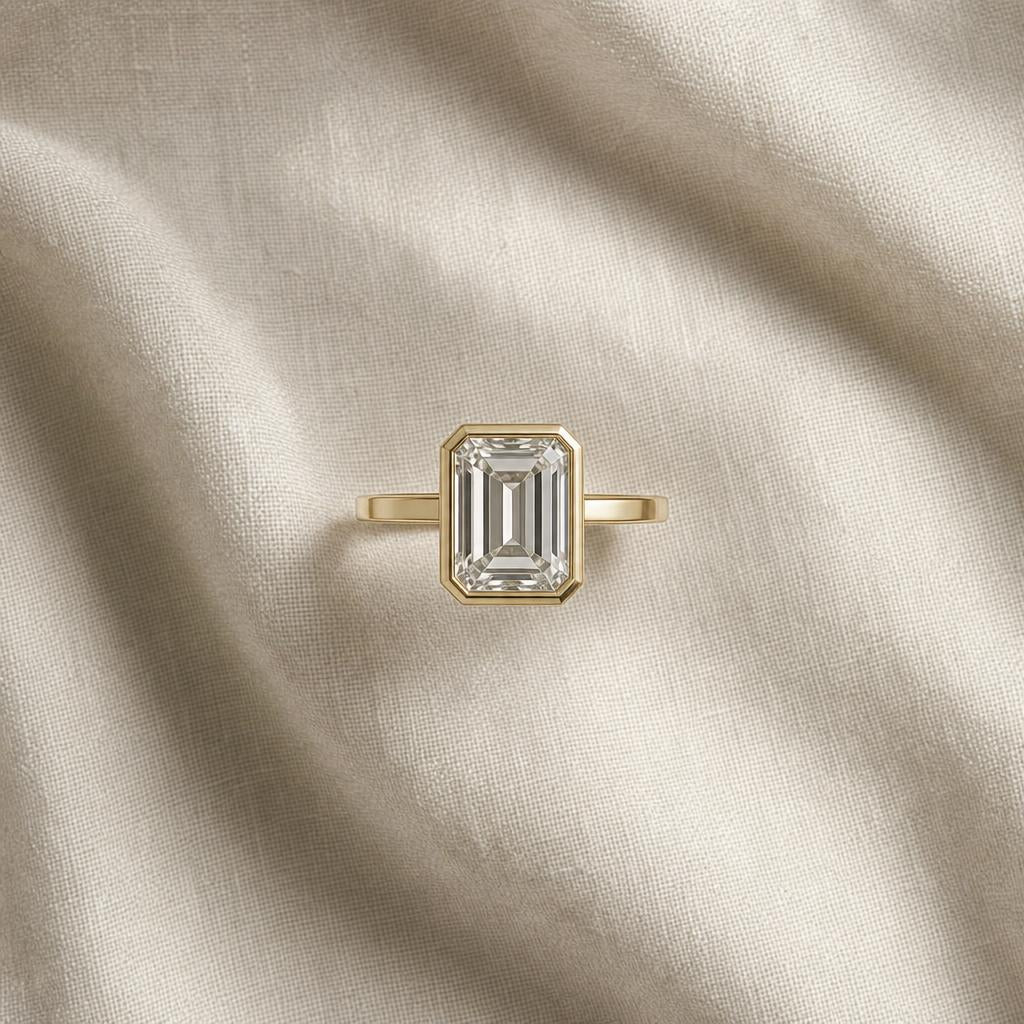
Emerald Cut Halo Engagement Rings and the Case for Architectural Style
Some rings ask for attention with sparkle. Others earn it with structure — a clean rectangular line, a squared corner, a stone that reads as architecture before it reads as jewelry. If you've always been drawn to the second kind, you're not imagining a preference. You're recognizing a design language, and it has a name: step-cut.
Emerald and asscher cuts are the two defining step-cut shapes, and they reward a buyer who wants a ring that looks considered rather than loud. Here's what that structure actually looks like, and which pieces in the Gemiros collection build on it.


What Makes a Ring "Architectural"?
Round and cushion cuts are brilliant cuts — dozens of tiny triangular and kite-shaped facets angled to scatter light in every direction. That's where the classic diamond "sparkle" comes from. Step cuts work differently. Emerald and asscher cuts are faceted in long, parallel rows that run around the stone like the steps of a staircase, which is exactly where the name comes from.
Instead of scattering light into a thousand small flashes, a step cut produces broad, deep planes of light and shadow — what jewelers call the "hall of mirrors" effect. The result reads as more architectural than sparkly: less glitter, more presence. It's the difference between a chandelier and a floor-to-ceiling window. Both are beautiful. Only one is quiet about it.
Worth knowing: A step-cut stone shows its clarity more than a brilliant cut does. The broad, flat table has nowhere to hide — every line has to be clean. Gemiros' moissanite and simulated diamond stones are cut for exactly this kind of scrutiny, indistinguishable from a diamond even under that open, unforgiving light.
Emerald Cut: The Elongated Line
The emerald cut is a rectangular step cut with cropped corners — the shape most people picture first when they hear "step cut," and the one behind some of the most recognizable rings ever photographed. Its long, narrow silhouette elongates the finger more dramatically than almost any other shape, which is part of why it keeps resurfacing in every generation's idea of a "modern classic."
Where emerald cut rings differ most is in what surrounds the stone. A halo setting rings the center stone in pavé, adding perceived size and a softer outer edge — the Harlow Ring builds on this, framing its emerald-cut center in a halo that keeps the rectangular line intact while adding extra light at the edges. A hidden halo does the same job invisibly: the pavé sits underneath the center stone rather than around it, so from the top the ring reads as a clean solitaire, and the drama only reveals itself in profile.

Kensington Ring
A 3-carat emerald-cut center set low over a hidden halo, so the top-down view stays architectural and unbroken while the profile carries extra sparkle underneath.
Shop Kensington Ring →Among emerald cut halo engagement rings, the real decision usually isn't halo versus no halo at all — it's how much visual weight you want added to the outer edge of an already elongated shape. A full halo widens the silhouette slightly and adds surface sparkle; a hidden halo keeps the line as narrow and architectural as the cut intended. Neither is more "correct." One is louder, one is quieter, and both are still unmistakably a step cut underneath.
For buyers who want the emerald cut with nothing else competing for attention, a plain solitaire does that job. The London Ring sets its emerald-cut center on a smooth, unadorned band with no pavé and no halo at all — just the stone and its own geometry. It's the purest expression of what a solitaire setting is supposed to do: let the shape carry the entire look.
Asscher Cut: The Squared Symmetry
The asscher cut takes the same step-faceting technique and applies it to a square outline instead of a rectangle, with the same cropped corners that give it a soft octagonal silhouette. It has a smaller table and a higher crown than the emerald cut, which makes the "hall of mirrors" effect even more concentrated — the light doesn't just move across the stone, it seems to fold inward.
It's also the rarer choice. Most step-cut engagement rings sold are emerald cuts; the asscher shows up far less often, which is exactly the appeal for a buyer who wants a ring that looks intentional rather than trend-driven. An asscher engagement ring reads as someone who did the research and picked the shape on its own merits, not because it was the obvious option in every case at the counter.
✦ Pro tip: Because both emerald and asscher cuts show their clarity so openly, they photograph differently depending on light. Warm, diffused light brings out the broad planes beautifully; harsh overhead light can flatten them. If you're choosing between the two shapes in person, look at the stone in more than one lighting setup before deciding.
The asscher's square proportions also make it a strong candidate for a three-stone build, since the shape sits compactly enough to flank with side stones without the ring reading as top-heavy. The Astrid Ring is built on exactly this logic — a 3-carat asscher-cut center in an Art Deco-inspired three-stone setting, where the side stones echo the center's geometry instead of competing with it.

Échelon Ring
A sharp, structured asscher-cut solitaire with deeply layered step cuts and nothing else on the band — the shape stands entirely on its own.
Shop Échelon Ring →If a three-stone build feels like more ring than you want day to day, an asscher cut diamond ring set as a plain solitaire — like the Échelon — gives you the same squared symmetry without the extra visual weight of side stones. It's a smaller commitment to the shape, and for a first step-cut ring, often the easier place to start.
Emerald vs. Asscher: A Quick Comparison
| Feature | Emerald Cut | Asscher Cut |
|---|---|---|
| Outline | Elongated rectangle | Square with cropped corners |
| Light effect | Broad, linear "hall of mirrors" | Concentrated, more inward-folding sparkle |
| Hand effect | Elongates the finger noticeably | Reads compact and symmetrical |
| Popularity | Common — a modern classic | Rare — a considered, deliberate pick |
| Best paired setting | Halo, hidden halo, plain solitaire | Solitaire, three-stone |
Neither shape is more "correct" than the other — they're simply two different answers to the same question: what does structure look like on your hand? If you want elongation and a slightly softer edge, the emerald cut is the more forgiving place to start. If you want something square, deliberate, and less commonly seen, the asscher cut does that job better than almost anything else in the case.
What both shapes share is the same quiet confidence. Neither one is trying to out-sparkle a round brilliant. They're not supposed to. A step cut is a ring for someone who already knows that a wall of tiny flashes isn't the only way to look expensive — sometimes a few broad, clean lines say more. And because Gemiros' moissanite and 925 sterling silver builds are cut and set with the same precision a mined stone would demand, that clarity holds up exactly the same way, indistinguishable from a diamond and just as ready for close inspection.
If you've been searching for unique emerald cut engagement rings that don't look like the default pick at every jewelry counter, the answer usually isn't a different cut altogether — it's a different setting on the same cut. A hidden halo, an unadorned solitaire band, or a three-stone build on the asscher side all change the personality of a step-cut ring dramatically, without abandoning the geometry that made you want one in the first place.
Quick Takeaways
- Step cuts (emerald, asscher) use parallel faceting for broad planes of light instead of brilliant-cut sparkle.
- Emerald cut elongates the finger; asscher cut reads square and compact.
- Halo and hidden halo settings add pavé sparkle without changing the underlying line.
- Asscher's proportions make it a natural fit for three-stone builds.
- Both cuts show clarity openly, so a clean stone matters more here than in a brilliant cut.
Frequently Asked Questions
Do emerald cut rings look more expensive than round rings?
They often read as more deliberate, which isn't quite the same thing. Because the stone's clarity is fully visible through that open table, a clean emerald cut can look strikingly polished — and a Gemiros emerald cut is indistinguishable from a diamond under that same scrutiny, no hedging required.
What does an emerald cut ring actually symbolize?
There's no fixed meaning attached to the shape, but it's long been associated with restraint and old-world elegance — a style choice for someone who wants a ring that looks considered rather than trend-chasing.
Why don't more people choose an asscher cut?
Mostly familiarity. Round and oval cuts dominate what people see first, so the asscher's squared, high-crown silhouette can feel unfamiliar at a glance. That rarity is exactly what makes it stand out on the hand.
Is a halo setting a good match for a step-cut ring?
Yes, especially if you want extra brilliance without losing the clean outline underneath. An emerald cut hidden halo engagement ring adds sparkle invisibly, underneath the center stone rather than around it, so the top-down view stays architectural while the profile carries the extra light.
What's the most distinctive engagement ring cut to choose right now?
Among step cuts specifically, the asscher is the rarer pick by far — most step-cut rings sold are emerald cuts. If distinctiveness matters most to you, the asscher, especially in a three-stone build like the Astrid, is the shape fewer people are already wearing.
A step-cut ring isn't a compromise on sparkle — it's a different definition of it. If clean lines, broad light, and a shape that photographs like architecture sound more like you than a halo of tiny flashes ever did, an emerald or asscher cut is worth trying on before you commit to anything rounder.


