

Three-Stone Engagement Rings: Meaning, Styles & How to Choose the Right Trio
Three stones. Three moments. Past, present, and future — arranged on a single band and worn every day as a quiet declaration of where you've been, where you are, and everything still ahead. If the three-stone ring has caught your eye, you've found one of the most personal silhouettes in modern jewellery — a style that earns its place on your hand with meaning, not just sparkle.
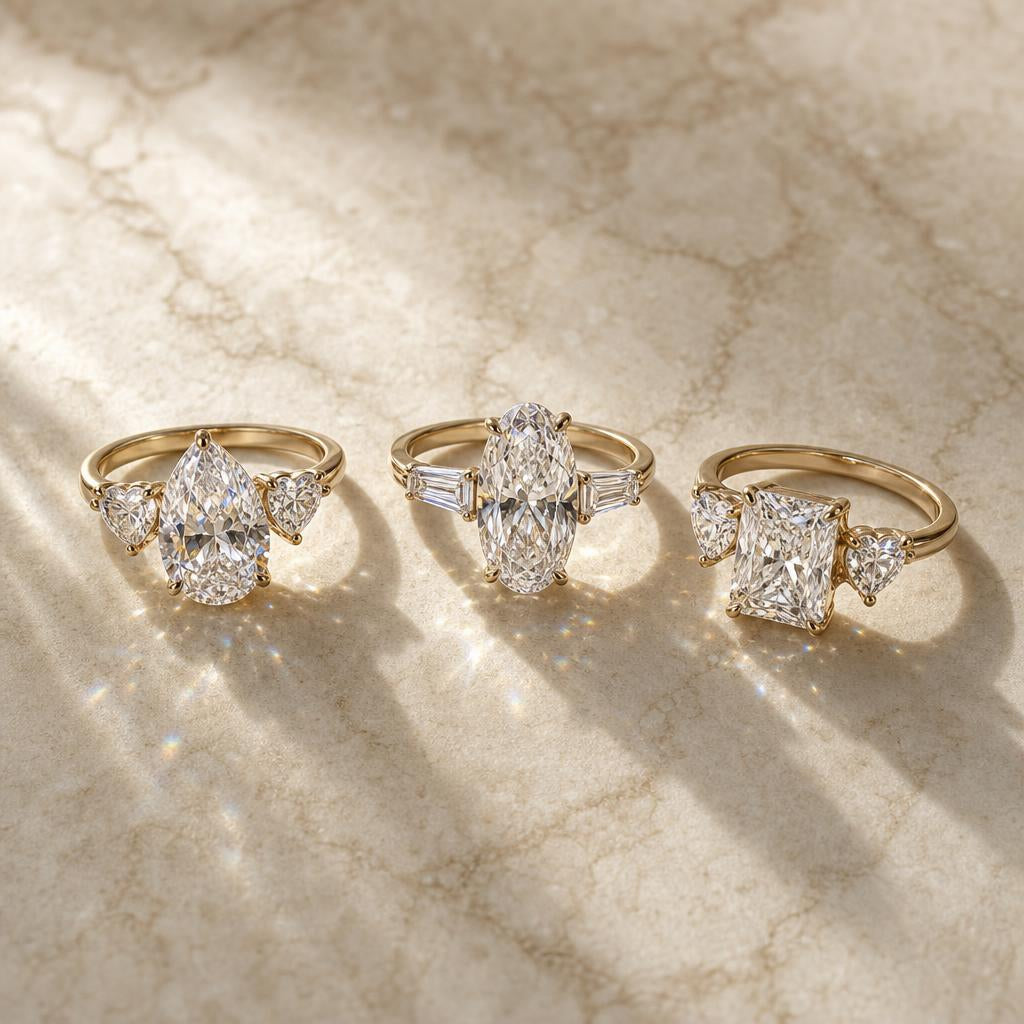
There's also the visual argument for it. Three-stone rings have a built-in sense of balance that solitaires simply don't — the side stones create context, frame the center stone, give it scale, and draw the eye through the ring rather than stopping at a single point. The result reads as considered rather than showy. Here are a few of the three-stone styles from the Gemiros collection worth knowing before you go further.
What makes a three-stone ring different
The defining feature is architectural. Instead of a single stone standing alone on a band, a three-stone ring uses two companion stones — traditionally called shoulder stones or side stones — to anchor the center. Those companions can match the center cut exactly, or they can be deliberately different to create contrast. They can sit flush or elevated, large or delicate, close to the center stone or with visible spacing between them. Every variation changes the feel of the ring, which is partly why this style has such staying power across decades of changing taste.
From a visual standpoint, the side stones do three things simultaneously. They make the center stone appear larger by extending the overall surface area of sparkle. They create a horizontal flow that elongates the finger, similar to the effect of an elongated oval solitaire. And they give the eye a path across the ring rather than a single focal point — which means the whole piece feels animated as the hand moves rather than static.
The symbolism — and whether it matters to you
The past-present-future interpretation is the most widely known. Each stone represents a chapter: where you've been together, who you are now, and what's still ahead. It's a romantic framing, and for many people that meaning adds real weight to a ring that's already beautiful. But the symbolism can be read several ways. Some interpret the three stones as friendship, love, and fidelity. Others as three stages of a person rather than a relationship: who you were, who you are, and who you're becoming. And plenty of people — especially those buying a three-stone ring for themselves — simply love the look and feel no obligation to attach a narrative to it. A ring that makes you feel good every time you put it on needs no further justification.
Worth knowing: If the meaning matters to you, proportion is where it shows. Rings where the center stone is dramatically larger than the sides read as a center stone with accents — the storytelling shifts. Rings where all three stones are relatively equal in visual weight feel more balanced symbolically, each stone holding its own. Neither is wrong; it's worth knowing which story you want the ring to tell before you choose.
Center stone shapes for three-stone rings
Not every cut translates equally well into a three-stone setting. Here's how the most common shapes behave and what they bring to the format.
Round — The most versatile center stone for a three-stone ring. A round brilliant cut works with virtually any side stone choice because its uniform, symmetrical silhouette doesn't compete with anything and allows the side stones to define the mood.
Oval — A natural fit for the three-stone format. The elongated profile pairs beautifully with tapered baguette sides (which echo the taper) or smaller oval sides. The combination creates a horizontal sweep that's consistently flattering across most hand types.
Pear — Striking in a three-stone format, particularly when paired with curved or heart-shaped side stones. The natural asymmetry of a pear cut reads as intentional rather than accidental when its companion stones are chosen thoughtfully to echo or balance its curves.
Radiant — Bold by nature. A radiant center works well with side stones that can hold their own — heart shapes work particularly well because they add a softness that balances the radiant's angular power. The result is a ring with significant presence without feeling heavy-handed.
Asscher — A more architectural choice. The step-cut faceting of an asscher creates a very different visual rhythm from brilliant-cut stones — long, cool reflections rather than sparkling points of light. In a three-stone format, this reads as distinctly Art Deco, and it's particularly well matched with baguette side stones that share the same geometric vocabulary.

The Juliette Ring
A 3-carat pear-cut simulated diamond takes center stage, flanked by two heart-shaped side stones that bring a distinctly romantic energy to the trio. The sleek 2.0mm band keeps the focus entirely on the stones, and the heart sides create a visual softness that makes the pear's elongated form feel even more graceful. A ring that tells a love story without needing words.
Shop The Juliette Ring →
The Empress Ring
A 3.5-carat elongated oval center stone flanked by two tapered baguette side stones that draw the eye inward and amplify the ring's regal silhouette. The baguettes and the oval share the same sense of clean, extended proportion — they make each other look better. Set in a polished 4-prong setting that keeps the visual lines uncluttered, this is a three-stone ring for someone who wants to own a room.
Shop The Empress Ring →Side stone shapes — the detail that defines the ring's personality
The side stones are where the real differentiation happens. The same center stone with different sides will produce a completely different ring — different in mood, in proportional logic, and in what it says about the person wearing it.
Baguette sides — Clean, modern, and architectural. Baguettes are step-cut rectangles that reflect light in long, cool flashes rather than the sparkling points of a brilliant cut. The contrast between a brilliant-cut center and baguette sides creates a sharp visual tension that reads as intentional and considered. Paired with an asscher center, the shared geometric vocabulary becomes fully coherent.
Heart-shaped sides — Romantic and unexpected. Heart sides add a softness to a bold center that few other side stone shapes can match. They work particularly well flanking a radiant or pear center, where the curves of the hearts balance the harder angles or the pointed tip of the pear cut.
Round or oval sides — The quietly elegant choice. Smaller round or oval stones flanking a larger center create a flowing, all-brilliant effect that reads as less structured than baguettes but no less refined. It's a style that wears consistently and doesn't date.
Side stone clusters — Rather than a single defined side stone, some three-stone rings use clusters of smaller stones to flank the center. This creates a softer, more romantic outline and a sense of depth and texture that single side stones don't achieve.

The Astrid Ring
A 3-carat asscher-cut simulated diamond surrounded by baguette side stones — a pairing so geometrically coherent it reads like a design principle rather than a jewellery choice. The asscher's step-cut facets and the baguettes' rectangular lines share the same architectural vocabulary, giving this ring the sophisticated soul of Art Deco at its most considered. For the woman who appreciates clean angles and deliberate design over decoration for its own sake.
Shop The Astrid Ring →How to choose your three-stone ring
Start with the center stone cut — that's the anchor, and everything else follows from it. Then consider what you want the side stones to do: echo the center cut and create coherence, or contrast with it and create visual tension. Both are valid approaches, and both produce beautiful results when the choice is deliberate rather than arbitrary.
If you have longer fingers, you can carry a more dramatic center-to-side size ratio without it looking unbalanced. If your fingers are shorter or wider, keeping the three stones relatively equal in visual weight produces a more proportional look across the hand. If your fingers are narrow, a delicate 2.0mm band lets the stones carry the whole visual argument without adding bulk at the base.
Metal tone shapes the feel of the ring considerably. Three-stone rings in white rhodium-plated silver read as contemporary and clean — the stones dominate the metal entirely. In yellow gold, the same silhouette feels warmer and more editorial. In rose gold, it softens everything and reads as distinctly romantic without being overtly vintage.

The Statement Ring
A 4-carat radiant-cut simulated diamond with two heart-shaped side stones — a pairing that balances the radiant's angular power with the hearts' unmistakable softness. The 2.0mm band keeps everything focused upward, so the eye goes straight to the stones. This is a ring for someone who isn't interested in understatement but still wants the design to feel intentional rather than simply loud.
Shop The Statement Ring →
The Orabelle Ring
A 2.0-carat oval-cut simulated diamond nestled between sparkling side stone clusters that add exactly the right touch of vintage-inspired romance. Where the larger three-stone rings in this collection make a statement, The Orabelle makes a declaration — quieter, more personal, full of the kind of meaning that doesn't need a dramatic setting to land. The proportions are elegant and the details reward close attention.
Shop The Orabelle Ring →Three-stone rings for everyday wear
The three-stone format is a more practical choice for daily wear than it might appear. When the side stones sit close to the center in a low-profile or well-set configuration, the ring catches less on fabric and has less leverage working against the prongs than a tall, isolated solitaire. The horizontal distribution of weight also means the ring sits more stably on the finger rather than rotating.
Simulated diamond three-stone rings in rhodium-plated sterling silver — the Gemiros standard — are particularly well suited to everyday wear. Rhodium resists tarnish and keeps the white metal consistently bright without needing professional cleaning, and nickel-free construction means the ring works for sensitive skin without concern. The no-green-finger promise is especially reassuring for rings worn continuously.
For travel, a three-stone simulated diamond ring solves the same problem as a solitaire travel ring — it replicates the look of an engagement ring without the anxiety of wearing something irreplaceable. The additional visual complexity of a three-stone ring makes it an even more convincing substitute than a plain solitaire. Three stones in deliberate relationship are harder to dismiss than one stone standing alone.
✦ Pro tip: If you're using a three-stone ring as a travel ring, choose a center stone shape that echoes your actual engagement ring. An oval-center three-stone can stand in for an oval solitaire; a pear-center three-stone works the same way for a pear cut. The closer the center stone shape, the more convincing the substitute — and the more satisfying it is to wear.
Quick Takeaways
- Three-stone rings symbolise past, present, and future — but wearing one purely for the aesthetic is equally valid
- The center stone cut is the anchor; the side stones define the ring's mood and personality
- Baguettes add architecture; heart sides add romance and softness; round or oval sides create elegant flow
- Equal visual weight across all three stones reads as more balanced and symbolically coherent
- Simulated diamond three-stone rings make excellent travel ring substitutes — more visual interest than a plain solitaire
- Rhodium-plated silver handles daily wear consistently well and resists tarnish without special maintenance
Frequently asked questions
What does a three-stone engagement ring mean?
The most widely known interpretation is past, present, and future — each stone representing a chapter of a relationship. Other readings include friendship, love, and fidelity, or the three stages of a person: who you were, who you are, and who you're becoming. There's no single definitive meaning, which makes the three-stone ring a flexible choice: take the symbolism that resonates, or simply appreciate the form.
Should all three stones be the same cut?
Not necessarily. Matching cuts create symmetry and coherence — every element speaks the same visual language. Mixed cuts — an oval center with baguette sides, a pear center with heart sides — create contrast and visual interest. Both are established approaches; it comes down to whether you want the ring to feel harmonious or dynamic.
Do three-stone rings make the finger look longer?
Generally yes. The horizontal spread of three stones across the band draws the eye lengthwise, which has a visually elongating effect on the finger. This is most pronounced when the side stones are tapered baguettes or elongated oval shapes that continue the horizontal line established by the center stone.
Can a three-stone ring work as a travel ring?
Absolutely — and it may be a better travel substitute than a plain solitaire. The additional visual complexity of a three-stone ring makes it a more convincing stand-in for an engagement ring, and the simulated diamond version means you're not risking a piece you can't replace. Choose a center stone shape that echoes your actual ring for the most convincing result.
How do I know if a three-stone ring will suit my hand?
Three-stone rings tend to suit most hand types because the horizontal spread distributes visual weight across the finger rather than concentrating it at a single point. For shorter fingers, keep the three stones roughly equal in size and choose a delicate band width. For longer fingers, you can carry a more dramatic center-to-side ratio without it looking unbalanced.
The three-stone ring is one of the most coherent ideas in jewellery design — three objects in deliberate relationship, arranged to say something. Whether you're drawn to the symbolism or simply to the look of a ring that earns a second glance, the format gives you genuine room to be specific: about the cut you love, the side stone shape that suits your style, the proportions that work for your hand. Which is, in the end, exactly what a ring worn every day should feel like.


