

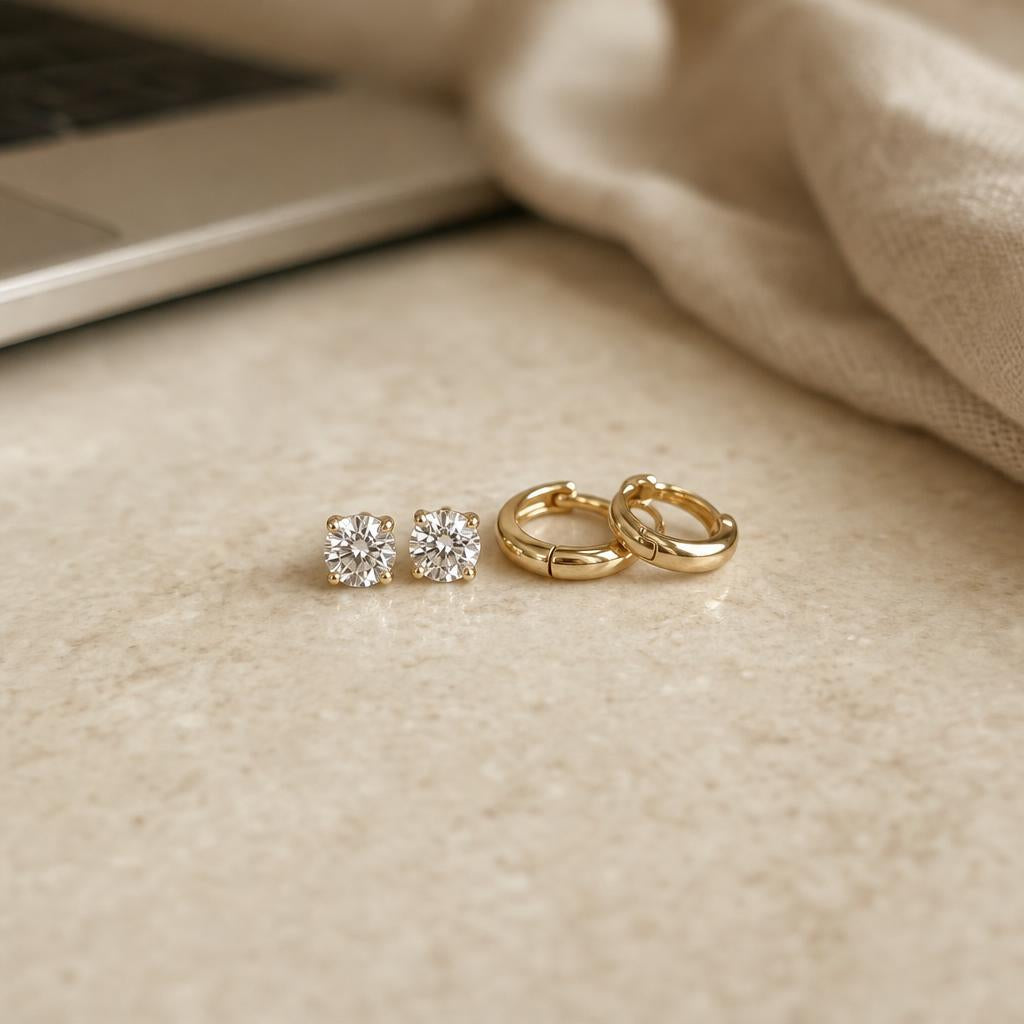
Earrings for Video Calls: What Actually Reads on Camera
Your camera crops you at the collarbone, compresses everything it sees, and gives your jewelry about two inches of screen to prove itself. The right earrings turn that small frame into a polished, deliberate look. The wrong ones disappear, swing into your headset, or flash like a strobe at the worst possible moment.
Choosing earrings for video calls is a different exercise from dressing for the office. On screen, your face is the whole picture and your ears are the frame. Here are the shapes, sizes and settings that actually read on camera, and the ones that quietly work against you.


What a Camera Actually Does to Earrings
A webcam is a small sensor with a lot of compression behind it. It flattens fine detail, smooths subtle sparkle into a soft glow, and treats anything that moves quickly as a blur. That is useful information, because it tells you what to look for.
Three things survive that process: contrast, clean shape and steady light. A well-cut stone with a crisp outline reads as a bright, confident point near your face. Delicate filigree, thin chains and fine texture do not make it through, and a pair that looks intricate in person can turn into a gray smudge on screen.
Movement is the other variable. Earrings that swing with every nod create a flicker the camera has to keep resolving, and that flicker pulls attention away from what you are saying. Earrings that stay put read as calm. On a call, calm reads as authority.
Why Studs Are the Default for Earrings for Video Calls
A solitaire stud is the closest thing to a guaranteed result. It sits at one fixed point, it does not move when you do, and a round stone throws light in every direction, so some part of it catches your room lighting whatever angle you are sitting at. If you only own one pair for this, make it a stud.
The Stella Stud is the cleanest version of that idea: a single round stone, nothing competing with it. It is the pair for the 9 a.m. call where you want your face and your words to carry the frame and your earrings to quietly confirm you made an effort.

The Ophelia Stud Earrings
An oval stone brings more presence than a round one while staying completely still. If you want to be noticed on a call without a single moving part, this is the shape to reach for.
Shop The Ophelia Stud Earrings →If you want to understand why certain cuts hold up under a lens and others do not, our guide to earring shapes that photograph well breaks it down shape by shape.
Size: Large Enough to Register, Small Enough to Stay Quiet
On a laptop, your head fills roughly a third of the frame, which means a stud that looks generous in a mirror looks modest on screen. That is the point. A stone you would call substantial in person lands as polished on camera, and a stone you would call tiny nearly vanishes.
A useful test: record ten seconds on your own camera before an important call. If you cannot see the earring at all, go up a size or choose a stone with a halo. If it dominates the frame or you catch yourself looking at it, go down.
✦ Pro tip: Check your earrings in the same light you will be on the call in. Window light from the side makes stones glow. A ring light straight on flattens them, so a halo or pavé pair can bring back the depth a single stone loses.
Halos and Pavé: Depth Where the Lens Is Flat
A halo gives a stone a bright frame, and a bright frame is exactly what a flattening camera needs. The center stone supplies the point of light and the surrounding stones add width, so the earring holds its shape even when the picture is soft. If you want to see how that logic carries over from rings, the explainer on how the halo setting works on earrings covers it.
The Belle Stud pairs a round center stone with a halo, which makes it a strong choice for calls where you want a little more sparkle than a bare solitaire without anything that moves. It is polished enough for a client presentation and quiet enough for a Monday stand-up.

The Leighton Stud Earrings
A round center stone inside a halo, set flush against the ear. It gives you the fullest sparkle in the frame while staying perfectly still through a full-length meeting.
Shop The Leighton Stud Earrings →Hoops, Huggies and the Headset Problem
Hoops are the pair most people ask about. Large hoops tend to be the problem on video: they swing, they brush your headphones, and they can knock against a microphone arm or the arm of a pair of glasses and produce a sound your whole meeting hears. Hoops are not off the table, though. The fix is size and fit, not abandoning the shape.
Huggies are the answer. They sit close to the earlobe, move only when your head does, and give you the light and line of a hoop without the swing. If you are curious about what separates a huggie from a standard hoop, our beginner's guide to the huggie earring is a quick read.

The Stella Huggie Hoop Earrings
A close-fitting huggie that gives you the clean line of a hoop with none of the swing. It stays clear of headphones, glasses and microphone arms.
Shop The Stella Huggie Hoop Earrings →The same logic applies to anything with a drop. A long dangle will tap your collar, catch on a headset cord or swing into your jaw line. Save those for in-person events where movement reads as personality instead of distraction.
Dressing the Whole Frame: Neckline, Hair and Background
Earrings do not work alone on camera. They work against your hair, your neckline and the wall behind you.
- Hair down: A stud with a halo or a larger stone still shows through. Tiny solitaires can disappear, so size up.
- Hair up: This is where a statement stud or a huggie performs best, because your ear is fully on display.
- Dark backdrop: Sparkle shows up brightly. Keep the pair simple so it does not compete with the contrast.
- Light backdrop: Stones with some weight, such as a halo or an oval, hold their definition better than a very small solitaire.
If you wear glasses, check the arms. A hoop or dangle that sits where the temple arm lands will tilt, rub and move all call long. A stud avoids the problem entirely.
What Counts as Professional on a Screen
For anyone dressing for a client call or an interview, the question is usually the same one you would ask about any workplace: is it polished or distracting? Whether you are choosing earrings for work in a hybrid week or dressing for a camera, the answer is close to identical. A fixed stone, in a clean setting, in a scale that reads as intentional. If you are dressing for a specific interview, our guide to work earrings for job interviews goes into what to wear and what to skip.
There is also a quieter benefit. Wearing something you chose deliberately changes how you carry yourself. Moissanite and simulated diamond studs set in 925 sterling silver read as fine jewelry up close and on camera alike, and you can wear them every working day without a second thought. You get the sparkle of a diamond and the confidence that goes with it.
Worth knowing: Closures matter more on calls than anywhere else. A pair that slowly slides or tilts is visible on screen, and fidgeting with your ear is noticeable. If a pair has ever loosened on you, the guide to types of earring backs explains which style holds firmest.
A Simple Call-Day Checklist
- Choose a stud, a halo stud or a huggie. Skip long drops and large swinging hoops.
- Match the scale to your frame: if you cannot see them in a ten-second test, size up.
- Check them in the actual lighting you will be using.
- Confirm the backs are snug before you log on.
- Keep everything else simple. One focal point near your face is enough.
Quick Takeaways
- Fixed stones read as calm on camera. Anything that swings becomes a flicker.
- Round, oval and halo studs hold their shape through compression better than fine or intricate designs.
- Huggies give you the hoop look without the swing, the headset taps or the microphone noise.
- Test your pair on your own camera in your own lighting before the call that matters.
Frequently Asked Questions
What earrings are considered professional?
Studs are the safest standard: a solitaire or a halo stud in a scale that suits your face. They stay still, they catch light and they never compete with what you are saying.
Are hoop earrings appropriate for work?
Yes, in the right size. Small, close-fitting huggies read as polished in most offices and on video. Large, swinging hoops are the ones to save for evenings out.
Is it professional to wear earrings at work?
Absolutely. A thoughtful pair signals attention to detail. The goal is choosing something that stays in place and does not draw focus away from the conversation.
Do sparkly earrings look good on camera?
They can, as long as the stone is well cut and the pair does not move. A round, oval or halo stud in moissanite or a Gemiros® simulated diamond catches the light and reads as a bright point near your face.
Should I wear one pair for every call?
If it works for you, yes. A single well-chosen pair worn consistently becomes part of how people recognize you, and there is a real case for wearing just one quiet stud and leaving it there.
The best earrings for the camera do the same job as the best earrings anywhere: they make you look like someone who knows exactly what she is doing. On screen, that just means choosing the pair that stays still and lets you do the talking.


