

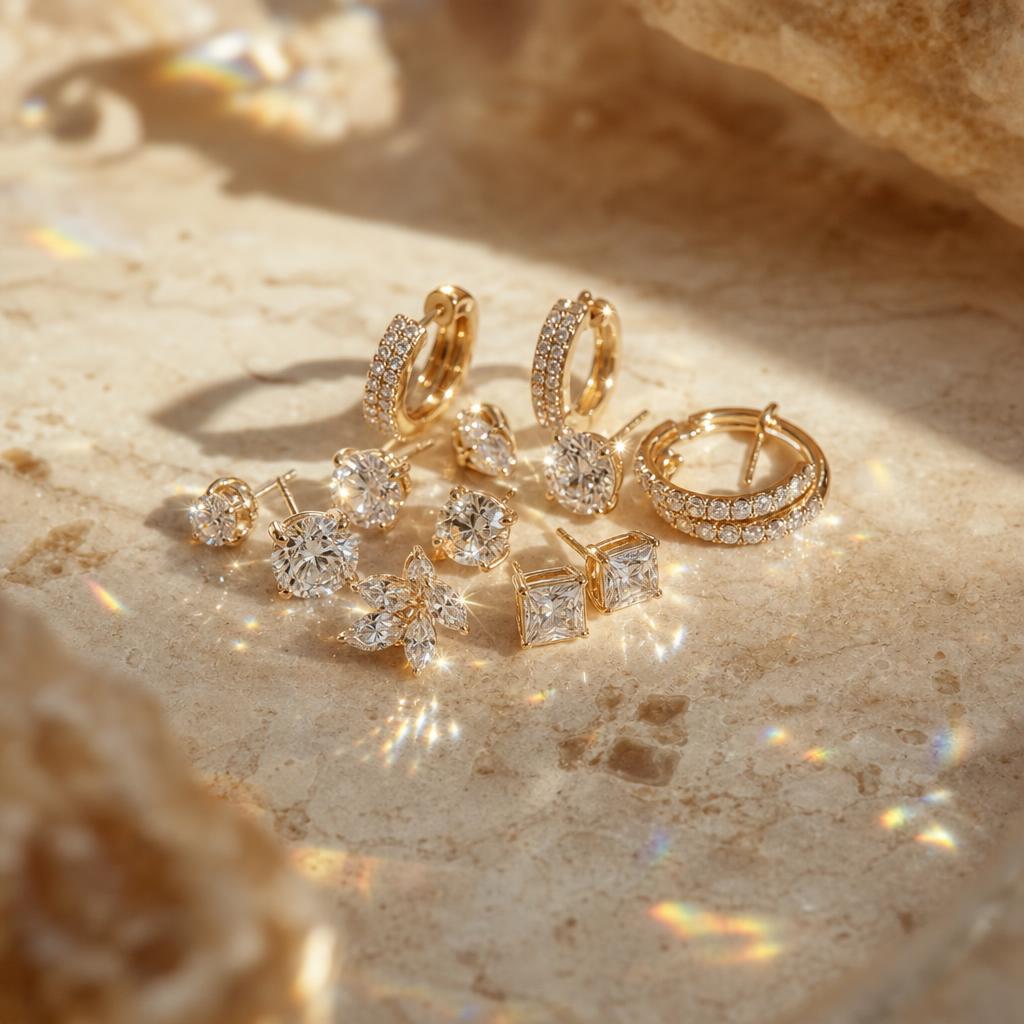
Earring Shapes That Photograph Well: Which Ones Actually Catch the Light
You know the moment. The earrings look extraordinary in the mirror — catching the bathroom light just right, throwing a little flash of color every time you turn your head. Then you take the photo, and somehow they've gone flat. Dull. Almost invisible. That gap between how a piece looks on your ear and how it reads on camera isn't bad lighting or a bad angle. It's shape.
Some cuts and settings are built to bounce light back at a lens the same way they bounce it back at a mirror. Others simply aren't — no amount of golden hour or ring light will fix a cut that scatters light sideways instead of forward. Before you buy your next pair, it's worth knowing which earring shapes actually do the work for you.


The Actual Physics of a Good Photo
A camera lens doesn't see the way your eye does. Your eye adjusts constantly, catching a stone's sparkle from a dozen micro-angles as you move. A lens freezes one instant. So the earrings that photograph best are the ones engineered to throw light back at a single fixed point — which is a setting question, not a price question. A well-cut stone in a well-designed setting will read as brilliant in a still photo. A poorly faceted stone in a flat setting won't, no matter what it cost.
This is where earring shapes start to matter more than most people expect. A round brilliant cut is engineered specifically to maximize light return — it's the most reflective shape in the entire cutting vocabulary, which is exactly why it dominates both solitaire studs and halo settings. An emerald or baguette cut, by contrast, is built for clarity and a mirror-flash effect rather than all-directional fire — beautiful in person, but it needs the light source aimed almost directly at it to read in a photo. Neither is a lesser choice. They're just doing different jobs.
Halo Settings: Built for the Camera
If you've ever wondered why halo earrings look disproportionately photogenic compared to their actual size, this is why: a halo setting surrounds the center stone with a ring of smaller stones, each one acting as its own tiny light source. In a photo, that reads as a single continuous glow rather than one point of sparkle. It's the earring equivalent of a ring light — the halo does the work that a single solitaire has to do alone.

The Isabella Stud Earrings
A pear-cut center stone wrapped in a halo, angled to catch light from the moment you turn your head — the elongated shape adds movement that a round stud can't.
Shop The Isabella Stud Earrings →A pear or teardrop shape inside a halo does something a round stone can't: it adds a line of movement. Because the shape is asymmetrical, it catches light differently depending on which way your head is tilted, which is exactly the kind of subtle variation that makes a photo look alive instead of static. If you've noticed that some earrings look almost identical in every photo while others seem to shift and shimmer from shot to shot, the shape of the stone is usually the reason.
Solitaire Settings: Fewer Facets, More Precision
A solitaire setting puts all the visual weight on one stone with no halo to soften or amplify it. That means the cut quality has to do all the work — a well-cut round solitaire is indistinguishable from a diamond in daylight and passes diamond testers, which is exactly why it remains the standard for a reason that has nothing to do with tradition and everything to do with optics. Six-prong settings in particular lift the stone slightly higher off the ear, which gives light more angles to enter and exit from — a small structural detail that makes a measurable difference on camera.

The Éclat Moissanite Stud Earrings
A six-prong round moissanite solitaire, set to catch light from every angle rather than just one — the higher refractive index means more fire per facet than a diamond of the same size.
Shop The Éclat Moissanite Stud Earrings →Moissanite is worth knowing about specifically for this reason. Its refractive index is actually higher than a mined diamond's, meaning it bends and scatters light more aggressively — which translates to more visible fire in a photo, not less. This isn't a compromise dressed up as a feature. It's a genuinely different optical profile, and for anyone shopping specifically for photos, it's arguably the smarter cut of stone to build a solitaire around.
Hoops and Huggies: A Continuous Line of Light
Studs and solitaires are single points of sparkle. Hoops and pavé huggies work completely differently — instead of one stone doing the work, you get a continuous line of smaller stones that catches light along its entire curve. In a photo, this reads as a soft, unbroken shimmer rather than a single flash, which is part of why huggie hoops photograph so consistently well regardless of the angle you're caught at. There's simply more surface area working in your favor.
Worth knowing: Pavé settings — the technique used in huggie hoops — pack small stones close together with minimal visible metal between them. That density is what creates the "continuous glow" effect instead of individual points of light. It's a construction choice, not a size illusion.
Choosing Earring Shapes for Round Faces
Shape doesn't only affect how light behaves — it affects how the earring sits against your face, which matters just as much in a photo as sparkle does. Among the most useful shapes for a round face are anything with vertical length or a defined angular edge: a pear-cut halo, an elongated oval, or a princess cut all introduce a straight line the eye reads as structure, gently balancing out softer, rounder features. A perfectly round stud in a round halo can look lovely in person but tends to echo the shape of a round face rather than contrast it, which is worth considering if you're choosing a pair specifically to photograph well from the front.
This isn't a rule that overrides personal taste — it's simply useful information. The same earring can look completely different depending on the face it's framing, and knowing why gives you more control over the final photo, not less.
The Popular Earring Styles That Actually Hold Up in Photos
Not every trend earns its popularity. But among the styles that stay reliably in rotation, a few hold up specifically because they photograph well, not just because they're fashionable. Princess-cut halos have quietly become one of the more popular earring styles for exactly this reason — the geometric facets catch light at sharper, more defined angles than a round cut does, which reads as crisp rather than diffuse on camera. Huggie hoops earn their staying power the same way: low-maintenance in person, consistently photogenic in every lighting condition.
The common thread across all of these isn't trend-chasing. It's that each one solves the same underlying problem — getting light to bounce toward the lens instead of away from it — using a different structural approach. Once you understand that logic, you stop guessing at what "looks good in pictures" means and start recognizing it in the setting itself.
A Quick Note on Metal Tone
Silver and platinum-plated settings reflect cooler, whiter light, which tends to photograph cleanly under most indoor and daylight conditions. Warmer gold tones can look stunning in golden-hour or candlelit shots but can occasionally wash out under harsh fluorescent lighting. Neither is objectively better — it's worth matching the metal tone to the lighting you photograph in most, whether that's a well-lit bathroom mirror or an evening dinner table.
Quick Takeaways
- Halo settings surround the center stone with smaller stones acting as extra light sources — they photograph brighter than their actual size suggests.
- Round brilliant cuts maximize light return more than any other shape, which is why they remain the standard for solitaires.
- Pear and oval shapes add movement across a series of photos because their asymmetry catches light differently at every angle.
- Hoops and pavé huggies create a continuous line of light rather than a single flash point.
- Moissanite's higher refractive index means more visible fire per facet than a mined diamond of comparable size.
- Structured, elongated shapes — pear, oval, princess — tend to photograph with more definition against rounder face shapes.
Frequently Asked Questions
What are the different types of earring cuts?
The core shapes are round, oval, pear, princess (square), and emerald or baguette cuts, each paired with a setting style — solitaire, halo, or pavé. The shape determines how the stone catches light; the setting determines how much light it has to work with.
Which shapes catch the most light?
Round brilliant cuts catch and return the most light of any shape, which is why they dominate solitaire settings. Halo settings amplify this further by surrounding the center stone with additional small stones, each reflecting light of its own.
Which shapes flatter a round face?
Shapes with vertical length or a defined angular edge — pear, oval, and princess cuts — introduce structure that balances softer, rounder features. A round stud in a round halo tends to echo rather than contrast a round face shape.
What earring styles are the most popular?
Halo studs, huggie hoops, and princess-cut solitaires remain consistently popular, largely because each one solves the light-return problem differently — through surrounding stones, continuous pavé, or sharp geometric facets.
The next time a pair of earrings looks incredible in the mirror and flat in the photo, you'll know it's not you, and it's not the light. It's geometry — and now you know exactly which shape to reach for instead.


