

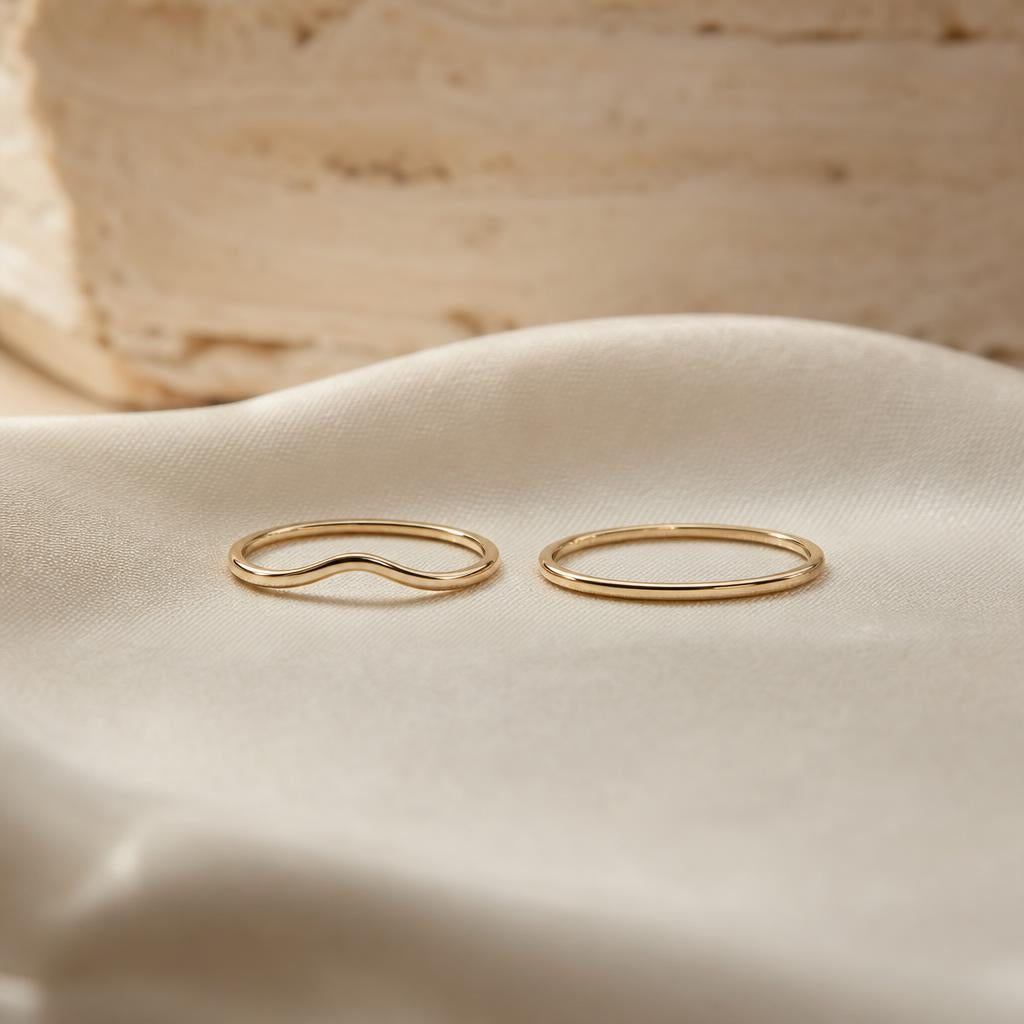
Curved Wedding Bands vs. Straight Bands: What Actually Decides the Fit
Some engagement rings were built to sit flush against a straight line. Others were never going to cooperate with one — and the wrong wedding band leaves a gap that catches on sweaters, snags on gloves, and photographs worse than either ring does alone. The setting decides this before your taste ever gets a vote.
Curved wedding bands exist to trace the shape a straight edge can't follow. But curved isn't automatically the safer pick, and some of the most popular settings actually sit better against something flat. Here's how to tell which one your ring is asking for — and which Gemiros stacking pieces do each job well.


What "Curved" Actually Means on a Wedding Band
A curved wedding band isn't just bent for style. It's engineered with a dip, an arc, or a notch that follows the outline of whatever sits next to it — usually the base of an engagement ring's center stone or its side stones. The goal is a closer, cleaner fit: less visible metal between the two rings, less shifting when you wear them together, and a stack that reads as one considered piece instead of two rings that happen to share a finger.
A straight band skips all of that. It's a continuous, unbroken line of metal — classic, symmetrical, and built to sit next to a ring rather than around it. Neither shape is more "correct." They solve different problems.
Setting Height Decides More Than the Shape of Your Stone
Before you think about round, oval, or emerald, think about how high your center stone actually sits. A high setting — the kind built on a raised basket or a tall halo — leaves enough clearance underneath for a straight band to slide flush without touching the stone or its prongs. A low setting, on the other hand, brings the stone's base much closer to your finger, and a straight band has nowhere to go but straight into it.
That's the entire logic behind curving a band to fit an engagement ring in the first place: the arc gives the low-set stone room to breathe instead of forcing a collision. If you've ever seen a stacked pair that looks pinched or slightly off-kilter at the base, a mismatched setting height — not a bad ring choice — is usually the reason.
Worth knowing: You can check this yourself in under a minute. Lay your engagement ring flat, band-side up, and slide a straight card or a spare band up against the base of the stone. If there's a visible gap, you're a curved-band candidate. If it sits flush, a straight band will work fine.
Curved Bands, Shape by Shape
Oval Center Stones
Oval stones are the classic case for a curved wedding band for an oval ring, mainly because the shape's long, elongated outline creates more visible negative space along the sides than a round stone does at the same carat size. A gentle arc closes that space and follows the oval's natural line instead of cutting across it. A pavé curve, in particular, tends to disappear into the setting rather than compete with it.
Emerald and Other Step Cuts
Step cuts behave differently. An emerald-cut stone has hard, geometric corners rather than a continuous curve, so a rounded band arcing underneath it can actually look mismatched — following a line the stone itself doesn't have. This is where a lot of buyers assume they need a curved wedding band for an emerald cut and end up happier with something architectural instead: a notched band, a slim V-shape, or a straight baguette row that echoes the stone's own angles.

Devotion Ring
A continuous circle of baguette-cut stones with the same clean, geometric rhythm as a step cut — a straight band that actually agrees with an emerald-cut silhouette instead of curving against it.
Shop Devotion Ring →Round Solitaires
Round stones are the most forgiving shape in this entire conversation. A curved band on a round diamond looks intentional, but so does a straight one — round settings are symmetrical enough that most heights and most prong counts leave room for either choice. This is usually where personal taste, not geometry, gets the final say.
When a Straight Band Is Actually the Smarter Pick
A straight band isn't a fallback for people who didn't think about fit — it's frequently the better-engineered choice. Bezel settings, which enclose the stone in a smooth metal rim rather than lifting it on prongs, already sit low and even. Curving a band around a bezel adds a step that doesn't need to exist; a straight edge meets the rim cleanly on both sides.
Straight bands also wear more evenly over time. Because the metal makes even contact along its entire inside edge instead of flexing around a curve, there's less concentrated pressure on any one point — which matters if you're stacking rings you plan to wear together every day, not just for photos.

Cherish Ring
Individually bezel-set stones on a straight band — a clean match for any low, rimmed setting where a curve would only add an unnecessary step.
Shop Cherish Ring →Metal Choice Changes the Read, Not the Logic
The curved-versus-straight decision is structural — it holds regardless of metal. But metal does change how obvious the choice looks day to day. In platinum, a curved band tends to disappear into a cool-toned engagement ring, reinforcing the sense that the two pieces were made for each other rather than paired after the fact.
A warmer metal tells a different story. Where platinum blends in, gold tones stand apart on purpose, giving the stack a visible seam between the two rings instead of one continuous line.

Forever Ring
A classic straight pavé band in 18k gold plating — the kind of dependable, everyday match that sits well next to almost any solitaire.
Shop Forever Ring →In rose gold, that same curve takes the contrast even further, since the warmth of the metal is doing just as much visual work as the shape itself. Some buyers want that deliberate two-tone look; others want the stack to disappear into a single, seamless line. Neither approach is more correct — if you want continuity, match metals and let the curve close the gap quietly. If you want each ring to hold its own identity, a contrasting metal makes that intentional rather than accidental.
✦ Pro tip: If you're buying the wedding band before the engagement ring exists yet, default to a straight band. It's the more versatile of the two and will sit correctly against the widest range of future settings — a curved band is a much more specific, ring-dependent commitment.
Quick Takeaways
- Setting height — not stone shape — is the real deciding factor between curved and straight.
- Low settings and elongated shapes like oval usually call for a curve; bezels and high settings usually don't need one.
- Step cuts like emerald often pair better with an architectural straight band than a rounded curve.
- Round solitaires are flexible enough to wear either shape well.
- Matching metal creates a seamless stack; contrasting metal creates deliberate two-tone definition.
Frequently Asked Questions
What is a curved wedding band called?
Contour band, arched band, and chevron band are the most common alternate names, depending on how sharp or subtle the curve is. All three describe the same core idea: a band shaped to follow the outline of whatever it sits against.
What's the actual difference between a curved and a straight wedding band?
A curved band has a built-in arc or notch designed to trace the base of a center stone or setting, closing the gap that would otherwise appear next to a low or elongated stone. A straight band is a continuous, unbent line of metal that sits alongside the ring rather than around it.
Do I need a curved band if my engagement ring has a halo?
Not automatically. Halo settings vary widely in height. A raised or hidden halo often has enough clearance for a straight band; only a genuinely low-set halo tends to need the extra room a curve provides.
Can a curved band be worn on its own, without an engagement ring?
Yes. A subtle curve reads as an intentional design detail on its own hand, not only as a stacking accessory — many buyers wear one as an everyday ring long before or entirely separate from any pairing.
Does a curved band cost more than a straight one?
Not inherently. Price comes down to metal, stone count, and setting style rather than the shape of the band itself — a simple curved pavé band and a simple straight pavé band typically land in the same range.
The real question was never curved or straight in the abstract — it's whether your specific ring has room underneath it or not. Check the setting, match the logic to the shape, and the rest is just deciding how much of a statement you want the pairing to make.


