

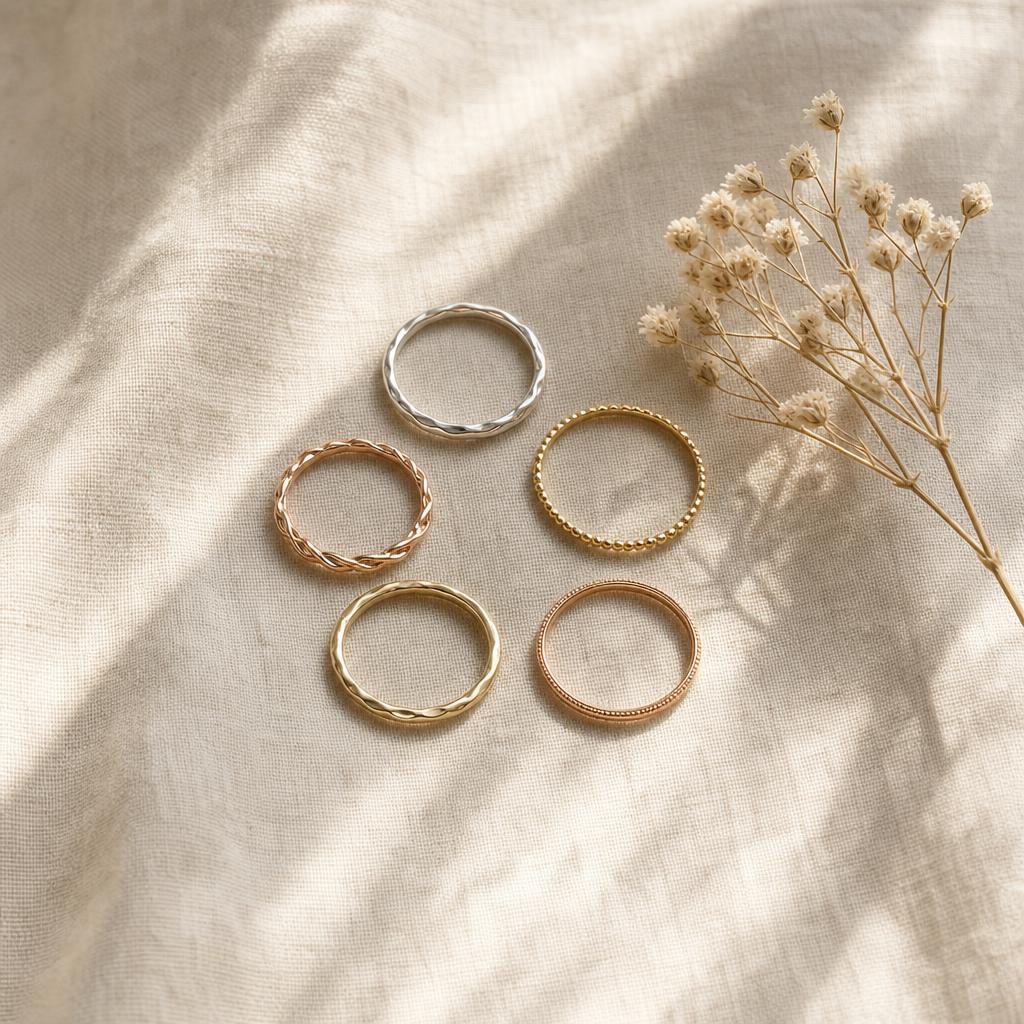
Building a Five-Year Ring Stack: Sterling Silver Stackable Rings
The ring you bought yourself at twenty-eight rarely looks the same on your hand at thirty-three. Not because the ring changed — because your stack did. The women who wear their hands well aren't the ones who bought five rings in a single order. They're the ones who added one at a time, on purpose, until the whole thing looked like it had always been there.
A ring stack built in a weekend usually looks like it was built in a weekend. A stack built over five years looks like a collection — each piece chosen for a reason you can still remember. Here are real ring stacking ideas for every year of that collection, not just the first purchase.


Why a Stack Should Grow With You, Not All at Once
There's a version of ring stacking that treats it like a single purchase: buy the engagement-style ring, buy two bands to go with it, done. It photographs fine. It just doesn't tell a story, because there isn't one yet — every piece arrived on the same afternoon, for the same reason.
The stacks that actually hold your attention belong to women who added slowly. A band from the year she moved into her own apartment. A second one from the year she got the promotion she'd been quietly working toward. A third that just felt right the December she turned thirty. None of that requires a single expensive piece — it requires rings you actually love, added when you have a reason to add them, not because a set told you to.
This is also the more honest way to build a wedding ring stack, whether you're engaged, married, or wearing rings entirely for yourself. Nobody arrives at a finished five-piece stack overnight. They arrive at it the way most good things happen — a little at a time, with room to change their mind.
Worth knowing: A stack built in stages almost always looks more intentional than one bought as a matched set. Slightly different widths, finishes, and years of purchase read as personal — not mismatched.
Year One: The Ring That Anchors Everything Else
Every stack needs a foundation before it needs company. That foundation is usually your main ring — a solitaire, a halo, or a side-stone design with enough presence to hold the eye on its own. It doesn't need a single band next to it to look complete, which is exactly the point: everything you add later should feel like it's in conversation with this ring, not competing with it.
If you don't already have a ring like this, start here. A hidden-halo oval or a clean solitaire in 925 sterling silver gives you the most flexibility for what comes next — the plain, quiet foundation that lets more decorative pieces do the talking in later years. This is the ring that isn't a dupe of anything: it's simulated diamond and sterling silver, indistinguishable from a diamond at a glance, and it wears that confidence from day one.
Year Two: The First Flush Band
The second piece is the one most people get wrong by overthinking it. It doesn't need to be dramatic. Its only job is to sit flush against your foundation ring without a gap, adding a continuous line of sparkle that makes the whole hand look finished rather than half-done.

The Infinity Ring
A 2.5mm crossover band of pavé simulated diamonds — thin enough to sit close against a foundation ring without crowding it, with enough movement in the design to read as more than a plain band.
Shop The Infinity Ring →A thin pavé band or a simple eternity design both work here. What matters more than the exact style is restraint — this is the piece that proves the stack was built with a plan, not assembled in one sitting.
Year Three: A Band That Adds Texture, Not Just Sparkle
By the third year, a stack that's all pavé and prongs starts to blur together. This is the year to introduce contrast — a bezel setting, a different finish, a band that catches light differently than everything sitting next to it. It's a small change, but it's the one that turns "rings I own" into "a stack I built."

The Cherish Ring
Individually bezel-set stones instead of a continuous pavé line — a secure, low-profile setting that reads as a deliberate style choice next to thinner, more delicate bands.
Shop The Cherish Ring →Bezel settings also happen to be the most durable option in a stack that gets worn daily — the smooth edge doesn't snag on clothing or hair the way a row of prongs eventually can, which matters more with every year you add another ring to the mix.
Year Four and Five: Anniversary Pieces and Signature Bands
The last two additions in a five-year stack tend to mark something specific — an anniversary, a milestone birthday, a year that was hard and deserved something beautiful at the end of it. These are the rings you'll be able to point to later and say exactly why they're there, which is what separates a meaningful stack from a decorative one.

The Destiny Ring
Two pavé bands that cross and weave together — a graphic, slightly more sculptural piece built for a year that calls for something with a little more presence than a plain flush band.
Shop The Destiny Ring →By year five, most stacks have found their own logic — a rhythm of widths, a metal tone that dominates with one or two accents in a different tone, a mix of plain and detailed bands that no longer needs explaining. That's the version worth aiming for from the start: not a finished set, but a stack with room left to grow.
| Year | What to Add | Why It Works |
|---|---|---|
| Year 1 | Foundation ring | Sets the scale and style for everything after it |
| Year 2 | Thin flush band | Closes the gap without competing for attention |
| Year 3 | Bezel or textured band | Introduces contrast so the stack doesn't blur together |
| Year 4 | Anniversary or statement band | Marks a specific milestone with a little more presence |
| Year 5 | Second thin band or guard ring | Balances out the statement piece and finishes the line |
How to Stack Rings Without It Looking Cluttered
The most common mistake in a multi-year stack isn't a bad ring choice — it's adding too many pieces at once and losing the sense of order that made the stack readable in the first place. A few rules that hold up no matter how many pieces you eventually own:
- Let one metal tone dominate. Two accent pieces in a second tone read as intentional; four competing tones read as cluttered.
- Vary width on purpose. A stack of identical 2mm bands disappears into itself — alternate thin and slightly wider pieces so each one is visible.
- Leave room. A stack that fills every millimeter of the finger stops looking like a collection and starts looking cluttered instead of curated. Space is part of the design.
- Size for the stack, not just the ring. A foundation ring that fits perfectly alone can feel tight once two or three bands sit against it — size with the finished stack in mind.
✦ Pro tip: Try a new addition against your existing stack before deciding on the metal tone. A band that looks perfect on its own can still throw off a stack that's already settled into a warmer or cooler palette.
Frequently Asked Questions
What order should you stack your rings in?
Most stacks work best with the foundation ring closest to the base of the finger and thinner bands layered above it, though there's no universal rule — the stronger guide is visual weight. Heavier or more detailed pieces generally anchor the bottom, with delicate bands finishing the top of the stack.
How long will sterling silver stackable rings actually last?
925 sterling silver is a genuinely durable, daily-wear metal — rhodium and gold plating add a protective layer on top of that base, and simulated diamonds don't fade or lose brilliance the way some materials do. With normal care, a sterling silver stacking ring holds up beautifully for years of everyday wear.
Is it okay to mix metal tones in a stack?
Yes — mixed metal stacks are one of the most popular directions in ring stacking right now, as long as one tone clearly leads. A platinum-and-gold stack looks curated when gold plays a supporting role; it looks accidental when both tones fight for the same amount of space.
How many rings is too many for one stack?
There's no fixed number, but most stacks start to feel crowded past four or five pieces on a single finger. If you're building toward a larger collection, consider spreading pieces across two fingers rather than piling everything onto one.
Do stacking rings need to match the style of your main ring?
They need to complement it, not match it exactly. A pavé foundation ring pairs naturally with a plain or bezel-set band; the goal is a stack that reads as a considered collection, not five variations on the same design.
Quick Takeaways
- Build a stack in stages — one meaningful addition at a time reads as more intentional than a matched set bought all at once.
- Start with a foundation ring strong enough to stand alone, then add a thin flush band, a textured piece, and one or two statement bands over time.
- Let one metal tone lead, vary the widths, and leave visible space between pieces so the stack stays readable rather than cluttered.
- Sterling silver stackable rings are built to handle years of daily wear — plan your stack for the long term, not just the next purchase.
However you build it, the best ring stack isn't the one that arrives finished. It's the one you can look down at in five years and remember exactly why every piece is there.


