

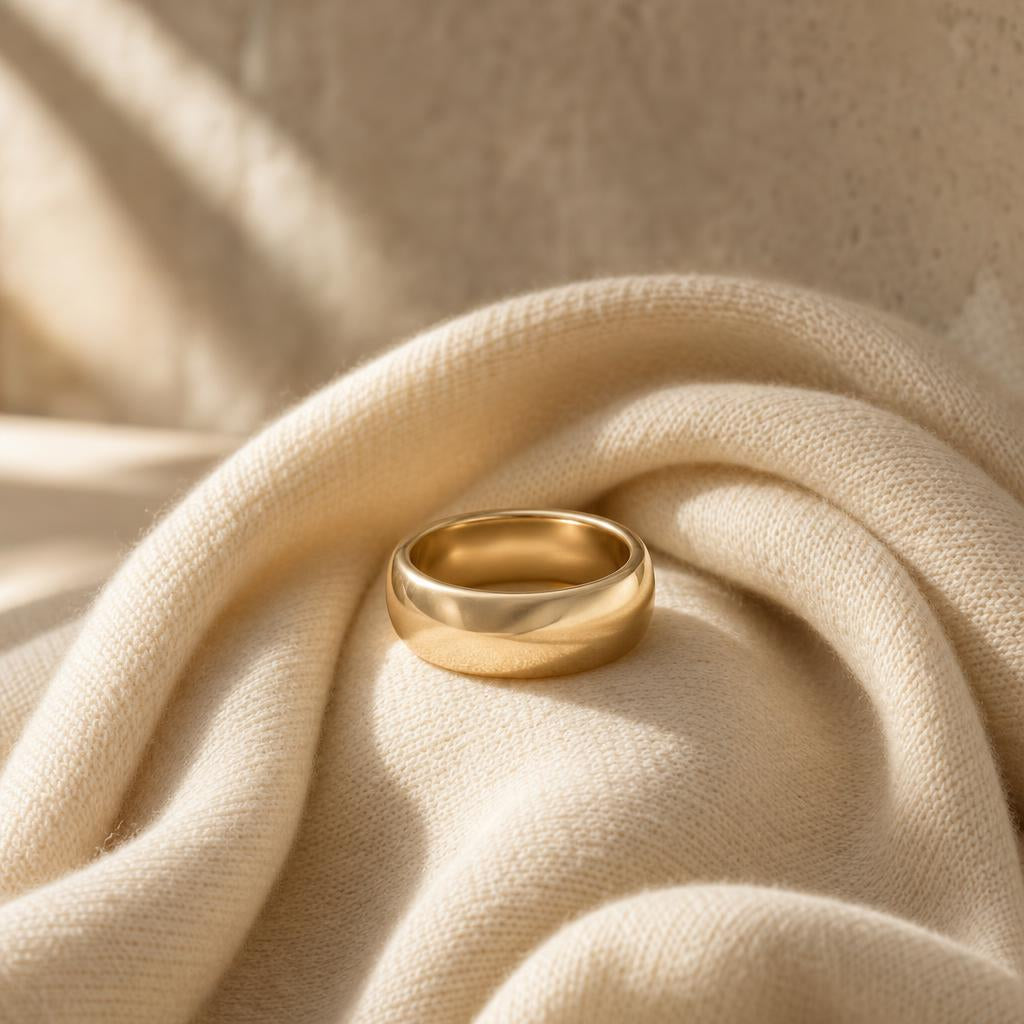
Arthritis-Friendly Ring Sizing: Comfort-Fit Bands and What Actually Helps
Somewhere between "I love this ring" and "I can't actually wear this ring today," a lot of women quietly give up on jewelry altogether. If your fingers swell by afternoon, ache in cold weather, or simply feel different day to day, the problem usually isn't your hands — it's that most rings are designed for a finger that never changes.
The good news is that ring design has quietly gotten smarter about this. A handful of setting and band choices make a real, felt difference for anyone dealing with joint sensitivity, arthritis, or fingers that swell and shrink throughout the day — and none of them require giving up on wearing something you love.


What "Arthritis-Friendly" Actually Means for a Ring
There's no single certification that makes a ring arthritis-friendly — it's really a combination of small design decisions that add up to less pressure, less catching, and less daily friction on a joint that's already working harder than it should. Three things matter most: the profile of the band's interior, how the stone is held in place, and how much room the fit allows for the natural swelling that happens over the course of a day.
None of this requires an entirely different category of jewelry. It mostly means paying attention to details that are easy to miss when you're shopping by photo alone — details that matter far more once a ring is actually on your hand for eight or ten hours at a stretch.
Why Standard Prong Settings Can Be a Problem
Traditional four- and six-prong settings hold a stone up and away from the band, which is part of what makes them sparkle. But those raised prongs are also the first thing to catch on gloves, blankets, sweater cuffs, and — if a joint is swollen or tender — the first thing to press uncomfortably into the side of a neighboring finger. For someone without joint sensitivity, this is a minor inconvenience. For someone with arthritis, it can be the difference between wearing a ring and leaving it in a drawer.
This doesn't mean prongs are off the table entirely. It means the rest of the ring — band width, interior shape, and how snugly it sits — needs to work harder to compensate.
Worth knowing: Swelling from arthritis inflammation tends to be more unpredictable than swelling from heat or exercise — it can vary significantly from morning to evening, or flare for days at a time. A ring that fits perfectly on a good day may feel tight on a harder one, which is exactly why fit flexibility matters more here than in most sizing conversations.
The Case for Comfort-Fit Bands
A comfort-fit band has a rounded, domed interior instead of a flat one, so the ring slides on and off more easily and doesn't create a tight seal against the skin the way a flat-backed band can. The difference sounds subtle until you've worn both — a flat interior band on a finger that swells slightly through the day can feel like a slow squeeze, where a comfort-fit band simply moves with you.
Comfort-fit construction is worth asking about specifically, because it's rarely obvious from a product photo. It's one of the few ring features that genuinely changes how a piece feels rather than how it looks — which makes it easy to overlook when you're shopping visually. If you want the fuller technical breakdown of how comfort-fit bands are actually built and how they compare to a standard interior, it's worth reading up before you buy: comfort fit vs standard fit bands covers exactly that distinction in more depth.
Bezel Settings: The Quiet Comfort Upgrade
If prong settings are the main source of daily friction, bezel settings are often the fix. A bezel wraps a thin rim of metal fully around the stone's edge, so there's no raised prong to snag or press into the skin — just a smooth, continuous surface from the band up and over the stone. For anyone managing joint sensitivity, that smoothness is the whole appeal: nothing to catch on a glove, nothing digging into the finger beside it, nothing to worry about bumping against a doorframe or a countertop.

The Cherish Ring
A round stone set fully within a smooth bezel rim, on a slim stacking band — no raised prongs, no sharp edges, just a clean line that sits close and quiet against the finger.
Shop The Cherish Ring →Bezel settings also tend to sit lower against the finger than a classic prong solitaire, which means less leverage catching on things throughout the day — a small mechanical detail that makes a real difference over hours of wear. If you're drawn to the look and want to see the full range of styles built this way, the best bezel-set rings rounds up the styles worth knowing.
A Quick Comparison
| Setting Type | Snag Risk | Everyday Comfort | Best For |
|---|---|---|---|
| 4-prong / 6-prong | Higher | Moderate | Occasional wear, low sensitivity |
| Bezel | Low | High | Daily wear, joint sensitivity |
| Channel / pavé | Low–Moderate | High | Stacking, flatter profiles |
| Hidden halo | Moderate | Moderate | Sparkle without a raised centre |
Getting the Size Right When Fingers Change Day to Day
Sizing for a joint that swells unpredictably is genuinely different from sizing for a joint that stays consistent. The usual advice — measure once, order that size — doesn't hold up well when a knuckle can be noticeably larger on a flare day than on a calm one. A few adjustments make this easier to navigate:
- Size for the knuckle if it's larger than the base of the finger, and use a guard or spacer to take up the extra room underneath on days when the finger is at its smallest.
- Choose a slightly looser fit over a snug one — a ring that spins a little is far more comfortable long-term than one that has to be forced over a swollen joint.
- Measure at a few different points in the day, not just once, so you're sizing around the full range rather than a single snapshot.
This is also where band width matters more than people expect. A wider band distributes pressure across more surface area, which usually feels gentler than a thin band exerting the same pressure across a narrower line of skin — one more reason a slim stacking band and a wider statement band can feel completely different on the same finger, even at the same size.
✦ Pro tip: If you're between sizes, size up rather than down. A ring that's a touch loose can be tightened with an inexpensive guard; a ring that's too tight has no easy fix short of resizing, and resizing isn't always kind to pavé or bezel-set bands.
It's also worth understanding what's actually happening physiologically — arthritis-related swelling shares some mechanics with the more common causes of finger-size change, even though the triggers are different. Why fingers swell in heat, after exercise, and during pregnancy is a useful companion read if you want the fuller picture of how and why finger size shifts.
Ring Guards, Adjusters, and Other Small Fixes
Not every fit problem needs a new ring. Ring guards — small clips or coils that attach to the underside of the band — are an inexpensive way to take up extra room on a ring that fits well most of the time but runs loose on lower-swelling days. They're removable, reversible, and far less disruptive than a permanent resize, which matters if your size genuinely varies week to week rather than settling into one number.

The Destiny Ring
Two delicate pavé bands that cross paths in a slim, low-profile silhouette — light enough to layer without adding pressure where a joint is already sensitive.
Shop The Destiny Ring →For anyone building a stack around a central ring, it's worth thinking through the sizing logic separately for each band rather than assuming the same size works identically across all of them — joints don't distribute swelling evenly, and a stack that fits at the base won't necessarily fit the same way higher up. If stacking is part of your everyday routine, sizing for a stack walks through exactly how to approach that.
Buying for Someone Else: Gift-Giving Without the Guesswork
If you're choosing a ring for a mother, grandmother, or friend who deals with joint pain, the instinct is often to focus entirely on style. Style matters, but fit and setting matter more here than almost anywhere else in ring shopping. A bezel-set stone, a comfort-fit interior, and a size that leans slightly generous will make the piece something she actually reaches for — rather than something beautiful that sits in a box because it's not comfortable enough to wear.

The Eternity Ring
A complete band of simulated diamonds in a smooth, continuous circle — no single raised point of pressure, and a classic look that reads as effortless rather than delicate.
Shop The Eternity Ring →If you're not entirely sure what she'd choose for herself, asking a few indirect questions about comfort — does she ever take rings off during the day, does anything currently bother her hands — will tell you more than asking about style alone.
Living With It: A Few Practical Habits
Beyond the ring itself, a few small habits make daily wear easier. Slipping a ring off during activities that involve gripping — carrying bags, opening jars, gardening — reduces the pressure moments that tend to aggravate a sensitive joint. Keeping a ring guard or two on hand means you're never stuck choosing between "too tight to wear" and "not wearing it at all" on a harder day. And rotating between a couple of pieces, rather than wearing one ring every single day without a break, gives any one joint some genuine rest.
None of this is about compromise. It's about choosing pieces that were designed with an actual hand in mind — one that changes throughout the day, the way real hands do — rather than a static idea of what a "normal" finger looks like.
Quick Takeaways
- Bezel settings remove the raised prongs that catch and press — the single biggest comfort upgrade for sensitive joints.
- A comfort-fit (rounded) interior band moves with a finger that swells, instead of sealing tightly against it.
- Size slightly loose rather than snug, and keep a ring guard on hand for lower-swelling days.
- Wider bands distribute pressure more gently than thin ones at the same size.
- When buying for someone else, prioritize setting and fit over style — comfort is what determines whether it actually gets worn.
Frequently Asked Questions
Are bezel-set rings actually more comfortable, or is that just a marketing claim?
It's a genuine mechanical difference. Without raised prongs, there's nothing for the stone setting to catch on fabric, gloves, or a neighboring finger — and the smoother profile sits lower against the skin, which most wearers with joint sensitivity notice immediately.
Should I size up if my fingers swell with arthritis?
Generally yes, slightly. A ring that's a touch loose can be adjusted with an inexpensive guard or spacer; a ring that's too tight is much harder to fix comfortably, especially on flare days.
Can I still wear a stacked look if my joints are sensitive?
Yes — choose slim, low-profile bands like pavé or bezel styles rather than bulky ones, and size each ring in the stack independently rather than assuming one size fits the whole hand evenly.
What's the single best change to make if I can only change one thing?
Switch to a bezel setting if you're currently wearing a prong style. It's the change most people notice fastest, and it works well alongside almost any band width or metal tone.
A ring should feel like something you forget you're wearing — not something you're managing around. With the right setting, the right band, and a little flexibility in how you think about size, that's entirely possible, joint sensitivity included.


