

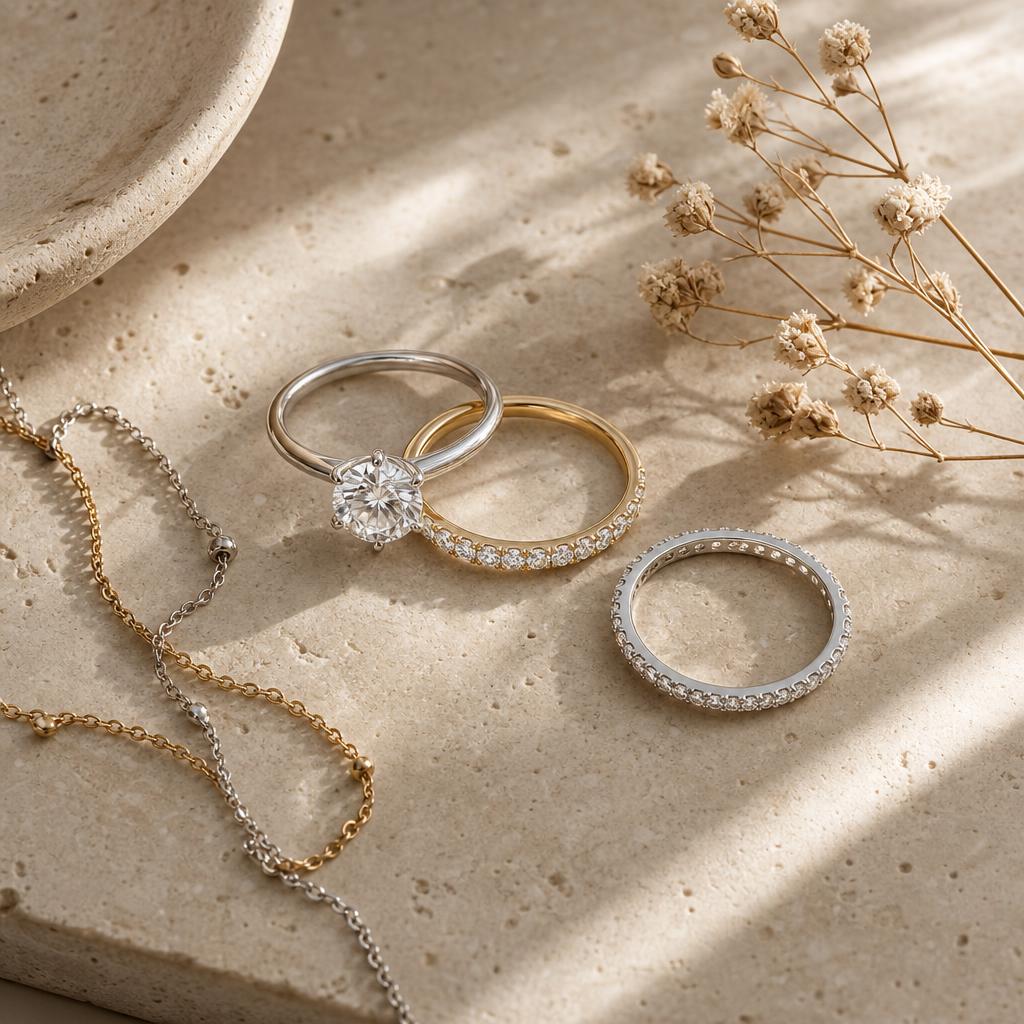
7 Ways to Style the Same Ring for Every Outfit You Own
You own one ring you reach for more than any other — the one that's already on your hand before you've decided what you're wearing. What changes isn't the ring. It's everything you put around it.
Most women don't need a different ring for every occasion. They need to know how to make one ring read differently depending on the day — dressier for dinner, quieter for the office, a little louder when you're actually in the mood to be seen. Here's how that works in practice, starting with four versatile styles worth building around.


Your ring doesn't need to change. Your styling does.
It's tempting to think that a more versatile jewelry box means owning more rings. In practice, it usually means owning a handful of pieces that work harder — and learning a few simple moves that let one ring shift its whole personality depending on what surrounds it. A solitaire on a bare hand reads clean and quiet. The same solitaire next to two slim stacking bands reads considered and a little more done. Neither look required buying a new ring. It just required a different supporting cast.
That's the real skill behind "effortless" jewelry styling: knowing which combinations to reach for on which days. Below are seven ways to do it, organized by the situations you actually move through in a normal week.
1. The office look: one ring, worn alone
For most workplaces, restraint reads as intentional. A single ring — nothing stacked beside it — is the fastest way to look put-together without looking like you tried. This is where a clean solitaire or a low-profile pavé band earns its keep. It catches just enough light to look finished on a video call, without competing with a blazer or distracting during a handshake.
Worth knowing: Low, close-set stones snag less on keyboards, papers, and cardigan sleeves than tall prong settings — a genuinely practical reason a lot of women default to solitaires for the nine-to-five.
2. Weekend errands: the same ring, worn with almost nothing else
On a Saturday spent running errands, the goal isn't to look styled — it's to look like you didn't have to think about it. The trick is to let the ring be the only jewelry doing any work. Pull off the earrings, skip the necklace, and let one ring sit on an otherwise bare hand. It reads as put-together specifically because it's the only decision you made.
Building a "one and done" moment
This is where a ring like The Beatrice Ring shines — dainty enough that it doesn't look like you're overdressed for the grocery store, but with enough pavé sparkle that it doesn't disappear either.

The Beatrice Ring
A round pavé band with just enough sparkle to hold its own — the ring that works as hard alone as it does inside a stack.
Shop The Beatrice Ring →3. Date night: add one stacking band
The fastest way to dress a ring up without swapping it out is to add a single companion band. It doesn't need to match — a slim eternity or bezel band sitting close against your main ring adds visual weight and a little more shimmer, and it photographs beautifully in low restaurant lighting. This is one of the few places where doing slightly more actually reads as more thoughtful, not more effortful.

The Cherish Ring
A bezel-set stacking ring designed to sit flush against a solitaire or pavé band — the easiest way to add a little more sparkle for evening.
Shop The Cherish Ring →4. Travel days: the ring you don't have to think about
Travel calls for a different kind of styling decision — not about how the ring looks, but about how little you have to manage it. Low settings that won't snag on seatbelts or luggage straps, and a style plain enough that it doesn't draw attention in transit, both matter more than sparkle on a travel day. If you're the kind of person who worries about a ring through airport security or a hotel safe, a travel ring dupe designed specifically for the road solves that problem separately — worth knowing about if this scenario comes up often enough to plan for.
5. A formal event: layer in the pavé or halo
Black-tie, a wedding as a guest, a milestone dinner — these are the moments to let a ring do more work. A halo setting or a pavé shank catches candlelight and camera flash in a way a plain band doesn't, and this is where stacking two or three thinner pieces around a central stone starts to look intentional rather than cluttered, provided the widths and metals are chosen with a little care.
✦ Pro tip: For formal events, match metal tones across your full stack rather than mixing them. A cohesive metal reads more polished under evening lighting than a mixed-metal stack does.
6. Loungewear and video calls: the quiet version
Some days call for almost no styling at all — just a ring that looks good in close-up on a laptop camera and doesn't feel like "jewelry" against sweatpants. A hidden halo setting is particularly good here: from a distance it reads as a simple solitaire, but the halo tucked beneath the center stone gives it a little more presence up close, which is exactly the ratio a video call rewards.

The Duchess Ring
A cushion cut with a hidden halo tucked beneath the center stone — quiet from across the room, considerably more sparkle up close.
Shop The Duchess Ring →7. The night you actually want to be noticed
Then there's the night you're not trying to be quiet about it — a birthday, a celebration, a first date you've been looking forward to. This is when the same ring gets its loudest treatment: full halo, full stack, maybe a second ring on the opposite hand. Nothing about the ring changed all week except how much company you gave it.
| Occasion | Styling move | Best-suited setting |
|---|---|---|
| Office | Worn alone | Solitaire or low pavé |
| Weekend errands | Bare hand, one ring only | Dainty pavé |
| Date night | Add one companion band | Bezel or eternity stack |
| Travel | Low, snag-free settings | Flush solitaire |
| Formal event | Full stack, matched metals | Halo or pavé |
| Loungewear / calls | Quiet from a distance | Hidden halo |
| Going-out night | Full halo, full stack | Halo + stacking bands |
The habit that makes this actually work
None of this requires a jewelry box full of options. It requires two or three well-chosen pieces — a versatile main ring, one slim stacking band, and one piece with a little more sparkle — used in different combinations depending on the day. That's the entire system. Buying with restyling in mind, rather than buying one ring per occasion, is what lets a small collection do the work of a much larger one.
Quick Takeaways
- Worn alone, a clean solitaire or pavé band reads as intentional for work and errands.
- Adding one companion band is the simplest way to dress a ring up for dinner or evening plans.
- Hidden halo settings look quiet from a distance but hold more detail up close — ideal for video calls.
- For formal events, match metal tones across a stack rather than mixing them.
- A small, well-chosen collection of two or three rings can cover an entire week of different looks.
Frequently Asked Questions
Do I need to buy a new ring for every occasion?
No. Most of the variation in how "dressed up" a ring looks comes from what you pair it with and whether you wear it alone or stacked — not from owning a different ring for every event.
What's the easiest way to make one ring look dressier for evening?
Add a single slim stacking or bezel band close against it. That one addition adds visual weight and sparkle without requiring a full new stack.
Which ring styles work best for the office?
Low-profile solitaires and pavé bands tend to work best — they catch light without snagging on keyboards, paper, or sleeves, and they read as polished rather than dressed-up.
Should a stack always match in metal tone?
For formal occasions, matching metal tones across a stack generally photographs and reads as more considered. For everyday wear, a little mixing is far more forgiving.
What ring is best for travel days specifically?
Look for low, flush settings that won't catch on straps or seatbelts. Some women prefer to wear a dedicated travel ring dupe on flights and save their main ring for once they've arrived.
The point isn't to own more. It's to notice what you already have and get more deliberate about how you wear it. The same ring that looked quiet on a Tuesday can look entirely different by Saturday night — no new purchase required, just a little more intention about what surrounds it.


