

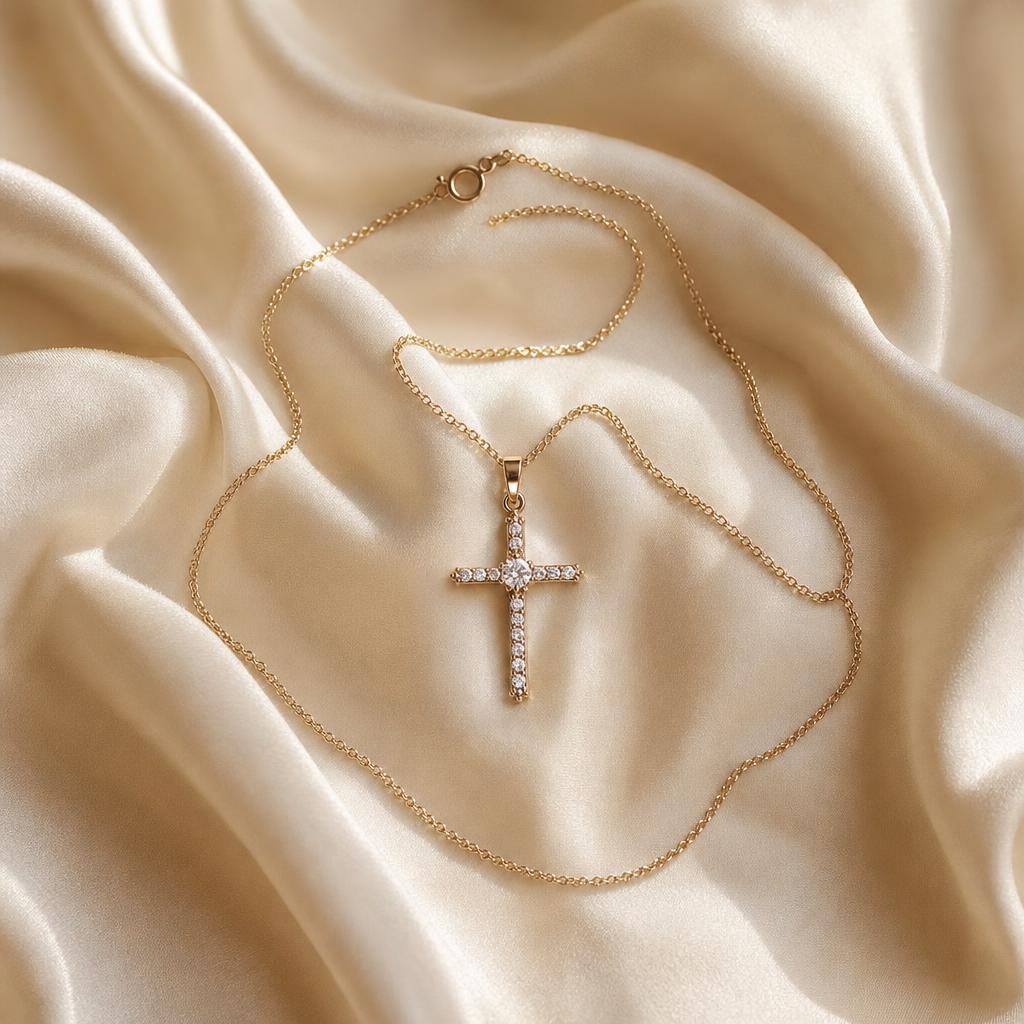
Why the Dainty Cross Necklace Never Actually Goes Out of Style
Every few years, someone declares the cross necklace over — too dated, too literal, too easy to overthink. And every few years, it quietly outlasts whatever was supposed to replace it. That's not an accident. It's one of the only pieces of jewelry that never had to chase a trend cycle to survive it.
Before we get into why that is, here's where to start if you're shopping for one right now — a small edit of pieces built for exactly this kind of everyday wear.


A symbol that stopped needing an explanation
Most jewelry trends have a shelf life because they're tied to a specific moment — a decade's color palette, a celebrity's engagement, an algorithm's idea of what's next. The cross pendant sidesteps all of that. It's been worn as devotion, as heirloom, as protest, and as pure aesthetic, sometimes by the same woman in the same year. That flexibility is exactly why it never reads as "trendy" in the way a statement earring or a specific chain length does. It doesn't need a trend to justify itself.
What's changed is who's reaching for it and why. A lot of women wearing one today aren't making a statement about faith at all — they're responding to the shape. A cross is a small, balanced, symmetrical form that catches light evenly and sits well against skin. It photographs cleanly. It layers without competing. Strip away every layer of meaning and you still have a genuinely good piece of jewelry design, which is the part that actually explains the longevity.
The dainty cross necklace as a wardrobe basic, not a statement
If you've spent any time in the minimalist jewelry space, you've noticed the shift: the dainty cross necklace has quietly become a neutral, the jewelry equivalent of a plain white tee. It's small enough to wear with a suit, a swimsuit, or nothing else at all, and it doesn't compete with whatever else you have on. That's a very different job than the one a cross pendant used to have, and it's worth naming directly — this isn't a religious accessory that fashion happened to borrow. For a lot of women, it's simply a small, well-made pendant that has outlasted every "next big thing" it was supposed to lose to.
That's also why sizing matters more than people expect. A small cross necklace under half an inch reads as everyday and understated — the kind of piece you forget you're wearing until someone compliments it. Go much larger and the same shape shifts into statement territory, which is a legitimate choice, just a different one. Neither is more "correct." The mistake is buying a size that splits the difference and ends up looking indecisive instead of intentional.

The Faith Moissanite Necklace
A delicate cross pendant set with radiant moissanites, in 925 sterling silver with rhodium plating. Sized to sit close to the collarbone — small enough for daily wear, bright enough to still catch the light.
Shop The Faith Necklace →The styling questions that actually come up
Once you've settled on scale, the remaining decisions are mostly about how the piece sits and what it sits next to. Here's what tends to trip people up.
Orientation: upright versus sideways
The sideways cross necklace had its own moment roughly a decade ago and never fully left — it just stopped being treated as a separate category and became one more way to wear the shape. Rotating the cross ninety degrees changes how it reads almost entirely: upright, it's recognizable as a cross from across a room; sideways, it reads first as a clean geometric pendant, and the symbolism only registers on a second look. Neither orientation is more "real" than the other. If you want the piece to function primarily as jewelry rather than as a legible symbol, sideways is the quieter choice.
Layering without losing the shape
A cross pendant layers more easily than most statement shapes because its silhouette stays clean at any distance from the collarbone. The most common mistake is pairing it with another pendant of a similar size and length, which forces the eye to choose between them. Instead, treat it as your shortest layer and let anything else you're wearing — a solitaire, a bar pendant, a plain chain — sit an inch or two lower. That size and length hierarchy is what makes a stack look deliberate instead of accidental, and it's a rule worth carrying into any layered necklace look, not just this one.
Worth knowing: If you're building a stack around a cross pendant, keep the total number of pieces to two or three. Past that, the individual shapes stop reading clearly and the whole thing starts to look cluttered rather than curated.
Metal and stone, without the guesswork
Warm skin tones tend to read best in gold or rose gold, while cooler undertones usually favor silver or platinum — but the honest answer is that a well-made cross pendant works in either, because the shape does most of the visual work. Where the metal choice matters more is durability and daily wear. The Faith Moissanite Necklace is built in 925 sterling silver with rhodium plating, which means it won't discolor skin and holds up to being worn every single day, not just for photos. If you'd rather go warmer, a dainty gold cross necklace in 14k plating gives you the same construction with a different finish, and the choice comes down to what you already wear most, not which one is "better."
The stone itself is worth being direct about, because this is usually where the hesitation actually lives. The moissanite set into a sterling silver cross pendant is indistinguishable from a diamond to the eye and passes diamond testers — it isn't a compromise dressed up as one, it's a genuinely different stone that happens to perform at the same level. No one clocking the sparkle on your collarbone is going to ask what it's made of, and if they do, "moissanite" is a complete answer, not an explanation you owe anyone.

The Lume Moissanite Necklace
A round-cut moissanite set in a minimal four-prong floating setting — the ideal second layer beneath a cross pendant, sized to sit just below it without competing for attention.
Shop The Lume Necklace →Why it keeps surviving the "what's next" question
Jewelry trends usually die the same way: something more novel comes along, and the old shape starts to look like it's trying too hard. That mechanism doesn't really apply here, because the cross pendant was never positioned as novel in the first place. It's not competing for attention the way a fast-fashion statement piece is — it's doing the quieter job of just being a good, small, well-proportioned pendant that happens to carry centuries of visual history. Betting against that isn't really a bet on taste; it's a bet against a shape that has already outlasted several decades of things that were supposed to replace it.
There's also a generational piece worth naming honestly. Younger buyers picking up a cross necklace today are frequently doing it as a style choice first, sometimes with no religious framing attached at all — the same way a moon pendant or an evil eye gets worn for its shape and history rather than a literal belief in either. That's not a contradiction; it's just how symbols work once they've been around long enough to mean more than one thing to more than one person. A piece doesn't need a single fixed meaning to be worth owning. It needs to be well made, the right size for how you actually dress, and durable enough that you're not thinking about it every time you put it on.
Quick Takeaways
- Scale decides the message: under half an inch reads as everyday; larger reads as a statement.
- A sideways cross necklace reads as geometric jewelry first, symbol second.
- Layer it as your shortest piece and let other pendants sit lower to avoid visual competition.
- Sterling silver with rhodium plating holds up to daily wear without discoloring skin.
- Moissanite is indistinguishable from a diamond to the eye and passes diamond testers.
Frequently asked questions
Can you wear a cross necklace if you're not religious?
Yes — most buyers today are choosing it for the shape and history rather than a specific faith practice, the same way people wear other symbolic pendants without a literal belief attached to them. There's no rule that the piece has to carry religious meaning to be worn well.
What are the small cross necklaces called?
A tiny pendant under roughly half an inch is usually described as "dainty" or "petite" — terms that refer to scale, not a different design. The proportions stay the same; only the size changes, which is why a smaller version reads as everyday while a larger one reads as a statement piece.
What does a sideways cross necklace mean?
Turning the cross horizontally doesn't change its symbolism — it changes how quickly it's recognized as a cross at all. Worn upright, it reads immediately; worn sideways, it first reads as a clean geometric pendant. It's a styling choice, not a different symbol.
Why do so many people keep wearing cross necklaces right now?
Part of it is nostalgia for late-2000s and early-2010s jewelry, and part of it is that the shape genuinely works as everyday jewelry — small, symmetrical, and easy to layer. It's less a revival than a piece that never actually left.
How much should a sterling silver cross pendant actually cost?
Look at construction rather than chasing the lowest number: solid 925 sterling silver with rhodium plating, a securely set stone, and a clasp that won't give out within a year. A well-made piece should hold up to daily wear without tarnishing your skin or losing its shine — that durability is what you're actually paying for, not the metal weight alone.
The pieces that last in a jewelry collection are rarely the ones that made the biggest first impression — they're the ones you reach for without thinking, year after year, because they were built well and sized right the first time. The cross pendant has had a two-thousand-year head start on proving that point. It's not going anywhere, and neither, honestly, is the woman who already figured that out.


