

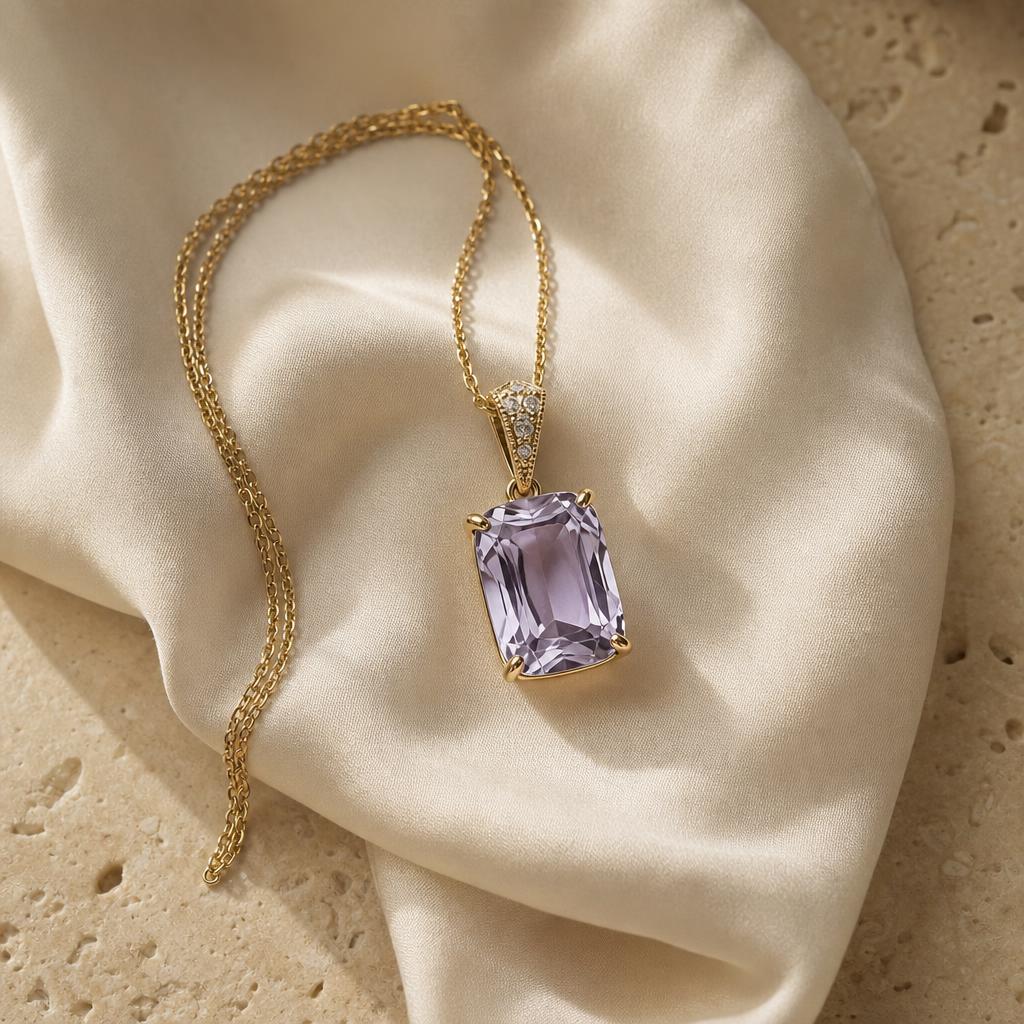
What Is a Pendant? A Plain-Language Guide to Necklace Anatomy
You've scrolled past a hundred necklace listings this week alone, and half of them read like a different language. Bail. Bezel. Illusion setting. Karat versus plating. You don't need a jewelry degree to buy something beautiful — but knowing what you're actually looking at means you stop guessing and start choosing.
Once you know the five or six terms that actually matter, every listing gets easier to read — including your own jewelry box. Here's a place to start, alongside a few pendant styles worth knowing by name.


What Is a Pendant, Really?
A pendant is the ornament — the charm, the stone, the shape — that hangs from a chain. A necklace is the whole piece, chain included. Every pendant needs a necklace to be worn, but not every necklace has a pendant; some chains are simply chains, worn on their own for exactly that reason. Once that distinction clicks, a listing that says "pendant necklace" stops feeling redundant and starts telling you something specific: this is a chain built to carry a focal point, not to be the whole story on its own.
It's a small distinction, but it's the kind of thing worth knowing before you spend anything. Reading a listing correctly is the difference between choosing on purpose and choosing by accident — and one of those makes you feel smarter about the piece in your jewelry box for years, not just the day it arrives.
The Parts of a Necklace, One by One
Strip any pendant necklace down to its components and you're really only looking at four or five parts. None of them are complicated once someone walks you through them once.
The short version: Chain (what goes around your neck), pendant (what hangs from it), bail (the small loop connecting the two), jump ring (a tiny metal ring that links components together), and clasp (how the whole thing opens and closes to go on and off).
Chain
The chain is the foundation — the part that actually sits against your skin and goes around your neck. It can be a fine cable chain, a flat box chain, or a simple cord, and its length is what determines whether a pendant sits at the collarbone, just below it, or lower at the chest. Chain length is its own subject entirely, and worth reading up on separately before you buy anything with a fixed drop.
Pendant
This is the part doing the visual work — the stone, the symbol, the shape you actually noticed in the product photo. Pendants range from a single solitaire stone to a cluster, a symbol like a clover or a star, or a design built from multiple smaller stones set close together.
Bail
The bail is the small connector loop at the top of the pendant — the piece the chain actually threads through. It's easy to overlook because it's small, but it's doing real structural work: a well-made bail lets the pendant hang straight and move naturally instead of twisting or sitting crooked against your collarbone.
Jump Ring
A jump ring is a small, simple loop of metal used to connect two components — a clasp to a chain, or sometimes a pendant to a bail. You'll rarely see it called out in a product photo, but it's one of the small hardware details that separates a piece that holds up daily from one that doesn't.
Clasp
The clasp is the mechanism that lets you put the necklace on and take it off. It's a separate rabbit hole from pendant anatomy, but worth knowing exists as its own category of terminology the next time a listing mentions it.
Setting Types: What Actually Holds the Stone in Place
This is where most of the confusing vocabulary lives, and it's also where the visual differences are the most dramatic. The setting is the metalwork that secures the stone to the pendant — and the setting is a huge part of why two necklaces with a similar carat weight can look completely different on the body.
Prong settings use small metal claws — usually four or six — to hold the stone up and away from the metal base, which lets the maximum amount of light hit the stone from every angle. A solitaire setting is simply a single stone held this way, with nothing else competing for attention.
Bezel settings do the opposite — a thin rim of metal wraps entirely around the stone's edge, holding it flush and secure. It reads as sleeker and lower-profile, and it's a genuinely practical choice if you want something that won't snag on scarves or sweaters.
Then there's the halo setting, where a ring of smaller accent stones surrounds the center stone to make it read larger and catch more light from the outer edge inward. And finally, a floating or illusion-style setting minimizes the visible metal almost entirely, so the stone appears to hang in place on its own, with barely any hardware visible around it.

The North Star Moissanite Necklace
A good example of a pendant built around shape rather than a single stone — a moissanite set at the center of a sleek starburst silhouette, part of the celestial pendant trend that's been quietly building for a few years now.
Shop The North Star Necklace →Symbolic and shaped pendants work a little differently from single-stone settings. A cross, a clover, a heart, or a celestial shape isn't described by its setting type so much as its silhouette — and the stones inside it are often arranged to trace that outline rather than sit in a single central mount.

The Sweetheart Necklace
A heart-shaped simulated diamond pendant where the cut itself carries the silhouette — no halo or accent stones needed to read the shape from across a room.
Shop The Sweetheart Necklace →Reading a Necklace Listing Like You Know What You're Doing
Once you understand how a pendant is actually put together, the listing itself becomes a lot less mysterious. A well-written product page will usually tell you the metal, the plating, the stone, and the setting — but only if you know what to look for.
Metal terminology is its own small maze. Solid gold, gold-filled, gold vermeil, and gold-plated are four different things that sound nearly identical in a product title, and the difference matters for how a piece wears over years, not just how it photographs on day one. Sterling silver, by contrast, is usually stated plainly — it's either 925 sterling silver or it isn't, and that number refers to its purity: 92.5% silver, alloyed for strength.
✦ Pro tip: If a listing doesn't specify whether a gold piece is plated, vermeil, or solid, that's usually your answer — solid gold pieces are rarely shy about saying so, since it's the more expensive claim to make.
Gemstone terminology deserves the same scrutiny. "Diamond," "moissanite," and "simulated diamond" are not interchangeable words, even though a listing photo can make them look identical. Gemiros' own simulated diamonds are indistinguishable from mined diamonds to the naked eye and pass diamond testers — this isn't a hedge or a maybe, it's simply what the stone does under normal wear and normal light. Moissanite, meanwhile, is its own distinct gemstone with a different refractive quality, prized for throwing off more visible fire and color flash than a diamond does. Neither one is a lesser version of the other — they're two different stones with two different personalities, and a listing that's written clearly will tell you plainly which one you're looking at.
The point of all this isn't to memorize a glossary. It's to walk into a purchase — for yourself, or as a gift for someone else — already knowing what the words mean, instead of hoping the photo tells the whole story.
Quick Takeaways
- A pendant is the hanging ornament; a necklace is the complete chain-and-pendant piece.
- The bail is the small connector loop that lets a pendant hang and move correctly — a detail worth checking on any piece you're considering.
- Prong settings maximize light and sparkle; bezel settings are sleeker and lower-profile; halo settings make a center stone read larger; floating settings minimize visible metal entirely.
- Solid gold, gold-filled, gold vermeil, and gold-plated are four different things — read the listing closely before you assume.
- "Moissanite" and "simulated diamond" are two distinct, legitimate gemstones — neither is a stand-in for the other.
Frequently Asked Questions
What is a pendant, exactly?
A pendant is a decorative ornament — a stone, charm, or symbolic shape — that hangs from a necklace chain. It's the focal point of the piece, but it isn't the whole necklace on its own; it needs a chain or cord to be worn.
What is the difference between a pendant and a necklace?
A necklace is the complete piece — the chain that goes around your neck, with or without an ornament attached. A pendant is specifically the hanging piece attached to that chain. Every pendant needs a necklace to be worn, but plenty of necklaces are worn with no pendant at all.
What are the parts of a necklace called?
The main parts are the chain (what wraps around the neck), the pendant (the hanging ornament), the bail (the loop connecting pendant to chain), the jump ring (a small connector loop), and the clasp (the mechanism that opens and closes the piece).
Does a pendant always come with a chain?
Not always. Some pendants are sold on their own, meant to be paired with a chain you already own or choose separately. Most ready-to-wear pendant necklaces, including a full pendant necklace listing, come with the chain included.
What's the difference between a halo setting and a solitaire setting?
A solitaire setting is a single stone held by prongs with nothing else around it. A halo setting surrounds that same center stone with a ring of smaller accent stones, which makes the center stone read larger and catches additional light from the outer edge.
None of this is difficult once it's laid out plainly — it just usually isn't. The next time a listing mentions a bail, a bezel, or a halo, you'll know exactly what you're looking at, and exactly what you're choosing.


